Temperature24 – 27 °C
Natural range
- Brazil area
CharacinsConservation status: Least concern LC
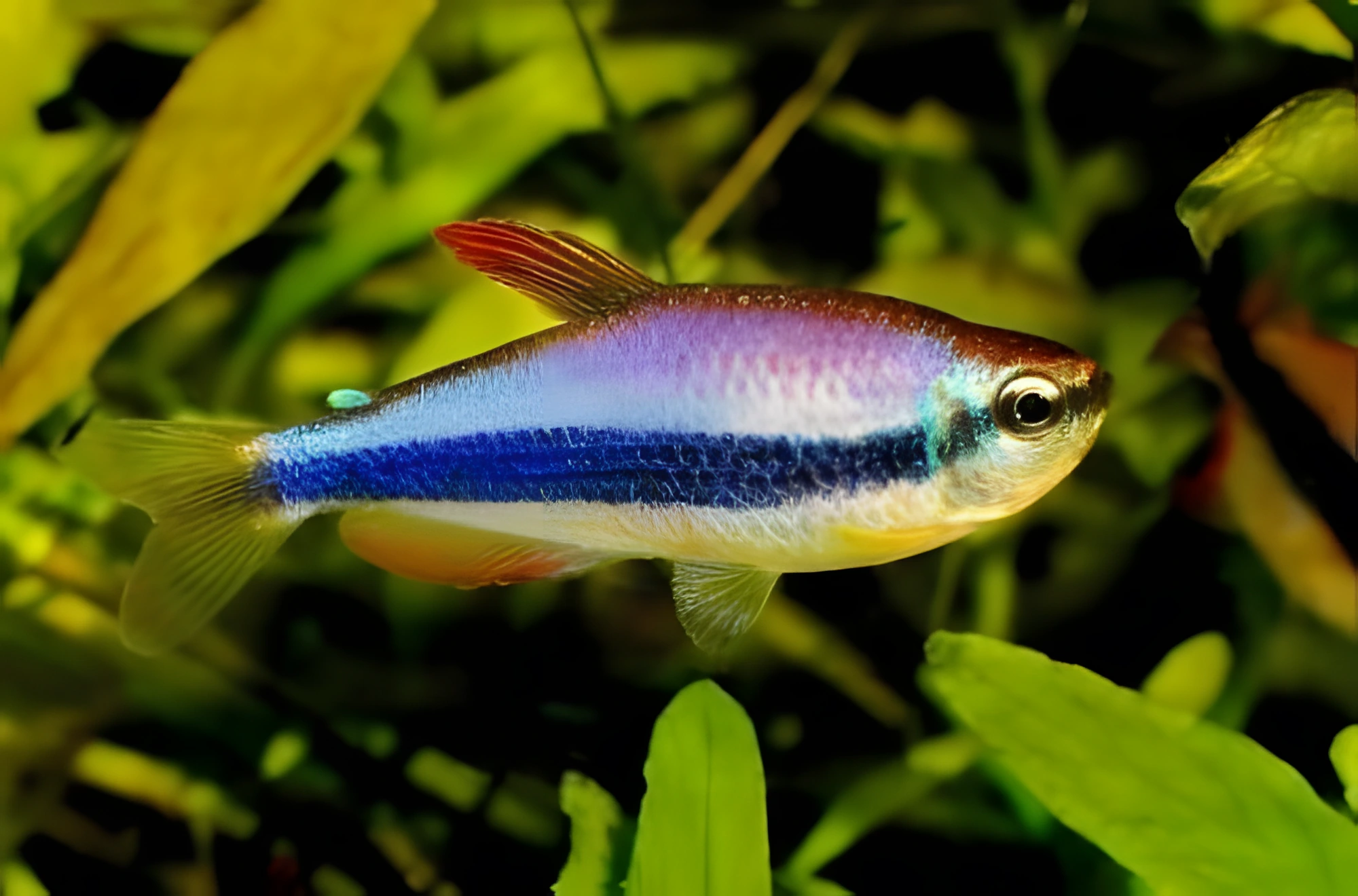
A miniature fish with original coloration, particularly prominent in males, the Kerri Tetra or Purple Emperor Tetra, scientifically known as Inpaichthys kerri, belongs to the Characidae family. It is distinguished by its ease of keeping, unpretentiousness, and simple breeding. This species coexists perfectly with other non-aggressive fish of similar or slightly larger size.
- Required aquarium volume
- 70 L
- Size in aquarium
- 3.5 – 5 cm
- Temperature
- 24 – 27 °C
- Temperament
- Peaceful, calm/shy/inactive
Parameters
Water pHSlightly acidic (5.5) – Neutral (7)
Water dHVery soft (1) – Hard (12)
Water salinityno salt (freshwater)
Size in aquarium3.5 – 5 cm
Lifespan5 years
TemperamentPeaceful, calm/shy/inactive
Toward small fishnot a predator
Required aquarium volume70 L
Lightingdimmed
Substratesandy (regular, light)
Water flowweak or moderate
FeedingAny (universal)
CareGroup (8–10 individuals)
Description
Adults of this species reach a length of about 3.5 cm. Their body is adorned with a wide horizontal dark stripe, and the overall coloration is a blue hue with a purple sheen. Males display brighter coloration compared to females, which typically have a modest brownish-yellow tint. Due to similarities in coloration and an almost identical name, this species is often confused with the Royal or Emperor Tetra.
Habitat
Its natural habitat is located in the upper basin of the Madeira River, which is the largest tributary of the Amazon. Here, the Purple Emperor Tetra inhabits numerous river channels and streams flowing through tropical forests. The water in these bodies of water is usually turbid, very acidic (pH below 6.0), and has a light brown tint, which is due to the high concentration of tannins and other humic substances released during the decomposition of organic material such as leaves, branches, and tree fragments.
Behavior and Compatibility
These peaceful, calm fish live in shoals. They react poorly to active and noisy neighbors, such as Barbs or African Red-Eyed Tetras. Kerri Tetras get along well with other South American species, for example, small Tetras, catfish, Pencilfish, Hatchetfish, and also Rasboras. It should be noted that this species has a reputation as a "fin nipper," although this is to some extent unfounded. The Purple Tetra can indeed damage the fins of aquarium neighbors, but this only happens if it is kept in a small group (up to 5–6 individuals). If a larger shoal is maintained, their behavior changes, and the fish begin to interact exclusively within their own group.
Care and Maintenance
For a shoal of 8–10 individuals, an aquarium of at least 70 L will be required. For decoration, it is recommended to use a sandy substrate with an abundance of shelters, such as snags or other decorative elements, as well as dense thickets of plants capable of growing in dim light. To recreate natural conditions, dried fallen leaves, oak bark, or deciduous tree cones can be placed on the bottom, which will eventually give the water a characteristic light brown tint. Before placing them in the aquarium, the leaves must be thoroughly rinsed under running water and soaked until they begin to sink. Using a filter with a peat filler can enhance this effect. Despite this, other decorations are permissible, or even their complete absence (an empty aquarium); however, under such conditions, the Purple Emperor Tetra may lose its bright coloration and become inconspicuous. Aquarium care comes down to regular cleaning of the substrate from organic waste (excrement, food remnants), replacing leaves, bark, or cones if they are used, and weekly water changes of 15–20% of the volume with fresh water.
Diet
These fish readily accept all popular types of dry, frozen, and live foods. A varied diet, including, for example, flakes and granules in combination with live food such as bloodworms or daphnia, promotes brighter and richer coloration.
Breeding and Reproduction
The appearance of fry is possible even in a community tank, but their number will be negligible, and it will decrease daily if they are not promptly transferred to a separate tank. To increase the chances of offspring survival and systematize the breeding process, it is recommended to set up a spawning aquarium, where adult individuals are placed during the breeding season. Usually, a small tank of about 20 L is used for this. The decor here is not as important; the main focus is on the substrate. To protect the eggs from being eaten, the bottom can be covered with a fine mesh, fine-leaved plants, or mosses, such as Java moss. An alternative method is to place a layer of glass marbles at least 1 cm in diameter. Lighting should be subdued, and the equipment needs only a heater and a simple air-driven filter. The stimulus for the start of the breeding season is a gradual change in water parameters in the main aquarium to the following values: pH 5.5–6.5, dH 1–5 at a temperature of about 26–27°C. The main diet during this period should consist of frozen or live foods. Careful observation of the fish will reveal how some of them become rounded — these are females full of eggs. Prepare and fill the spawning tank with water from the main aquarium. Move the females there, and the next day — a pair of large and most brightly colored males. All that remains is to wait for spawning; its completion can be determined by the significantly "thinner" females, as well as by visible eggs among the vegetation or under the fine mesh. After spawning, the fish are returned. Fry will appear within 24–48 hours, and after 3–4 days they will begin to swim freely in search of food. They should be fed specialized micro-food.
Diseases
The best guarantee of fish health from any disease is a balanced aquarium biosystem with optimal keeping conditions. Therefore, if you notice changes in behavior, fish coloration, the appearance of uncharacteristic spots, or other symptoms, you should first check the water parameters, and only after that proceed with treatment measures.
How to choose
When choosing Kerri Tetras, attention should be paid to the activity of the fish and the cleanliness of their skin. Healthy individuals should be mobile, without visible damage, spots, or film on the body and fins. Avoid buying fish with signs of emaciation, sunken bellies, or unnatural behavior, such as attempts to stay at the water surface or, conversely, apathetic lying on the bottom. Since this is a schooling species, it is recommended to purchase a group of 6–10 individuals at once to reduce stress during transfer and ensure normal adaptation in the aquarium. Before purchasing, make sure there are no dead individuals in the tank with the fish, as this may indicate the presence of infections in the system.
Frequently asked questions
The essentials: size, tank volume, water parameters and care
How big does Kerri Tetra get?
An adult reaches 3.5–5 cm in length. Plan the tank around the maximum size: the fish quickly outgrows a cramped setup.
What size aquarium does Kerri Tetra need?
The minimum recommended volume is 70 L. A smaller tank speeds up nitrate build-up and raises stress levels.
What water parameters does Kerri Tetra need?
Temperature 24–27 °C, pH 5.5–7, hardness 1–12 dGH. Stability matters more than exact values: sudden swings are harder on the fish than a small deviation from the ideal.
How long does Kerri Tetra live?
Around 5 years when kept properly. Lifespan depends directly on tank volume, water quality and a varied diet.
Is Kerri Tetra aggressive?
Temperament: peaceful, calm/shy/inactive. Keep this in mind when choosing tank mates.
How many Kerri Tetra should be kept together?
Recommended setup: group (8–10 individuals). Ignoring this is a common cause of stress and disease.
What does Kerri Tetra eat?
Diet type: any (universal). Feed small portions that are finished within a couple of minutes — overfeeding does more harm than underfeeding.
What is the scientific name of Kerri Tetra?
The scientific name of the species is Inpaichthys kerri, family Characidae.