Temperature8 – 32 °C
Natural range
- Namak Lake area
- Qom Province area
Killifish
Aphanius arakensis, or the Arak Killifish, belongs to the family Cyprinodontidae. This fish is not frequently encountered in aquariums, partly due to its modest coloration and not always docile temperament. Nevertheless, it impresses with its hardiness and unpretentiousness, successfully surviving in conditions that would be extreme for most other species.
- Required aquarium volume
- 60 L
- Size in aquarium
- 3 cm
- Temperature
- 8 – 32 °C
- Temperament
- Territorial (often aggressive)
Parameters
Water pHNeutral (7) – Slightly alkaline (8.5)
Water dHMedium hardness (10) – Very hard (30)
Water salinityvery low (up to ~3 g/L)
Size in aquarium3 cm
Lifespan3 years
TemperamentTerritorial (often aggressive)
Toward small fishnot a predator
Required aquarium volume60 L
Lightingbright
Substrateany (no restrictions)
Water flowmoderate or strong
FeedingAny (universal)
CareHarem (1 male and several females)
Description
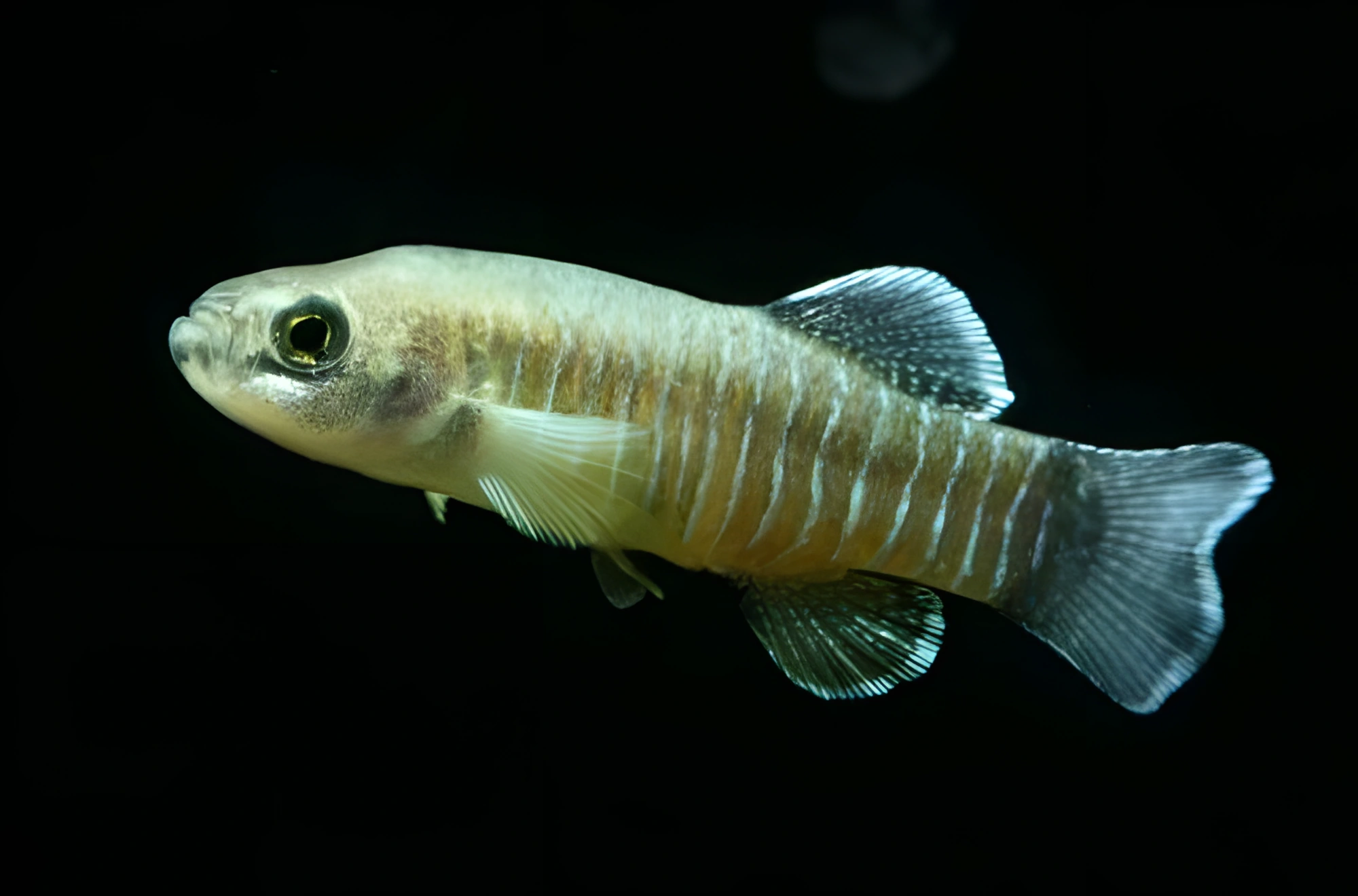
These fish are characterized by their modest size. Males appear more robust, with a characteristic hump at the base of the head. Their coloration is grayish-yellow, adorned with vertical rows of silvery stripes. The pelvic fins have a yellowish tint, while the dorsal, anal, and caudal fins are dark, with a contrasting light edge. Females, in contrast, are slimmer but can be longer. Their grayish-yellow coloration is complemented by numerous dark spots on the sides, and their fins are usually whitish.
Habitat
This species is endemic to the brackish Lake Namak, located in Qom Province in northern Iran. This natural environment is a desert or semi-desert landscape with an arid climate and significant temperature fluctuations. The lake is fed by the waters of the Qom River, which gave its name to both the province and its administrative center. The lake bottom consists of mud and gravel, devoid of any aquatic vegetation.
Behavior and Compatibility
The specific keeping conditions significantly narrow the range of possible tank mates for these fish. Given their challenging temperament, especially during spawning, the number of potential tank mates is minimized. The Arak Killifish is recommended to be kept in a species-only aquarium, in a group of its own kind. The ideal combination is achieved by keeping one male with 3–4 females. If multiple males are present, territorial skirmishes are possible.
Care and Maintenance
Since killifish naturally inhabit extremely harsh conditions, recreating a suitable habitat for them in an aquarium is not difficult. For decor, it is recommended to use a substrate of fine gravel mixed with sand, supplemented with numerous large stones or rock formations of various types. This will create an underwater landscape with broken and irregular lines, providing the fish with many hiding places. The use of artificial vegetation, such as dense moss thickets, is preferable; if natural plants are used, their selection must be particularly careful, considering the water parameters. An air pump and lighting system will be sufficient equipment. The water composition should range from medium to high dGH, and the pH should be alkaline. More detailed information on dGH and pH can be found in the section "Hydrochemical composition of water." It is important to maintain dissolved salt in a proportion of 1–3 g per 1 liter of water. To maintain optimal water quality and remove organic waste, it is recommended to renew 10–15% of the aquarium volume weekly.
Diet
In natural conditions, the diet of the Arak Killifish includes various crustaceans, worms, insect larvae, and algae. In aquarium conditions, the fish easily adapts to dry foods with plant additives. Despite this, it is advisable to regularly, at least every few days, include protein-rich foods such as daphnia, bloodworms, or brine shrimp in their diet. It is recommended to feed the fish 2–3 times a day, offering an amount of food that will be eaten within 5 minutes.
Breeding and Reproduction
The breeding strategy of the Arak Killifish developed in unstable and harsh natural conditions, leading to a relatively short lifespan and early sexual maturity. Breeding these fish in aquariums usually presents no difficulties, with spawning occurring during the spring and summer months. During the breeding season, males become noticeably brighter and display extreme aggression, actively defending their temporary territories. They persistently court females, so it is crucial for the latter to have hiding places where they can rest and regain strength. Eggs are laid in batches among algae thickets or on other surfaces; in an aquarium, artificial mosses, other vegetation, or decor elements will serve this purpose. Since the eggs can be eaten by the parents, they should be moved to a separate tank with similar conditions after spawning. Fry hatch after 7–14 days, depending on water temperature. They grow quickly and are able to feed on micro-foods from their first days of life, such as brine shrimp nauplii or finely crushed dry flakes.
Diseases
The species is highly hardy and adapted to the extreme environmental conditions characteristic of its natural range. No specific species-specific diseases have been recorded; however, the fish are sensitive to water quality if sanitation standards are not maintained. The main threat is the accumulation of organic waste, which can lead to bacterial infections. Prevention includes regular water changes, maintaining a stable salt balance, and providing sufficient space to reduce intraspecific aggression, which often causes injuries and subsequent development of secondary infections.
How to choose
Acquiring this species is difficult due to its rarity in widespread sale, so purchases are more often made through specialized breeders or dedicated communities. When selecting individuals, attention should be paid to the fish's activity and the absence of visible fin damage, which can be a consequence of aggressive skirmishes. Healthy fish should exhibit typical species behavior, actively exploring the bottom and water column. Avoid individuals with sluggish movements, signs of emaciation, or skin damage, as this may indicate poor keeping conditions in the store.
Frequently asked questions
The essentials: size, tank volume, water parameters and care
How big does Arak Killifish get?
An adult reaches 3 cm in length. Plan the tank around the maximum size: the fish quickly outgrows a cramped setup.
What size aquarium does Arak Killifish need?
The minimum recommended volume is 60 L. A smaller tank speeds up nitrate build-up and raises stress levels.
What water parameters does Arak Killifish need?
Temperature 8–32 °C, pH 7–8.5, hardness 10–30 dGH. Stability matters more than exact values: sudden swings are harder on the fish than a small deviation from the ideal.
How long does Arak Killifish live?
Around 3 years when kept properly. Lifespan depends directly on tank volume, water quality and a varied diet.
Is Arak Killifish aggressive?
Temperament: territorial (often aggressive). Keep this in mind when choosing tank mates.
How many Arak Killifish should be kept together?
Recommended setup: harem (1 male and several females). Ignoring this is a common cause of stress and disease.
What does Arak Killifish eat?
Diet type: any (universal). Feed small portions that are finished within a couple of minutes — overfeeding does more harm than underfeeding.
What is the scientific name of Arak Killifish?
The scientific name of the species is Aphanius arakensis, family Cyprinodontidae.