Temperature20 – 28 °C
Natural range
- Orinoco River Basin
- Rio Negro Basin
- Venezuela area
- Colombia area
CharacinsConservation status: Least concern LC
Carnegiella marthae, more commonly known as the Black-winged Hatchetfish or Martha's Hatchetfish, belongs to the family Gasteropelecidae (freshwater hatchetfishes). The origin of its first common name remains unknown. Its second name was given by Margaret Carnegie, the wife of the researcher Eigenmann, who first described and discovered this species. This fish is considered relatively easy to care for, but breeding in aquarium conditions is unlikely to occur.
- Required aquarium volume
- 50 L
- Size in aquarium
- 2.5 – 3.5 cm
- Temperature
- 20 – 28 °C
- Temperament
- Peaceful (regular)
Parameters
Water pHAcidic (4) – Neutral (7)
Water dHVery soft (1) – Medium hardness (10)
Water salinityno salt (freshwater)
Size in aquarium2.5 – 3.5 cm
Lifespan2 years
TemperamentPeaceful (regular)
Toward small fishnot a predator
Required aquarium volume50 L
Lightingdimmed or moderate
Substrateany (no restrictions)
Water flowweak or moderate
FeedingFloating (any)
CareLarge group (10+ individuals)
Description
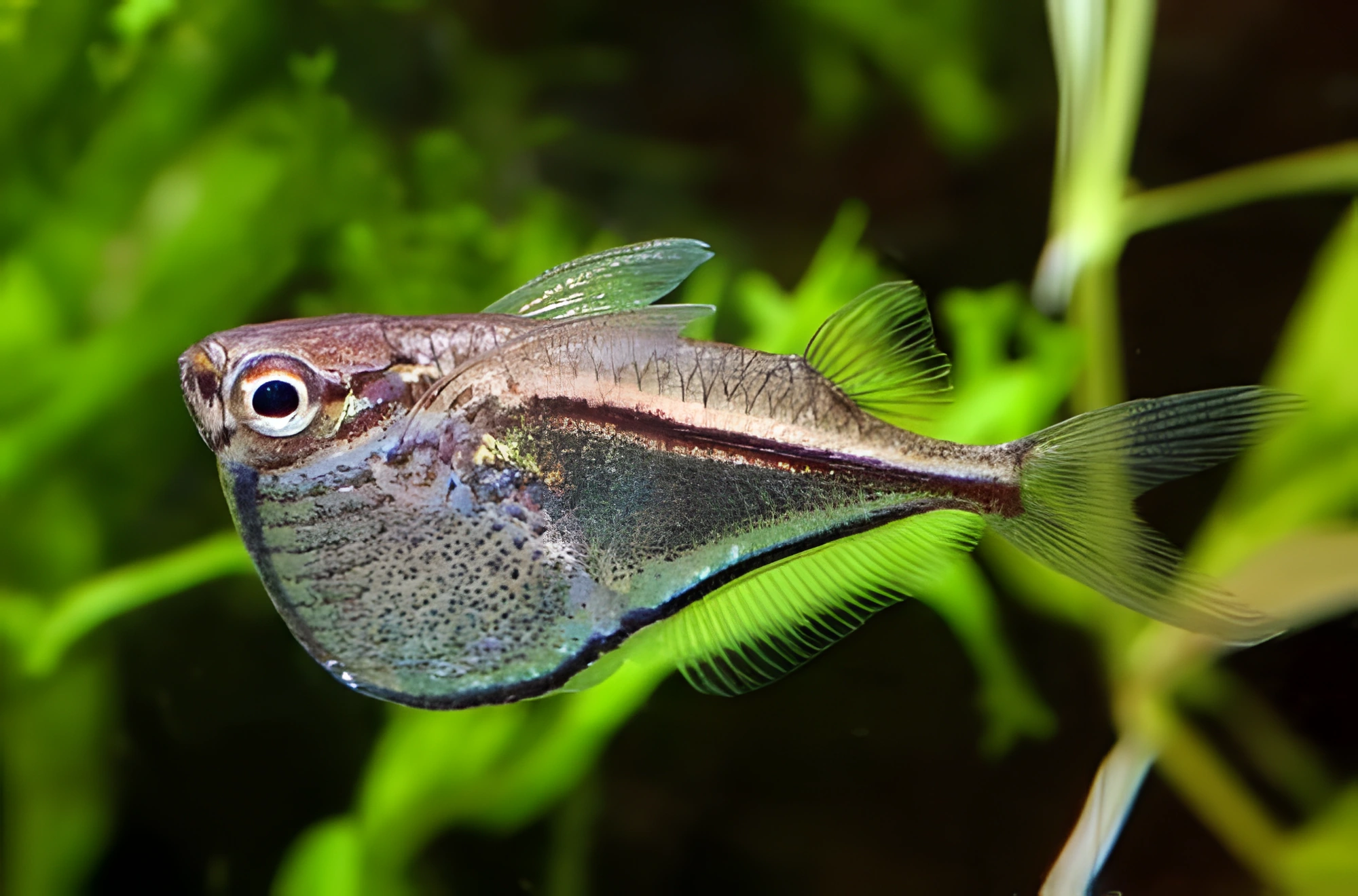
It is a close relative of the Pygmy Hatchetfish, but Carnegiella marthae differs in its slightly larger size and lack of a translucent body. Adult specimens can reach a length of about 3 centimeters. Their body has the characteristic hatchetfish shape — a strongly convex and laterally compressed belly, resembling a ship's keel or an axe blade. The coloration is usually silvery or gray, with a black stripe running along the back and the edge of the belly. Pronounced sexual dimorphism is not noted in this species, although females are thought to be slightly larger and stockier than males. The fins are short and translucent, with the pectoral fins resembling miniature wings. For a long time, there was a myth that these fish could make long jumps above the water, using their pectoral fins for maneuvering in flight. However, this myth was debunked in 1995; jumps are possible, but only when startled.
Habitat
The natural habitat of this species is the waters of South America. Carnegiella marthae is found in the upper reaches of the Orinoco and Rio Negro river basins, covering the territories of modern-day Venezuela, Colombia, and Brazil. The fish inhabit igarapés — small tributaries or streams, whose name in Nheengatu translates to "canoe path." These watercourses flow under the dense canopies of humid tropical forests. The bottom of such bodies of water is usually covered with a thick layer of fallen leaves, branches, and snags, lying on a sandy substrate. The water here has a rich brown or reddish-brown tint due to the high concentration of humic acids released during the decomposition of plant organic matter. It should be noted that the natural living conditions of these fish are subject to seasonal fluctuations related to periods of drought and rain.
Behavior and Compatibility
This peaceful fish prefers to stay in a school, which should consist of at least 10 individuals. When selecting tankmates, it is recommended to choose equally peaceful species, such as characins, plecos, Apistogramma cichlids, and others.
Care and Maintenance
For a group of ten Carnegiella marthae, an aquarium of at least 50–60 liters will be required. These fish prefer to stay near the water surface, which requires sufficient free space for their swimming. It is also important to provide several areas with floating plants, under which they can hide and gather. The decoration of the bottom of the aquarium does not play a significant role. However, some aquarists use dried leaves from certain trees, placing them on the bottom. This not only gives the aquarium a more natural look but also enriches the water with humic acids and other tannins, bringing its composition closer to the fish's natural habitat. Long-term and successful keeping of Carnegiella marthae largely depends on maintaining high water quality. It is crucial to prevent the accumulation of organic pollutants and strictly control temperature, as well as hydrochemical parameters, to ensure they remain within acceptable limits. For this purpose, the aquarium must be equipped with appropriate systems, primarily effective filtration. Regular maintenance activities are also essential: partial water changes (10 to 15% of the volume) with fresh water, as well as timely removal of organic residues, including uneaten food and excrement.
Diet
This species is omnivorous and readily accepts most popular aquarium foods — both dry and frozen or live. An important dietary feature is that the fish feed exclusively from the water surface, so food must float for as long as possible.
Breeding and Reproduction
To date, successful cases of breeding Carnegiella marthae in home aquariums have not been recorded. Supplies of these fish primarily come from commercial fish farms and nurseries.
Diseases
Maintaining the health of these fish is primarily guaranteed by a stable biological system in the aquarium, a balanced diet, and the absence of stress factors, such as harassment by aggressive tankmates. At the first signs of illness, attention should first be paid to these three aspects, as a deviation in one of them may be the cause. Often, eliminating the cause leads to self-recovery. However, if the immune system cannot cope, medication may be required. More detailed information on symptoms and treatment methods can be found in the "Aquarium Fish Diseases" section.
How to choose
When purchasing Carnegiella marthae, select only active individuals that stay in the water column or near the surface and show interest in food. Avoid fish with damaged fins, signs of emaciation, sunken bellies, or film on their bodies, as this species is extremely sensitive to stress and transport conditions. In the store, the fish should be in an aquarium with a lid, as their jumping ability makes them vulnerable to injury if they attempt to leap out of open containers. Given the species' timidity, it is advisable to ensure before purchase that the fish do not show signs of severe fright when a person approaches.
Frequently asked questions
The essentials: size, tank volume, water parameters and care
How big does Carnegiella marthae get?
An adult reaches 2.5–3.5 cm in length. Plan the tank around the maximum size: the fish quickly outgrows a cramped setup.
What size aquarium does Carnegiella marthae need?
The minimum recommended volume is 50 L. A smaller tank speeds up nitrate build-up and raises stress levels.
What water parameters does Carnegiella marthae need?
Temperature 20–28 °C, pH 4–7, hardness 1–10 dGH. Stability matters more than exact values: sudden swings are harder on the fish than a small deviation from the ideal.
How long does Carnegiella marthae live?
Around 2 years when kept properly. Lifespan depends directly on tank volume, water quality and a varied diet.
Is Carnegiella marthae aggressive?
Temperament: peaceful (regular). Keep this in mind when choosing tank mates.
How many Carnegiella marthae should be kept together?
Recommended setup: large group (10+ individuals). Ignoring this is a common cause of stress and disease.
What does Carnegiella marthae eat?
Diet type: floating (any). Feed small portions that are finished within a couple of minutes — overfeeding does more harm than underfeeding.
What is the scientific name of Carnegiella marthae?
The scientific name of the species is Carnegiella marthae, family Freshwater Hatchetfish (Gasteropelecidae).