Temperature22 – 28 °C
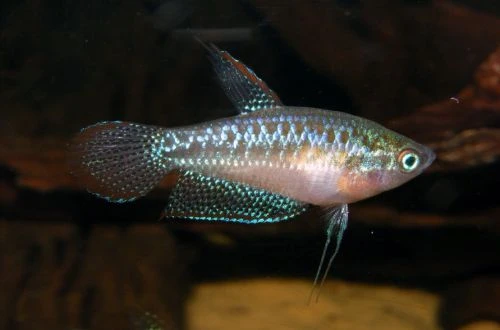
Other scientific names: Ctenops pumilus, Trichopsis pumilis
The Dwarf Gourami, or Pumila, known scientifically as Trichopsis pumila, is a member of the Osphronemidae family. This aquarium fish is popular due to its interesting coloration, as well as its ease of care and breeding. However, its modest size and timid nature significantly narrow the range of possible tank mates, often leading to its keeping in specialized species-only tanks.
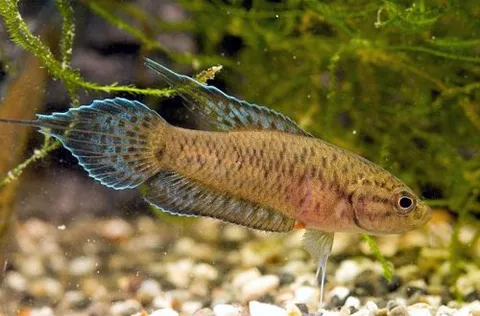
Adults can reach a length of up to 4 cm. Their coloration is a light brown background with a distinct blue sheen. Two dark stripes run along the sides of the body. The fins are translucent, adorned with a pattern of red and blue speckles. Sexual dimorphism is weakly expressed: males can be distinguished from females by their enlarged fins and more intense coloration.
The natural habitat of this fish covers Southeast Asia, where it is widespread throughout the lower Mekong basin in Laos, Vietnam, Cambodia and Thailand, as well as in the watersheds of central and peninsular Thailand. It prefers to live in shallow, swampy bodies of water with stagnant water, and is numerous in flooded rice fields and canals densely overgrown with aquatic vegetation.
This species is peaceful and extremely timid. It is not recommended to place it in a community tank, as even small but very active fish can easily frighten the Dwarf Gourami. Coexistence is permissible with species of similar size and temperament, such as the Dwarf Rasbora and Firefly Rasbora, among others.
For keeping a single pair or a small group of these fish, a tank of 40 L or more is suitable. The aquarium decor should prioritize a soft substrate and dense thickets of rooted plants, placed mainly along the side walls. The presence of shelters is an essential element, so it is good to use driftwood, ceramic pots or hollow tubes, as well as various decorative objects in the form of sunken ships or castles. To recreate natural water conditions, it is recommended to install a filter with alder cone filler, and hydrochemical parameters should be maintained at a slightly acidic pH and low hardness (dGH). This effect can be enhanced by adding fallen leaves to the bottom, which, upon decomposition, will enrich the water with tannins, giving it a light brown tint. Collected leaves must first be dried, and then soaked for several days so that they become waterlogged and begin to sink. Such leaves should be replaced every one to two weeks. All labyrinth fish, including the Dwarf Gourami, inhabit waters with low dissolved oxygen content, so they have developed the ability to obtain it directly from the air by gulping bubbles from the surface. To avoid a significant temperature difference between the water and the air, the aquarium should be covered with a lid, if not already included, which will create a warm air layer above the water surface.
In the wild, these fish feed on small insects and invertebrates. In a home aquarium, it is recommended to offer them live foods such as daphnia, artemia, or bloodworms, or to use specialized nutritional mixes from trusted manufacturers developed for gouramis. It should be remembered that the well-being of the fish and the intensity of their coloration directly depend on the quality and variety of the food.
During the breeding season, males build bubble nests, preferring locations under broad leaves, among dense floating vegetation, or in bottom shelters such as ceramic pots or hollow tubes used in the decor. During construction, the male displays noticeable aggression towards the female, not allowing her to approach the nest until it is fully ready. Spawning occurs in a peculiar "embrace" as the fish entwine around each other. At the climax, milt and several eggs are released, which are then moved to the nest. This process is repeated several times until all eggs are laid. After this, the female leaves the nest, leaving the male to protect and care for the future offspring. Fry appear after 24–48 hours and remain in the nest for another 3–4 days; during this time, the male diligently returns any that accidentally fall out or swim away from the nest. Once the fry begin to swim freely, the male loses interest in them. Adult Dwarf Gouramis do not exhibit cannibalism and usually do not eat their own offspring. However, this does not apply to other aquarium inhabitants, so it is recommended to transfer the fry to a separate tank with identical water conditions. Young fish should be fed specialized fry food for aquarium fish.
The main cause of most diseases in these fish is unsuitable keeping conditions and poor-quality nutrition. If initial symptoms are observed, it is first necessary to check water parameters and the concentration of dangerous substances such as ammonia, nitrites, and nitrates. If the indicators deviate from the norm, they should be brought back into order, and only then should treatment begin.
When selecting dwarf gouramis, pay attention to the fish's activity: healthy individuals should show curiosity, swim in the water column, and display the species' characteristic coloration without pale spots or scale damage. Avoid purchasing fish with signs of emaciation, sunken bellies, clamped fins, or a film on their bodies, as labyrinth fish are sensitive to stress and water quality in retail tanks. It is advisable to acquire individuals from the same group to minimize the risk of introducing infections and facilitate adaptation to the new aquarium.
The essentials: size, tank volume, water parameters and care
An adult reaches 4 cm in length. Plan the tank around the maximum size: the fish quickly outgrows a cramped setup.
The recommended volume is 40 L. A smaller tank speeds up nitrate build-up and raises stress levels.
Temperature 22–28 °C, pH 5–7.5, hardness 1–12 dGH. Stability matters more than exact values: sudden swings are harder on the fish than a small deviation from the ideal.
Around 4 years when kept properly. Lifespan depends directly on tank volume, water quality and a varied diet.
Temperament: peaceful (regular). Keep this in mind when choosing tank mates.
Recommended setup: small group (3–4 individuals). Ignoring this is a common cause of stress and disease.
Diet type: any (universal). Feed small portions that are finished within a couple of minutes — overfeeding does more harm than underfeeding.
The scientific name of the species is Trichopsis pumila, family Osphronemidae. It also appears in the literature as: Ctenops pumilus, Trichopsis pumilis.
Matched by family, categories and overlapping keeping conditions
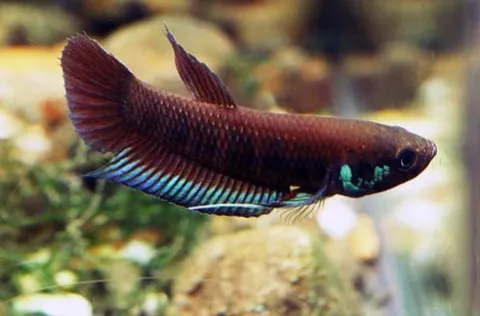
Betta krataios
Betta krataios, or Krataios Betta, is classified as a member of the family Osphronemidae and bears the scientific name Betta krataios. This species belongs to the group of Fighting Fish, however, its temperament and…
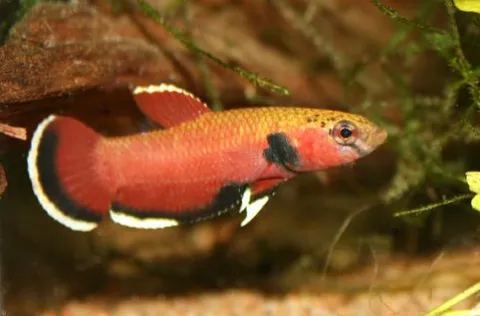
Betta channoides
Betta channoides, also known as Channa's Betta or Chan's Fighting Fish, is a member of the Osphronemidae family. Despite belonging to the group of fighting fish, this species is distinguished by its peaceful and calm…
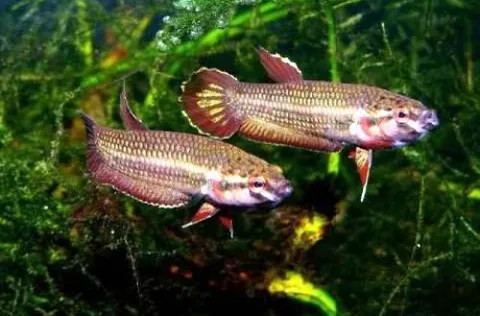
Betta dennisyongi
Betta dennisyongi, also known as Dennis Yong's Betta, belongs to the family Osphronemidae. This fish received its scientific name in honour of Dennis Yong Ghong Chong, a naturalist deeply versed in the fauna and flora…
Malpulutta kretseri
Malpulutta kretseri, also known as Kretser's Paradise Fish, bears the scientific name Malpulutta kretseri and belongs to the family Osphronemidae. It was named in honour of the Sri Lankan lawyer De Kretser, who…