Temperature23 – 26 °C
Other scientific names: Rasbora maculata
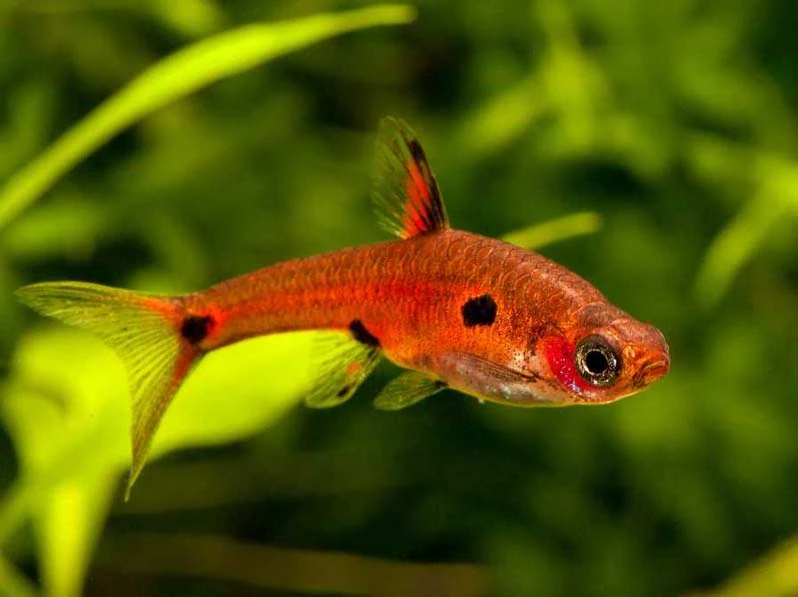
The Dwarf Rasbora (Boraras maculatus), belonging to the Cyprinidae family, stands out among carp-like fish. Although it is one of the smallest species, its miniature size only emphasizes the striking effect of a school of a dozen such fish. However, these rasboras require special keeping conditions and careful selection of tank mates, so they should not be recommended for beginner aquarists.
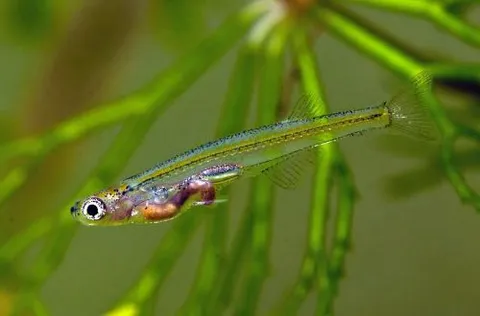
This slender, miniature fish, no more than 3 cm long, attracts attention with its bright coloration, predominantly red. Several rounded dark spots are located along the sides of the body — near the pectoral and anal fins, as well as at the tail. The intensity of the hues can vary depending on the fish's origin and sex: males are generally brighter. The fish's color can range from cherry-red to orange, which is often associated with diet and lighting conditions. Female dwarf rasboras usually have rounder bellies and are generally larger than males. During spawning, males, on the other hand, acquire more intense coloration.
The history of the Dwarf Rasbora began in 1904 when it was first described during a study of Southeast Asian fauna. The natural habitats of these fish are shaded bodies of water with slow currents, such as forest streams, peat swamps, as well as ponds and canals. There, they prefer to hide among fallen leaves and branches, in soft, acidic water. The diet of rasbora schools in nature consists mainly of small insects, worms, and zooplankton. The keeping conditions for this fish present special requirements.
It is essential to keep rasboras in schools of 8–10 individuals, as with fewer numbers, they become restless, leading to constant stress. For cohabitation, fish of similar size, not too active, and in small numbers are suitable. This task can be difficult, considering that potential tank mates must also be adapted to soft and slightly acidic water. Optimal conditions are often easier to achieve in a species-specific aquarium, where only dwarf rasboras reside.
Maintaining high water quality is critically important for these fish. About a quarter of the aquarium's water volume should be replaced weekly, while regularly cleaning the substrate with a siphon. Using a filter equipped with an alder cone filler will help achieve the required pH level. Great care should be taken with any sudden fluctuations in hydrochemical parameters; therefore, before introducing fresh water, ensure that its values match the aquarium's water parameters for pH, hardness, and temperature. The fish are tiny but shoaling, so even a small school needs an aquarium of 40 litres or more — about four buckets of water. For decorative purposes, leafy plants are ideal, best arranged in compact groups near hiding places. Lighting should be subdued; floating plants will create additional shaded areas. Using a dark substrate not only matches the natural color of the substrate in Rasbora habitats but also effectively highlights their coloration.
The Dwarf Rasbora is an omnivorous species, and in aquarium conditions, it can be successfully fed dry commercial foods designed for this species. It is recommended to choose foods with special color-enhancing additives to ensure your pets look as vibrant as possible. For dietary variety, small crustaceans such as daphnia or Artemia are excellent.
Breeding dwarf rasboras requires some experience. Like other carp-like fish, they lay their eggs directly on the substrate and do not care for their offspring. Moreover, the fish may eat their own eggs, so spawning is more effective in a separate tank. The spawning aquarium should be small, with a water level of about 15 cm or slightly more. It is advisable to use water from the main aquarium. For equipment, a heater to maintain a temperature of about 26–27 °C and an aerator are sufficient; a filter is not essential. For the substrate, small balls up to 1 cm in diameter or similar gravel are recommended; the eggs will roll into the gaps between the stones, protecting them from being eaten by the parents. Among plants, preference should be given to low-growing, creeping species with small leaves. Place 2 or 3 pairs in the spawning aquarium; spawning usually begins after two weeks when the males establish their territories. Egg laying typically occurs in the morning hours, after prolonged courtship. Fry appear in approximately 24–36 hours and are extremely small. They should be fed micro-food, which can be purchased at a pet store or prepared independently from crushed flake food for adult fish.
The fish show a propensity for many common diseases, even when kept in favorable conditions, and are also very sensitive to medications. This makes treatment in a community tank impossible. An affected individual must be moved to a quarantine tank, and the recommended dose of medication should be halved. More detailed information on symptoms and treatment methods is provided in the "Fish Diseases" section.
When purchasing, choose active individuals that stay in a school and show no visible damage, ulcers, or white film on their scales. Avoid fish with sunken bellies, signs of emaciation, or those that stay alone near the water surface, as this may indicate stress or hidden diseases. Given their miniature size, carefully inspect their fins for integrity and absence of signs of fin rot. Since rasboras are sensitive to water quality, ask the seller about the parameters (pH and hardness) in which the fish are kept in the store: a sudden transfer from hard alkaline water to soft acidic water can be detrimental to them. If possible, prefer individuals that already have vibrant coloration, which indicates good health and proper feeding.
The essentials: size, tank volume, water parameters and care
An adult reaches 1.3–3 cm in length. Plan the tank around the maximum size: the fish quickly outgrows a cramped setup.
The recommended volume is 40 L. A smaller tank speeds up nitrate build-up and raises stress levels.
Temperature 23–26 °C, pH 5–6, hardness 1–5 dGH. Stability matters more than exact values: sudden swings are harder on the fish than a small deviation from the ideal.
Around 5 years when kept properly. Lifespan depends directly on tank volume, water quality and a varied diet.
Temperament: peaceful (regular). Keep this in mind when choosing tank mates.
Recommended setup: schooling (usually from 5–6 individuals and more). Ignoring this is a common cause of stress and disease.
Diet type: small / appropriate size / pieces. Feed small portions that are finished within a couple of minutes — overfeeding does more harm than underfeeding.
The scientific name of the species is Boraras maculatus, family Cyprinids (Cyprinidae). It also appears in the literature as: Rasbora maculata.
Matched by family, categories and overlapping keeping conditions
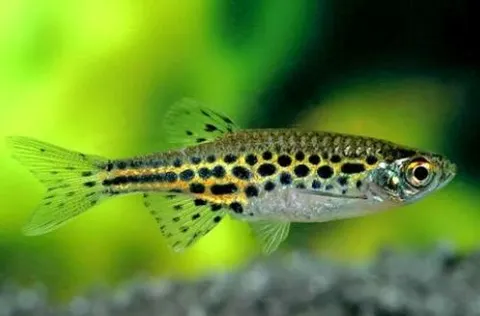
Danio tinwini
Danio tinwini, also known as the Gold-ring Danio or Burmese Spotted Danio, bears the scientific name Danio tinwini and belongs to the family Cyprinidae. It received one of its names in honor of U Tin Win, a prominent…
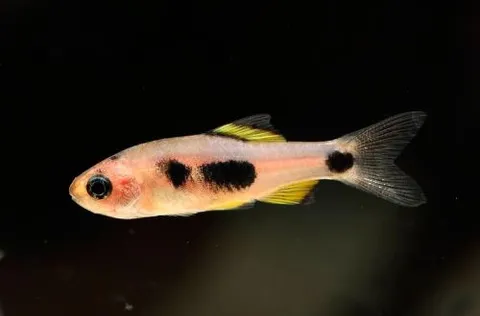
Enteromius hulstaerti
Enteromius hulstaerti, known as the Butterfly Barb or Moth Barb, belongs to the family Cyprinidae. This fish attracts attention with its beauty and does not cause much trouble in maintenance, but it is not often found…
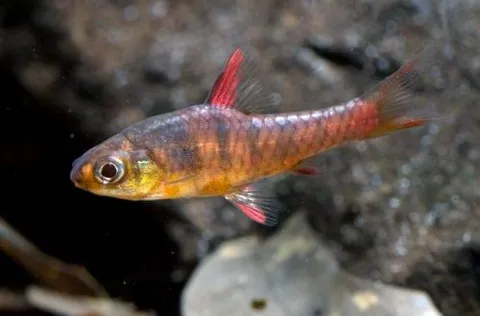
Enteromius jae
The Jae Barb, also known by its scientific name Enteromius jae, belongs to the family Cyprinidae. This miniature and picturesque fish can become a true gem in a nano aquarium. Its care and breeding are straightforward,…
Danionella dracula
The Dracula Danio, or Danionella dracula according to scientific classification, belongs to the carp family (Cyprinidae). It's interesting to consider what might have led to such a formidable name for this miniature and…