Temperature14 – 22 °C
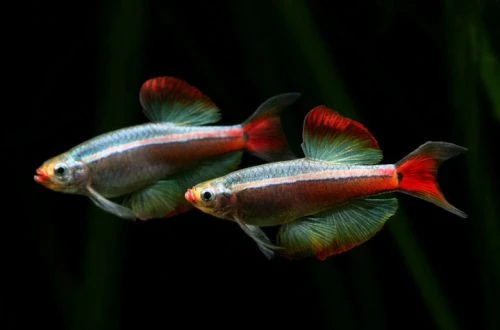
Other scientific names: Aphyocypris pooni
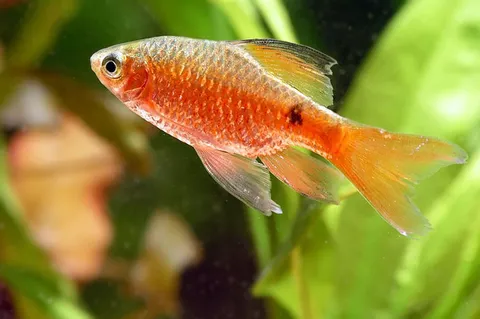
The White Cloud Mountain Minnow (Tanichthys albonubes), a member of the Cyprinidae family, is an extremely popular aquarium fish due to its undemanding care and ease of breeding. By 2010, four stable selective forms had been developed, but only two of them gained widespread popularity – one closely resembling the natural coloration, and another with a dominant red hue.
Adults reach up to 4 cm in length. Females are generally larger than males, but their coloration is less vibrant. Several color variations exist. One resembles the natural coloration: the main color is gray, with a wide, bright pink stripe running from head to tail. The fins have a pale yellow edge. Another form features a similar pattern but with a pronounced red pigment that colors the posterior part of the body, the caudal fin, and the edges of the other fins.
Originally, these fish inhabited the territory of modern China. Today, White Cloud Mountain Minnows have practically disappeared from the wild and are on the verge of extinction. Several relict populations have been discovered in coastal areas of Guangdong province in southern China and Quang Ninh province in northeastern Vietnam. They prefer to stay in shallow waters, up to 60 cm deep, in slow-moving rivers and streams, hiding among dense riparian aquatic vegetation.
These are peaceful and calm fish that get along well with other species of similar size and temperament, capable of living in similar temperature conditions. It is recommended to keep a school of at least 10 individuals of both sexes. Within the group, males actively compete for the attention of females, which enhances the vibrancy of their coloration.
For a school of these fish, a tank volume of at least 60 liters is recommended. Although the decor can be arbitrary, using a dark substrate in combination with floating plants is considered optimal. Artificial or natural snags, roots, and/or tree branches can be used as decoration. Essential equipment includes filtration systems, lighting, and an air pump. White Cloud Mountain Minnows thrive at relatively low temperatures, so a heater is usually not necessary if the aquarium is in a heated living space. These fish prefer water conditions with a weak current; temperature, pH, and dGH parameters can be within a fairly wide range, which simplifies water preparation – often, simply letting it stand for 24 hours is sufficient. Aquarium care includes weekly water changes of 20–25% with fresh water, as well as regular cleaning of the substrate from organic deposits and removal of algae from the glass.
The fish readily accept all types of food: dry, frozen, and live. To maintain the best coloration, it is recommended to combine different types of food. Feeding should be done 2–3 times a day, in portions that the fish can consume within 5 minutes. It is important to promptly remove any uneaten food to prevent contamination of the aquarium water.
White Cloud Mountain Minnows are egg-laying fish: females scatter their eggs in the water column, and males fertilize them. Parental instincts in these fish are weakly developed: after spawning, they may eat both their eggs and the hatched fry. To ensure the safety of the offspring, it is recommended to conduct breeding in a separate spawning tank. The setup of such a tank is simple; the main attention is paid to the substrate, which should consist of sufficiently large, loosely packed particles that form voids, such as pebbles or decorative glass beads. When the eggs sink to the bottom, most of them fall into these voids, becoming inaccessible to the adult fish. A similar effect is achieved by using a fine-mesh net fixed to the bottom. Another way to protect the eggs is to heavily plant low-growing, fine-leaved plants or mosses, such as Riccia fluitans or Java moss, which will cover most of the substrate surface (in this case, the type of substrate does not matter). Dense plant thickets create a reliable refuge for eggs no worse than a special substrate. A spawning tank usually has a volume of 20–30 liters and is filled halfway. Equipment includes an air pump, a heater, and a simple low-power sponge filter to avoid accidentally sucking in eggs and fry. Spawning occurs under dim lighting, so a light source is not required initially. To stimulate the breeding period, the water temperature is raised to the upper permissible limit of 20–21°C with neutral or slightly acidic pH, and protein-rich food – live or frozen bloodworms, daphnia, brine shrimp – is included in the daily diet. After some time, the females become noticeably rounded, and the males begin to actively show attention to their chosen mates. At this point, a separate tank should be prepared, filled with water from the main aquarium, and then several females and the most vibrant males should be transferred there. The end of spawning is easily determined by the females, who become slender again. After this, the fish are returned to the main aquarium. Fry will hatch in 48–60 hours, and after another day, they will begin to swim freely. They should be fed specialized microscopic food for aquarium fish fry.
Prolonged hybridization and inbreeding have led to undesirable consequences, such as weakened immunity and a high frequency of congenital defects in juveniles. However, a balanced diet and properly selected living conditions can significantly reduce the risk of diseases, although they do not eliminate them entirely.
When choosing White Cloud Mountain Minnows, preference should be given to active individuals that stay in a school and display natural mobility. Healthy fish should have clean fins without signs of damage, clear eyes, and tightly adhering scales without whitish film or spots. Avoid specimens with unnaturally bloated or sunken bellies, or those that stay at the water surface or, conversely, constantly lie on the bottom. Given that selective forms are often available for sale, assess the vibrancy of their coloration, which should be rich and clear. Before purchasing, it is recommended to observe the fish's behavior in the store's general aquarium: they should not show signs of apathy or timidity, nor should they have visible skin damage.
The essentials: size, tank volume, water parameters and care
An adult reaches 4 cm in length. Plan the tank around the maximum size: the fish quickly outgrows a cramped setup.
The recommended volume is 60 L. A smaller tank speeds up nitrate build-up and raises stress levels.
Temperature 14–22 °C, pH 6–8.5, hardness 5–21 dGH. Stability matters more than exact values: sudden swings are harder on the fish than a small deviation from the ideal.
Around 4 years when kept properly. Lifespan depends directly on tank volume, water quality and a varied diet.
Temperament: peaceful, calm/shy/inactive. Keep this in mind when choosing tank mates.
Recommended setup: large group (10+ individuals). Ignoring this is a common cause of stress and disease.
Diet type: any (universal). Feed small portions that are finished within a couple of minutes — overfeeding does more harm than underfeeding.
The scientific name of the species is Tanichthys albonubes, family Cyprinids (Cyprinidae). It also appears in the literature as: Aphyocypris pooni.
Matched by family, categories and overlapping keeping conditions
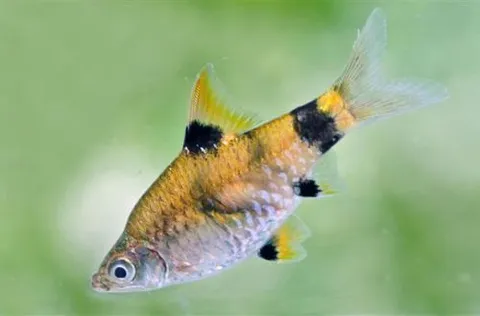
Pethia gelius
The Sun Barb, also known as the Golden Dwarf Barb (Pethia gelius), belongs to the Cyprinidae family. This species is known for its unpretentiousness and ease of care, but it requires special attention to the protein…
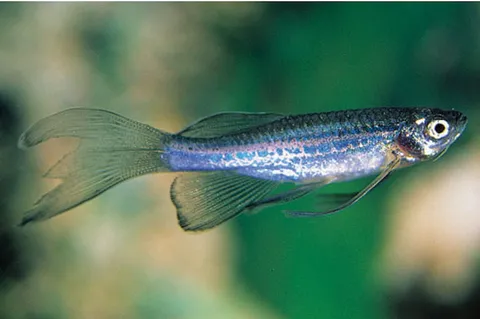
Danio rerio
The Blue Danio, known by its scientific name Danio rerio, belongs to the carp family (Cyprinidae). This variation of the classic Danio rerio stands out for its silvery-blue coloration, consisting of numerous small…
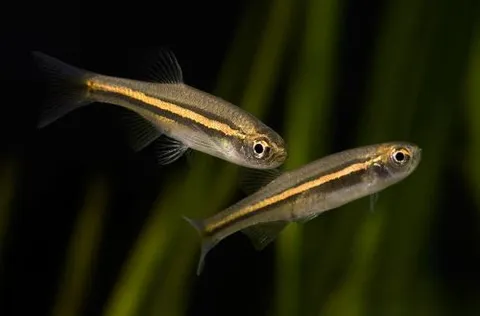
Danio jaintianensis
The Jaintia Danio, scientifically known as Danio jaintianensis, belongs to the family Cyprinidae. The fish is named after the Jaintia Hills, where it was first discovered. Although this species is not frequently…
Pethia conchonius
The Rosy Barb, scientifically known as Pethia conchonius, is a member of the Cyprinidae family. Its vibrant appearance is sure to catch the eye, and its high activity makes observing these fish a captivating experience,…