Temperature20 – 22 °C
Natural range
- Upper Amazon Basin
- Brazil area
- Peru area
- Ecuador area
Corydoras
Other scientific names: Brochis coeruleus, Brochis dipterus, Callichthys splendens, Callichthys taiosh, Chaenothorax bicarinatus, Chaenothorax eigenmanni
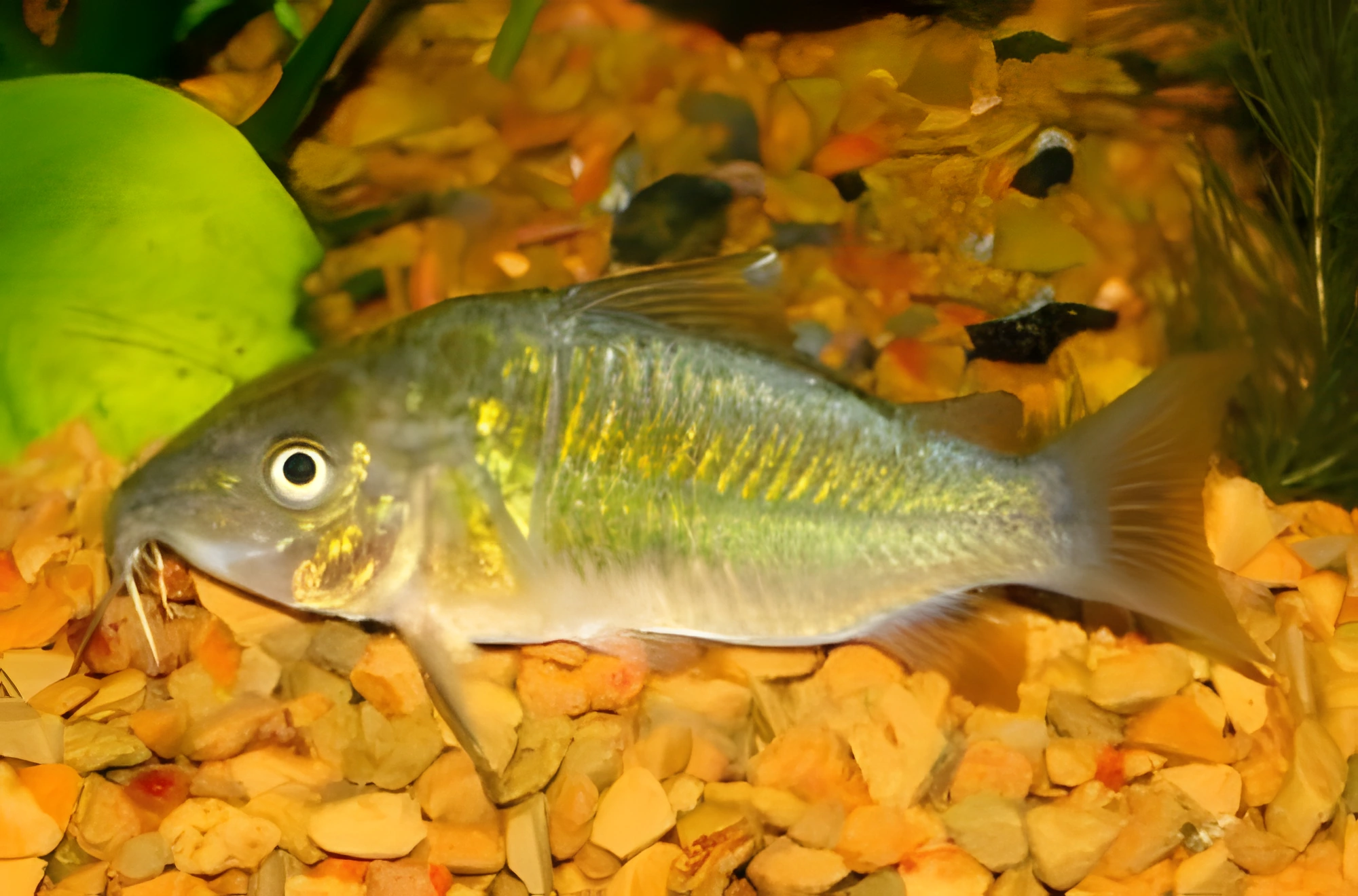
The Emerald Catfish, or Green Brochis (Corydoras splendens), earned its name from its stunning body coloration. Its scales shimmer from metallic blue to rich emerald green, changing hues depending on the light.
- Required aquarium volume
- 100 L
- Size in aquarium
- 7 – 9 cm
- Temperature
- 20 – 22 °C
- Temperament
- Peaceful (regular)
Parameters
Water pHNeutral (6.8) – Neutral (7.2)
Water dHMedium hardness (8) – Medium hardness (10)
Water salinityno salt (freshwater)
Size in aquarium7 – 9 cm
Lifespan10 years
TemperamentPeaceful (regular)
Toward small fishnot a predator
Required aquarium volume100 L
Lightingmoderate (regular)
Substrategravel (regular)
Water flowmoderate
FeedingMixed diet (meat + plant-based)
CareMedium group (6–8 individuals)
Description
Adults of this species typically reach 8–9 cm. As noted, their scale coloration depends on the lighting, displaying iridescent green, blue-green, or dark blue. The anal and pelvic fins are light yellow, harmonizing with the belly, which takes on a pinkish hue in females. The dorsal and caudal fins, in contrast, are a darker brown.
Habitat
The history of the Emerald Catfish (Corydoras splendens) began with its description by François Castelnau in 1855. These fish prefer to inhabit the upper Amazon basin, found in parts of Brazil, Peru, and Ecuador. They populate both rivers and tributaries, as well as still waters. Choosing shallow areas covered with silty substrate and dense vegetation, they live in schools. Although these catfish prefer oxygen-rich shallows, they can also rise to the surface to gulp air if necessary. In their natural habitat, their diet consists of worms, small crustaceans, insects, and various plants.
Behavior and Compatibility
Emerald Catfish are an excellent addition to any aquarium community: they are peaceful and non-aggressive. Being schooling fish, they require a group of at least six individuals; keeping them alone is highly undesirable.
Care and Maintenance
Keeping this catfish is quite simple, but one of the key conditions is a powerful filtration and aeration system. If the fish frequently rise to the surface to gulp air, it may indicate low oxygen levels in the water, caused by insufficient aeration or a clogged filter. Unlike many of its relatives, the Emerald Catfish needs more light, so care should be taken to ensure that floating plants do not create excessive shading in the aquarium. Catfish lead a group lifestyle; when kept alone, they can become timid and shy. To create comfortable conditions in the aquarium, it is recommended to arrange hiding places using twisted roots, pieces of wood, and to build caves or grottoes from stones. Green Brochis, constantly sifting through the substrate with their sensitive barbels, require fine gravel as a substrate to avoid damaging them. It is important to perform regular partial water changes — approximately once every two weeks.
Diet
Green Brochis are not demanding about food and readily accept a variety of live foods, as well as dry commercial mixes. To ensure a balanced diet, it is recommended to combine different types of food. Since these catfish are bottom dwellers, it is important that dry food sinks — flakes or pellets are suitable. In addition to live food, frozen food can also be used. Fish should be fed 1–2 times a day.
Breeding and Reproduction
Distinguishing the sex of Emerald Catfish by external characteristics is quite difficult. However, when kept in a group, the chances of having at least one female and one male significantly increase, eliminating the need to select partners separately. For a beginner aquarist, breeding these catfish might seem challenging, as recreating all the necessary conditions in a home aquarium is not easy. Catfish reproduce during the rainy season, so to stimulate spawning, the water temperature needs to be lowered by a couple of degrees. A female can lay 900 to 1100 eggs, attaching them to various surfaces — stones, plants, and other objects. It is important to note that the eggs are susceptible to fungal infections, so antifungal agents are recommended during the maturation period of the clutch.
Diseases
The Emerald Catfish is highly resilient. Provided with favorable living conditions, it rarely gets sick. Special attention should be paid to the condition of their barbels, which the fish use to explore the substrate: if ammonia concentration is high, they may become infected.
How to choose
When selecting emerald catfish, first examine the condition of their skin and fins. Healthy fish should be free of ulcers, whitish spots, or film, and their fins should show no signs of splitting or erosion. Special attention should be paid to their barbels: they must be intact, without any signs of damage, as their absence makes it difficult for the fish to find food and indicates poor keeping conditions at the store.
- give preference to individuals that are active and stay in a group, rather than hiding alone in corners
- avoid purchasing fish with severely sunken bellies, which may indicate emaciation or the presence of internal parasites
- check that the fish do not show signs of labored breathing, expressed by constantly staying at the water surface even with aeration in the display aquarium
Frequently asked questions
The essentials: size, tank volume, water parameters and care
How big does Emerald Catfish get?
An adult reaches 7–9 cm in length. Plan the tank around the maximum size: the fish quickly outgrows a cramped setup.
What size aquarium does Emerald Catfish need?
The minimum recommended volume is 100 L. A smaller tank speeds up nitrate build-up and raises stress levels.
What water parameters does Emerald Catfish need?
Temperature 20–22 °C, pH 6.8–7.2, hardness 8–10 dGH. Stability matters more than exact values: sudden swings are harder on the fish than a small deviation from the ideal.
How long does Emerald Catfish live?
Around 10 years when kept properly. Lifespan depends directly on tank volume, water quality and a varied diet.
Is Emerald Catfish aggressive?
Temperament: peaceful (regular). Keep this in mind when choosing tank mates.
How many Emerald Catfish should be kept together?
Recommended setup: medium group (6–8 individuals). Ignoring this is a common cause of stress and disease.
What does Emerald Catfish eat?
Diet type: mixed diet (meat + plant-based). Feed small portions that are finished within a couple of minutes — overfeeding does more harm than underfeeding.
What is the scientific name of Emerald Catfish?
The scientific name of the species is Brochis splendens, family Armored Catfish (Callichthyidae). It also appears in the literature as: Brochis coeruleus, Brochis dipterus, Callichthys splendens.