Temperature20 – 24 °C
Natural range
- Inle Lake area
- Shan State
CyprinidsConservation status: Endangered EN
Other scientific names: Celestichthys erythromicron, Microrasbora erythromicron
The Emerald Danio, known to the scientific community as Danio erythromicron, belongs to the family Cyprinidae. Previously, it was mistakenly called the Emerald Microrasbora or Microrasbora erythromicron. However, research in the early 2000s showed that, based on a number of characteristic features, these fish are correctly classified into the Danio group. Despite this, outdated names are still found in old publications and on some internet resources.
- Required aquarium volume
- 50 L
- Size in aquarium
- 2 cm
- Temperature
- 20 – 24 °C
- Temperament
- Peaceful (regular)
Parameters
Water pHNeutral (7) – Slightly alkaline (8)
Water dHHard (12) – Very hard (21)
Water salinityno salt (freshwater)
Size in aquarium2 cm
Lifespan4 years
TemperamentPeaceful (regular)
Toward small fishnot a predator
Required aquarium volume50 L
Lightingdimmed
Substrateany, but dark
Water flownone or stagnant (no flow)
FeedingSmall / appropriate size / pieces
CareLarge group (10+ individuals)
Description
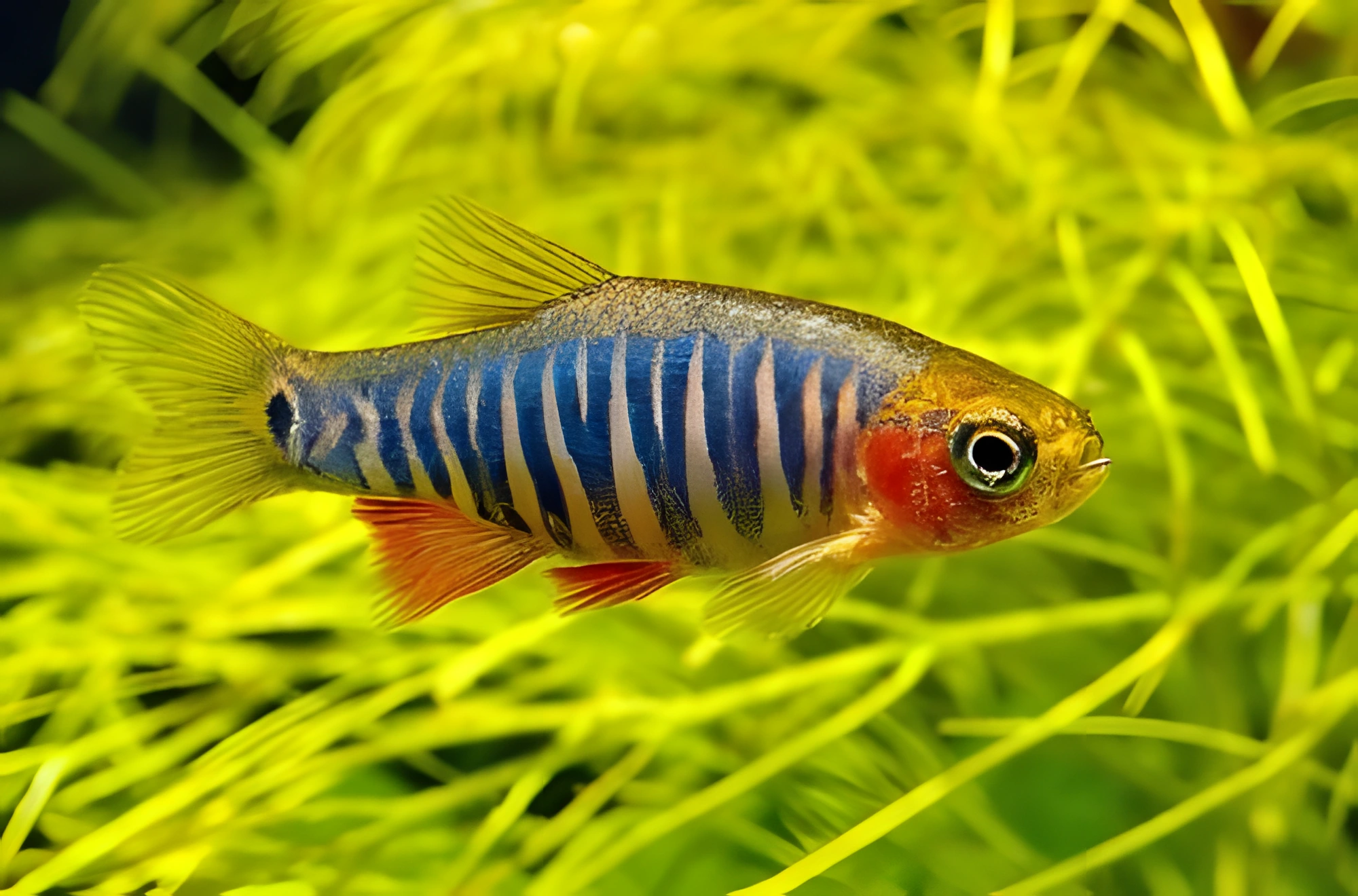
Adults of this species reach a length of approximately 2 centimeters. A characteristic feature of their body coloration is alternating transverse stripes that combine blue-emerald and orange hues. The ventral and anal fins are red, while the other fins remain translucent. A distinct black spot is visible at the base of the caudal fin. External differences between males and females are subtle. Although males and females are very similar, the latter usually appear somewhat larger, especially during spawning when their bodies are full of eggs.
Habitat
The native range of this species is central Myanmar, located in Southeast Asia. The Emerald Danio inhabits Lake Inle, which is located in a mountainous area, on the Shan Plateau, at an altitude of about 900 meters above sea level. The lake is shallow, only 2–3 meters deep, has a loamy substrate, and its waters are generally clear, although areas with cloudy water due to silt accumulation can be observed near the shores. “Vegetation islands” formed by dense clusters of aquatic plants develop on the water surface, serving as an important refuge for many fish species, including Emerald Danios.
Behavior and Compatibility
These fish are peaceful and active, preferring to live in schools of at least 20 individuals. Within such groups, there is competition between males, which can sometimes be quite intense, something not always expected from such miniature creatures. In a large school, weaker individuals receive relative protection, as the attention of dominant males is dispersed among many conspecifics. Due to their small size, the choice of tank mates requires special attention. Emerald Danios are compatible only with species of comparable size. Any large fish, even if it is a peaceful vegetarian, can accidentally swallow them.
Care and Maintenance
Since these fish thrive in large groups, despite their small size, they require an aquarium of 50–60 liters or more. For decoration, it is recommended to use a soft dark substrate, driftwood and other decorative elements, as well as an abundant quantity of aquatic plants, including floating ones. Floating plants will provide the necessary shade and be a pleasant addition to the overall environment. Lighting should be subdued. For successful keeping of Emerald Danios, it is extremely important to maintain stable water parameters, including temperature, pH, and dGH. Achieving this stability requires regular performance of standard aquarium maintenance procedures. In particular, these include: weekly partial water changes with fresh water, prompt removal of organic waste (e.g., excrement and food residues), and preventive maintenance of equipment. Air-lift filters can be used in the filtration system, which, in addition to their main function, help increase the level of dissolved oxygen. This is especially important in aquariums with a large number of live plants. At night, when photosynthesis stops, plants begin to consume oxygen and release carbon dioxide, which can lead to oxygen deprivation in fish.
Diet
These fish prefer a varied diet, including various foods of appropriate size. The optimal option would be a combination of dry flakes and granules with live or frozen foods, such as brine shrimp, daphnia, and bloodworms.
Breeding and Reproduction
In their natural habitat, these fish breed year-round. In a home aquarium, under favorable conditions, spawning can also occur regularly. The fish lay several dozen eggs among plant thickets; the eggs are equipped with adhesive threads, allowing them to attach to various surfaces. The incubation period lasts about 72 hours, its duration depending on the water temperature. After another 3–4 days, the hatched fry begin to swim freely. It is important to note that Emerald Danios do not exhibit parental care and may eat their own offspring. Therefore, if the fry are not promptly transferred to a separate tank, they are unlikely to survive to adulthood.
Diseases
In a balanced aquarium ecosystem that meets the needs of this species, diseases are rare. Most often, ailments are provoked by deteriorating environmental conditions, contact with already sick fish, or mechanical damage. If the fish shows clear signs of illness, medicinal treatment should be applied. More detailed information on symptoms and therapy methods can be found in the “Aquarium Fish Diseases” section.
How to choose
When selecting individuals, preference should be given to active fish with clean fins and no visible damage or sores on the body. Avoid specimens with unnaturally bloated or sunken bellies, as well as fish that stay near the water surface or appear apathetic. Since this species is schooling and timid, healthy fish in a store usually exhibit group behavior; single individuals may experience severe stress. It is recommended to purchase a group of 10 or more individuals at once, as in small numbers, fish become extremely fearful and are susceptible to diseases due to constant stress. Before purchasing, make sure that the keeping conditions in the retail aquarium meet basic requirements and that the fish do not show signs of emaciation, as adaptation to new conditions after transportation can be difficult for weakened individuals.
Frequently asked questions
The essentials: size, tank volume, water parameters and care
How big does Emerald Danio get?
An adult reaches 2 cm in length. Plan the tank around the maximum size: the fish quickly outgrows a cramped setup.
What size aquarium does Emerald Danio need?
The minimum recommended volume is 50 L. A smaller tank speeds up nitrate build-up and raises stress levels.
What water parameters does Emerald Danio need?
Temperature 20–24 °C, pH 7–8, hardness 12–21 dGH. Stability matters more than exact values: sudden swings are harder on the fish than a small deviation from the ideal.
How long does Emerald Danio live?
Around 4 years when kept properly. Lifespan depends directly on tank volume, water quality and a varied diet.
Is Emerald Danio aggressive?
Temperament: peaceful (regular). Keep this in mind when choosing tank mates.
How many Emerald Danio should be kept together?
Recommended setup: large group (10+ individuals). Ignoring this is a common cause of stress and disease.
What does Emerald Danio eat?
Diet type: small / appropriate size / pieces. Feed small portions that are finished within a couple of minutes — overfeeding does more harm than underfeeding.
What is the scientific name of Emerald Danio?
The scientific name of the species is Danio erythromicron, family Cyprinids (Cyprinidae). It also appears in the literature as: Celestichthys erythromicron, Microrasbora erythromicron.