Temperature22 – 26 °C
Natural range
- Western Ghats area
- Goa area
CyprinidsConservation status: Data deficient DD
Other scientific names: Barbus melanampyx, Dravidia melanampys, Dravidia melanampyx, Labeo melanampyx, Puntius melanampyx
The Indian Striped Barb, known scientifically as Haludaria melanampyx, belongs to the family Cyprinidae. It is worth noting some taxonomic uncertainty regarding this species, as some researchers consider it a variety of the Striped Barb, rather than a separate species.
- Required aquarium volume
- 100 L
- Size in aquarium
- 7 cm
- Temperature
- 22 – 26 °C
- Temperament
- Semi-peaceful (including aggression during spawning / intraspecific conflicts)
Parameters
Water pHSlightly acidic (6) – Neutral (7)
Water dHVery soft (1) – Medium hardness (10)
Water salinityno salt (freshwater)
Size in aquarium7 cm
Lifespan6 years
TemperamentSemi-peaceful (including aggression during spawning / intraspecific conflicts)
Toward small fishnot a predator
Required aquarium volume100 L
Lightingdimmed
Substrateany (no restrictions)
Water flowweak or moderate
FeedingSmall / appropriate size / pieces
CareGroup (8–10 individuals)
Description
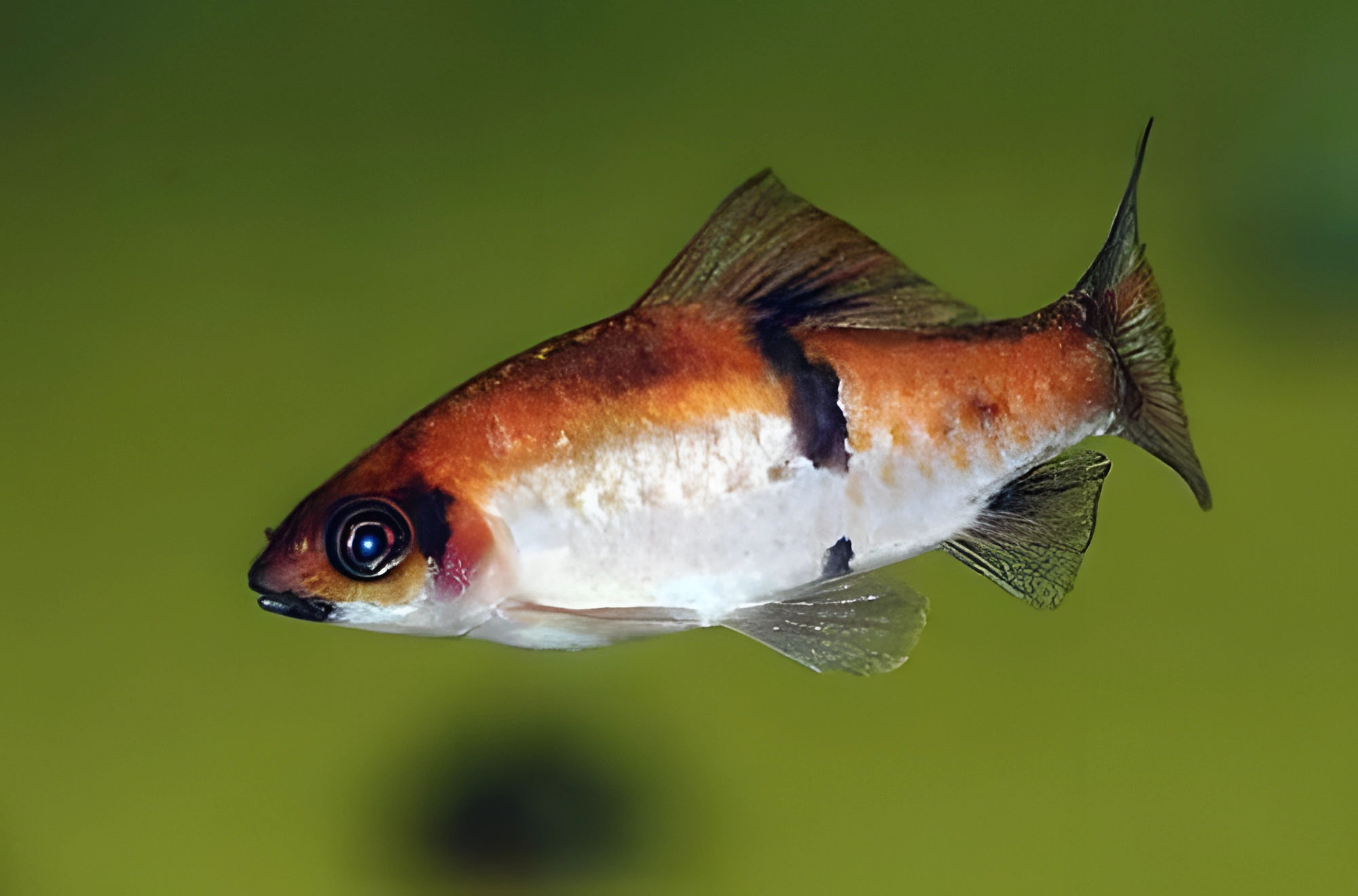
Adults reach approximately 7 cm in length. Their coloration is predominantly red, with a silvery belly. The body features a characteristic pattern of several black vertical stripes and markings. It should be noted that the size and number of stripes can vary. In some cases, the Indian Striped Barb can be externally indistinguishable from the Striped Barb. Sexual dimorphism in this species is weakly expressed; males and females are almost impossible to distinguish visually.
Habitat
The native habitat of this fish is South Asia, specifically the western part of India. Its natural environment covers the territories of the states of Goa, Karnataka, and Kerala. It inhabits numerous river systems that originate in the Western Ghats mountains. These fish prefer shallow sections of rivers where the bottom consists of sand covered with a layer of plant debris, such as leaves, branches, and tree roots.
Behavior and Compatibility
This fish is characterized by an active and peaceful disposition. It prefers to be in a group of its kind, so it is recommended to keep a school of at least 8–10 individuals. They get along well with most other freshwater species of comparable size. However, it should be remembered that their high activity can cause discomfort to slower fish.
Care and Maintenance
For comfortable keeping of a school of 8–10 Indian Striped Barbs, an aquarium of 80–100 liters or more will be required. Important conditions include a productive filtration system and regular weekly partial water changes. When keeping this species, it is critically important to maintain high water quality within acceptable temperature and hydrochemical parameters. The aquarium decoration can be anything. A classic option involves a combination of open swimming spaces with areas for shelters. The latter can include natural snags, dense thickets of live plants, or various artificial decorations.
Diet
This is an omnivorous species. The daily diet can include both dry and frozen, as well as live foods, used in various combinations. If the chosen product is high-quality and contains all the necessary trace elements, it is permissible to limit feeding exclusively to dry foods in the form of flakes or granules.
Breeding and Reproduction
The breeding characteristics of this species are typical for cyprinids. During spawning, the Indian Striped Barb does not form a clutch but scatters its eggs across the bottom of the reservoir. Parental care for the offspring is absent. Adults tend to eat their own eggs, so for successful breeding, it is recommended to use a separate tank to timely remove the parents.
Diseases
In a balanced aquarium ecosystem, closely matching the requirements of this species, diseases are extremely rare. Illnesses often arise due to deteriorating habitat quality, contact with already sick fish, or physical injuries. If these factors could not be avoided, the “Aquarium Fish Diseases” section will provide detailed information on symptoms and treatment methods.
How to choose
When choosing individuals, attention should be paid to the cleanliness of the skin and fins: there should be no white spots, ulcers, film, or signs of damage on the body. Healthy fish show activity and stay in a school, avoiding isolation in the corners of the aquarium. Due to the high variability of coloration depending on mood, it should be noted that a temporary fading of the black stripes in stressed fish in the store is normal. It is recommended to purchase individuals from the same batch, as various geographical forms, which may differ in the intensity of red or ochre hues, are often grouped under the names Haludaria fasciata or H. melanampyx in trade.
Frequently asked questions
The essentials: size, tank volume, water parameters and care
How big does Indian Striped Barb get?
An adult reaches 7 cm in length. Plan the tank around the maximum size: the fish quickly outgrows a cramped setup.
What size aquarium does Indian Striped Barb need?
The minimum recommended volume is 100 L. A smaller tank speeds up nitrate build-up and raises stress levels.
What water parameters does Indian Striped Barb need?
Temperature 22–26 °C, pH 6–7, hardness 1–10 dGH. Stability matters more than exact values: sudden swings are harder on the fish than a small deviation from the ideal.
How long does Indian Striped Barb live?
Around 6 years when kept properly. Lifespan depends directly on tank volume, water quality and a varied diet.
Is Indian Striped Barb aggressive?
Temperament: semi-peaceful (including aggression during spawning / intraspecific conflicts). Keep this in mind when choosing tank mates.
How many Indian Striped Barb should be kept together?
Recommended setup: group (8–10 individuals). Ignoring this is a common cause of stress and disease.
What does Indian Striped Barb eat?
Diet type: small / appropriate size / pieces. Feed small portions that are finished within a couple of minutes — overfeeding does more harm than underfeeding.
What is the scientific name of Indian Striped Barb?
The scientific name of the species is Haludaria melanampyx, family Cyprinids (Cyprinidae). It also appears in the literature as: Barbus melanampyx, Dravidia melanampys, Dravidia melanampyx.