Temperature24 – 28 °C
Natural range
- Mekong River Basin
- Myanmar area
- Laos area
- Thailand area
UnusualConservation status: Least concern LC
Other scientific names: Chitara ornata, Notopterus ocellifer, Notopterus ornatus
The Indian Featherback, or Chitala ornata by its scientific name, belongs to the family Notopteridae. It is a large fish distinguished by its unusual body shape. Keeping it requires significant financial investment and certain experience. Despite these challenges, the species is quite popular in aquaristics, and today there are even hybrid forms.
- Required aquarium volume
- 200 L
- Size in aquarium
- 50 – 60 cm
- Temperature
- 24 – 28 °C
- Temperament
- Predator, but semi-peaceful (gets along with large ones)
Parameters
Water pHSlightly acidic (6) – Neutral (7.5)
Water dHSoft (4) – Hard (15)
Water salinityno salt (freshwater)
Size in aquarium50 – 60 cm
Lifespan12 years
TemperamentPredator, but semi-peaceful (gets along with large ones)
Toward small fishpredator
Required aquarium volume200 L
Lightingdimmed
Substratesand or gravel + stones/boulders
Water flowweak or moderate
FeedingMeat / protein (live, frozen, fresh)
CareBoth solitary and in group (flexible)
Description
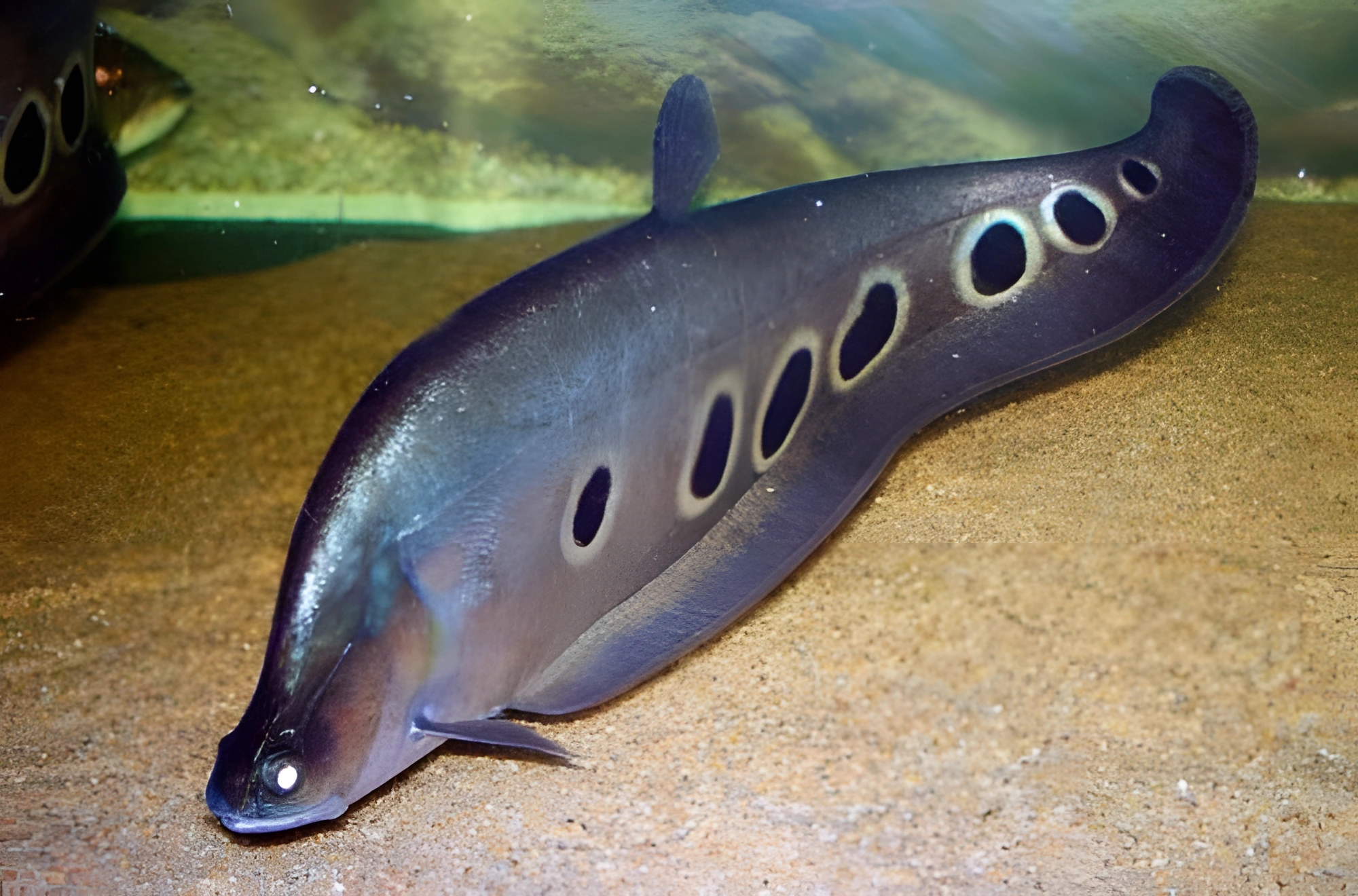
Adults of this species can reach a length of one meter. Their body shape is distinctive and resembles the blade of a large knife, which gave the species its common name. The fish's back is arched, and there is a small dorsal fin on the top of its head. The lower part of the body is straight, and a long fin runs along its entire length, responsible for propulsion. A caudal fin as such is absent. The coloration is usually gray, and a characteristic feature is the presence of large black spots with a light border, arranged symmetrically in a single row.
Habitat
The native range of this species is Southeast Asia, particularly the Mekong River basin — one of the largest rivers in Indochina, flowing through Myanmar, Laos, Thailand, Cambodia, and Vietnam. The Indian Featherback has been artificially introduced to the Philippines and the USA, where it is cultivated as a food fish. It is found everywhere, inhabiting the main channel of the Mekong, its tributaries, as well as lakes and swamps. During the rainy season, the fish swims into flooded forest areas for spawning.
Behavior and Compatibility
This fish is considered relatively peaceful and is well compatible with other, sufficiently large fish so as not to become their food. It can be kept alone or in a group. However, if the aquarium volume is insufficient, the likelihood of territorial skirmishes between conspecifics increases.
Care and Maintenance
The impressive size of these fish implies the use of a specialized aquarium with a volume exceeding one thousand liters, the installation of which requires a professional approach. The Indian Featherback is not intended for beginner aquarists, and therefore a detailed description of its keeping is beyond the scope of this site. Presumably, those who decide to acquire such a fish already possess sufficient knowledge or seek assistance from aquarium maintenance specialists.
Diet
The species is carnivorous; its diet consists of small fish, crustaceans, and other invertebrates. In a home aquarium, these fish readily accept fresh or frozen food. Young Indian Featherbacks can be offered bloodworms, small earthworms, and chopped shrimp. Adult specimens are fed pieces of fish meat, whole shrimp, large earthworms, and other meaty products. It is strictly forbidden to use mammalian or poultry meat as food, as it contains lipids that are poorly assimilated and not digested by the fish's digestive system.
Breeding and Reproduction
Breeding in home conditions is extremely difficult due to the enormous size the fish need to reach sexual maturity and the specific requirements for aquarium volume. In nature, spawning is seasonal and tied to the rainy season. Eggs are laid on hard surfaces or aquatic plants. The male exhibits parental care, guarding the clutch and fanning it with his fins. Fry require feeding with Artemia nauplii and other small live foods.
Diseases
The species has sensitive skin, prone to mechanical damage and infestation by skin parasites under stress or poor water quality. Typical problems for large tropical fish include bacterial infections causing fin rot or ulcers, and infestation by protozoan parasites, such as those causing ich. Prevention involves maintaining stable water parameters, powerful filtration, and avoiding overpopulation of the aquarium.
How to choose
When purchasing, avoid specimens showing signs of emaciation, mucosal damage, white film or spots on the body and fins. It is important to assess the fish's activity: a healthy Indian Featherback should show caution but not be apathetic. Given the rapid growth of the species, it is necessary to ensure in advance that you can provide the fish with an aquarium of 500–1000 liters or more, as young specimens in the store are often sold at around 10 cm, concealing their growth potential to 50–60 cm and beyond.
Frequently asked questions
The essentials: size, tank volume, water parameters and care
How big does Indian Featherback get?
An adult reaches 50–60 cm in length. Plan the tank around the maximum size: the fish quickly outgrows a cramped setup.
What size aquarium does Indian Featherback need?
The minimum recommended volume is 200 L. A smaller tank speeds up nitrate build-up and raises stress levels.
What water parameters does Indian Featherback need?
Temperature 24–28 °C, pH 6–7.5, hardness 4–15 dGH. Stability matters more than exact values: sudden swings are harder on the fish than a small deviation from the ideal.
How long does Indian Featherback live?
Around 12 years when kept properly. Lifespan depends directly on tank volume, water quality and a varied diet.
Is Indian Featherback aggressive?
Temperament: predator, but semi-peaceful (gets along with large ones). This is a predatory species — any fish small enough to fit in its mouth will eventually be eaten.
How many Indian Featherback should be kept together?
Recommended setup: both solitary and in group (flexible). Ignoring this is a common cause of stress and disease.
What does Indian Featherback eat?
Diet type: meat / protein (live, frozen, fresh). Feed small portions that are finished within a couple of minutes — overfeeding does more harm than underfeeding.
What is the scientific name of Indian Featherback?
The scientific name of the species is Chitala ornata, family Notopteridae. It also appears in the literature as: Chitara ornata, Notopterus ocellifer, Notopterus ornatus.