Temperature23 – 26 °C
Natural range
- Democratic Republic of the Congo area
CichlidsConservation status: Least concern LC
The Red Chromide, or "Red Jewel Cichlid," scientifically known as Hemichromis lifalili, is a member of the Cichlidae family. This is a beautiful and vibrant fish, whose keeping and breeding do not present significant difficulties. However, it has one significant nuance: extreme aggression during spawning, which makes selecting suitable tankmates in a small aquarium a very challenging task.
- Required aquarium volume
- 70 L
- Size in aquarium
- 10 – 15 cm
- Temperature
- 23 – 26 °C
- Temperament
- Semi-peaceful (including aggression during spawning / intraspecific conflicts)
Parameters
Water pHSlightly acidic (6) – Slightly alkaline (7.8)
Water dHSoft (4) – Hard (15)
Water salinityno salt (freshwater)
Size in aquarium10 – 15 cm
Lifespan7 years
TemperamentSemi-peaceful (including aggression during spawning / intraspecific conflicts)
Toward small fishnot a predator
Required aquarium volume70 L
Lightingdimmed
Substratefine sand
Water flowweak
FeedingAny (universal)
CarePair (male/female)
Description
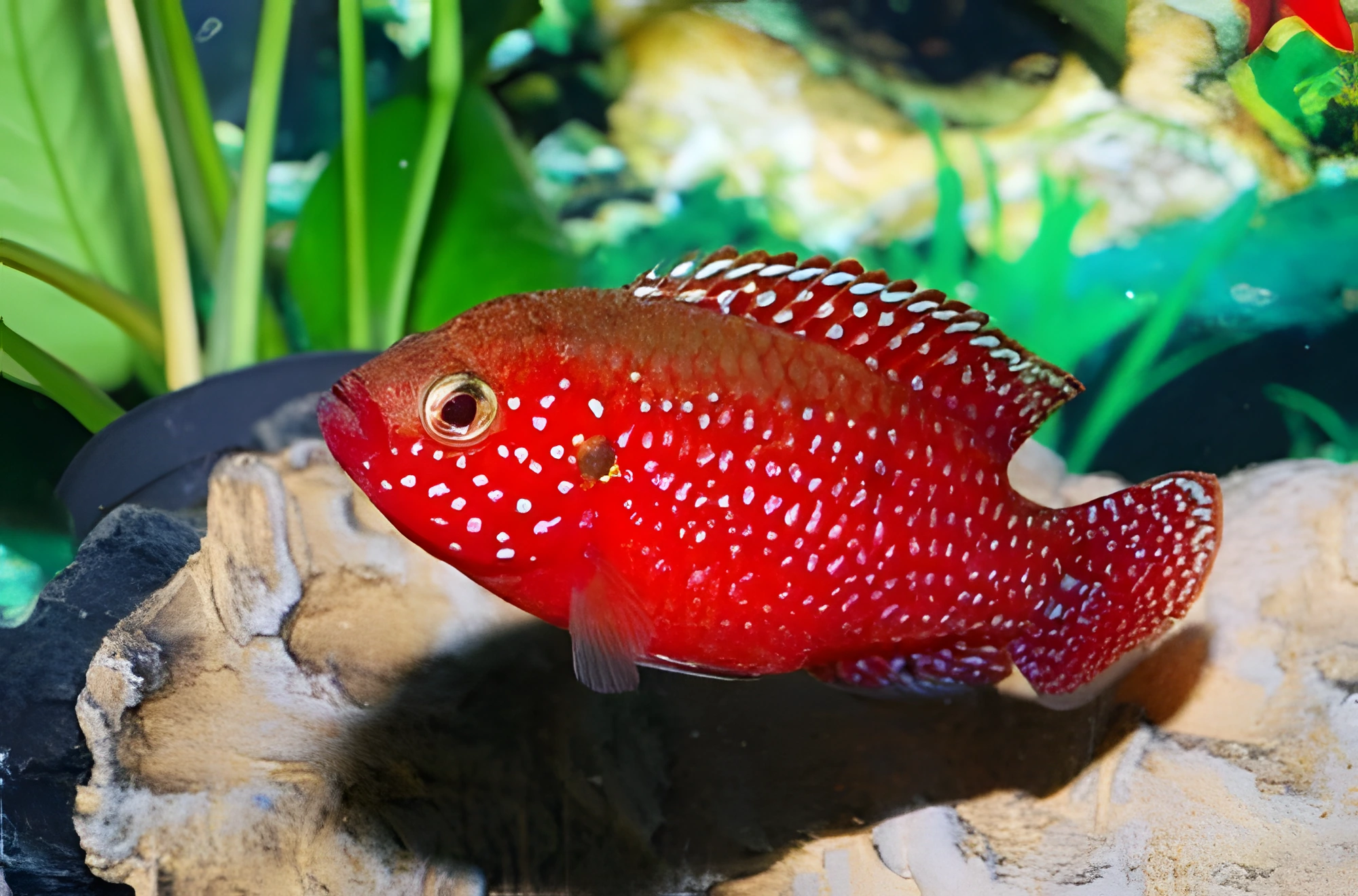
These fish reach a length of 10 to 15 cm when fully grown. Their coloration varies from orange to red, with beautiful small blue speckles. During the breeding period, the colors become noticeably more intense. Sexual dimorphism in the species is weakly expressed, which makes it difficult to determine the sex of individuals.
Habitat
Its origin is associated with the Congo River basin, specifically the Democratic Republic of Congo. Its natural habitat includes streams and small rivers with moderate currents. Due to numerous rapids, the water in these areas is saturated with dissolved oxygen.
Behavior and Compatibility
This fish is territorial and exhibits strong aggression during spawning. Outside the breeding period, it can coexist relatively peacefully with calm fish species of similar or slightly larger size. Red Chromides form monogamous pairs that last a lifetime. However, they are extremely unfriendly towards other members of their species and, as a rule, eliminate weaker individuals. It is important to note that simply placing a male and female in an aquarium is not always enough to form a pair; this often leads to the death of one of the fish due to persecution. Pairs form naturally as they mature, when young fish develop together in a group of at least a dozen individuals.
Care and Maintenance
For comfortable keeping of a single pair of these fish, an aquarium of at least 70 liters is required. When arranging decor elements, it is important to provide a sufficient number of shelters, which can be caves or snags, and to create areas with dense vegetation. Since the Red Chromide tends to dig in the substrate, the use of sand or fine gravel is recommended. For the same reason, live plants are best planted in pots to prevent them from being uprooted or their root systems damaged. Regarding water parameters, slightly acidic pH values and low to medium hardness (dGH) are preferred. To maintain a high level of dissolved oxygen, effective water aeration must be ensured, and the substrate should be regularly cleaned of organic residues, which actively consume oxygen during decomposition.
Diet
The diet should preferably include live or frozen foods such as bloodworms, daphnia, and artemia, with the addition of plant components, for example, spirulina flakes. High-quality dry foods with increased protein content can be a good alternative.
Breeding and Reproduction
During the breeding period, as mentioned, Chromides become exceptionally aggressive, capable of even attacking the aquarist's hand if it enters the water; therefore, it is advisable to relocate other tank inhabitants during this time. The male is usually very persistent in his courtship, and if the female is not ready, she will need reliable shelters to hide from his intrusive attention. Any flat surface can become a suitable place for egg-laying; the female can even attach them to the glass. The total number of laid eggs can reach 400. The incubation period lasts approximately 48 hours, and throughout this time, the female remains with the clutch, while the male, staying at a distance, digs several depressions. After the fry hatch, for several days the female will alternately move the brood from one pit to another until the young reach the free-swimming stage. Parental care continues for about a month, after which it is advisable to transfer the fry to a separate tank.
Diseases
The main cause of most diseases in Leaf Fish is unsuitable keeping conditions and poor-quality nutrition. If initial symptoms are observed, it is first necessary to check water parameters and the concentration of dangerous substances such as ammonia, nitrites, and nitrates. If the indicators deviate from the norm, they should be brought back into order, and only then should treatment begin. More detailed information on symptoms and treatment methods can be found in the "Aquarium Fish Diseases" section.
How to choose
When choosing healthy individuals, pay attention to the fish's activity: it should be mobile, with fins held close to the body, without visible damage, sores, white film, or spots on the body. Avoid specimens that appear emaciated, have a sunken belly, or an unnaturally bloated abdomen. It is important to assess their behavior in the store: healthy chromides show curiosity and territoriality, and do not constantly hide in corners. Given the high aggressiveness of the species, it is not recommended to buy adult individuals singly to add to a community tank without prior territory planning. The best option is to acquire a group of young fish, from which a stable pair will subsequently form.
Frequently asked questions
The essentials: size, tank volume, water parameters and care
How big does Red Chromide get?
An adult reaches 10–15 cm in length. Plan the tank around the maximum size: the fish quickly outgrows a cramped setup.
What size aquarium does Red Chromide need?
The minimum recommended volume is 70 L. A smaller tank speeds up nitrate build-up and raises stress levels.
What water parameters does Red Chromide need?
Temperature 23–26 °C, pH 6–7.8, hardness 4–15 dGH. Stability matters more than exact values: sudden swings are harder on the fish than a small deviation from the ideal.
How long does Red Chromide live?
Around 7 years when kept properly. Lifespan depends directly on tank volume, water quality and a varied diet.
Is Red Chromide aggressive?
Temperament: semi-peaceful (including aggression during spawning / intraspecific conflicts). Keep this in mind when choosing tank mates.
How many Red Chromide should be kept together?
Recommended setup: pair (male/female). Ignoring this is a common cause of stress and disease.
What does Red Chromide eat?
Diet type: any (universal). Feed small portions that are finished within a couple of minutes — overfeeding does more harm than underfeeding.
What is the scientific name of Red Chromide?
The scientific name of the species is Hemichromis lifalili, family Cichlids (Cichlidae).