Temperature22 – 28 °C
Natural range
- Southern Guinea area
- Central Liberia area
- Niger River Basin
- Congo River Basin
CichlidsConservation status: Least concern LC
Other scientific names: Hemichromis cristatus, Hemichromis fugax
Hemichromis bimaculatus, or the Jewel Cichlid, belongs to the family Cichlidae. This fish possesses a bright, attractive appearance, however, its temperament can create difficulties for other aquarium inhabitants. It exhibits particular aggression during spawning. This species is not recommended for beginner aquarists, and the best solution for keeping them is a pair in a species-specific tank.
- Required aquarium volume
- 110 L
- Size in aquarium
- 15 cm
- Temperature
- 22 – 28 °C
- Temperament
- Territorial (often aggressive)
Parameters
Water pHSlightly acidic (6) – Neutral (7)
Water dHSoft (4) – Hard (16)
Water salinityno salt (freshwater)
Size in aquarium15 cm
Lifespan5 years
TemperamentTerritorial (often aggressive)
Toward small fishnot a predator
Required aquarium volume110 L
Lightingmoderate (regular)
Substrategravel (regular)
Water flowmoderate
FeedingMeat / protein (live, frozen, fresh)
CarePair (male/female)
Description
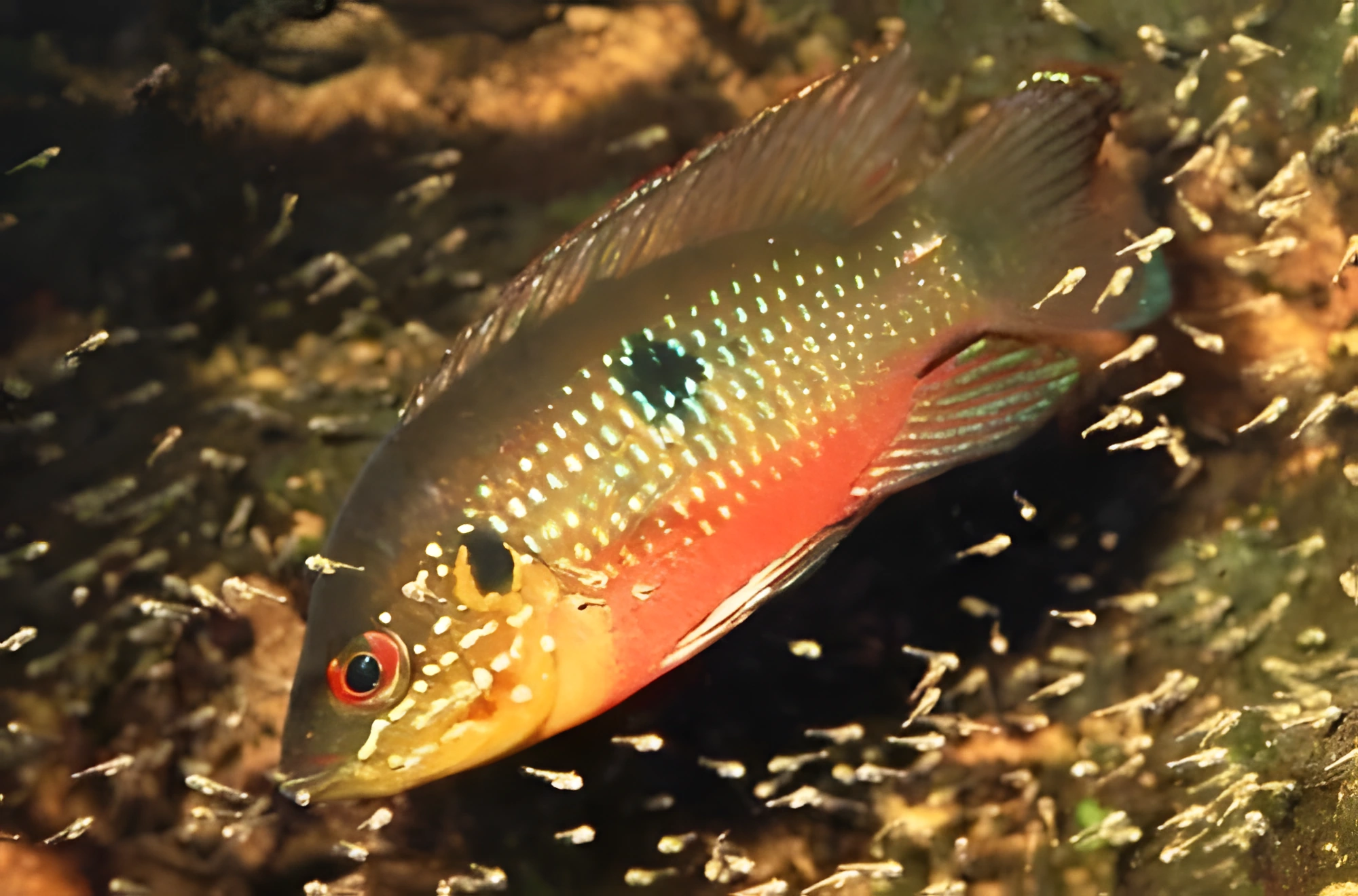
This fish is characterized by a high, elongated body. The tips of the dorsal and anal fins are pointed, and the caudal fin is rounded. The coloration is predominantly carmine-red, with its intensity increasing in females during the breeding season. Rows of light, bluish-tinged spots are located throughout the body and fins. Two dark spots stand out on the fish's body: one near the head, the second closer to the center. The fins are edged with a dark band.
Habitat
The natural habitat of this species extends along the western coasts of Africa, encompassing territories from Southern Guinea to central Liberia. The Jewel Cichlid can be found in the Niger, Congo, and Nile river systems. It prefers to inhabit shallow streams and canals with dense vegetation. Next, we will consider the requirements for their keeping.
Behavior and Compatibility
This fish is characterized by an uncooperative, territorial nature and exhibits particular aggression during spawning. The ideal solution is to keep a male/female pair in a species-specific aquarium. However, there is a risk of incompatibility here, as not all individuals of the opposite sex can form a stable pair. Cases are often noted where one Jewel Cichlid attacked and even killed a weaker tankmate. Therefore, before acquiring these beautiful fish, it is recommended to consult an experienced breeder and purchase an already established pair.
Care and Maintenance
The size of the aquarium for Jewel Cichlids is determined by the type of keeping: whether it will be a species-specific or a community tank. For a comfortable life for one pair, 110 L is sufficient, but for several fish, and even more so for cohabitation with other species, a significantly more spacious tank will be required. Numerous shelters are an essential element of the decor; in addition to decorative objects, ceramic pots, jars, or sections of plastic pipes, partially buried in the substrate, can be used. A dense stony substrate is preferred, as the Jewel Cichlid likes to dig in it. This imposes restrictions on the choice of plants: large species with powerful root systems should be chosen, securely anchored to the bottom. The water should be slightly acidic, soft or medium hardness. Details on pH and dH parameters can be found in the "Hydrochemical composition of water" section. It is recommended to perform weekly water changes of 10–15% of the volume and regularly clean the substrate of organic waste. Standard equipment includes a filter, aerator, heater, and lighting system.
Diet
The diet of the Jewel Cichlid primarily consists of live food, such as small fish, earthworms, or insect larvae. It is permissible, though not desirable, to include dry and freeze-dried foods in the menu, but only as a supplementary element to the main diet. Plant-based supplements, for example, in the form of dried flakes, will also be beneficial.
Breeding and Reproduction
In this species, pairs form for life, which gives reason to expect offspring. Stimuli for spawning include a complete diet of live food, maintaining slightly acidic water close to neutral pH values, and a temperature regime of 26–27°C. When the male and female are ready to reproduce, their coloration becomes maximally vibrant. It is during this period that Jewel Cichlids pose the greatest danger to other species if they are in a community tank. The male prepares a spawning site, which can be any suitable shelter, carefully cleaning it and the surrounding area of debris. He then actively invites the female to join him. If the female is not ready, such persistent pursuit can result in her death. It is important to carefully observe the pair and, if necessary, move the female to a separate tank. The female lays up to 600 eggs, with an incubation period of 24 hours. During this time, the male begins to guard the clutch and simultaneously digs several depressions in the substrate. After the fry emerge, they, along with the female, leave the shelter and move to one of the previously prepared pits. They move from one pit to another until they are old enough to live independently, which usually takes about a month. After this period, the fry are moved to another aquarium.
Diseases
The main causes of deteriorating fish health are an unbalanced diet and unsuitable living conditions. In addition, the aggressive nature of these fish can lead to physical injuries. More detailed information on symptoms and treatment methods can be found in the "Diseases of aquarium fish" section.
How to choose
When purchasing, choose active individuals with clean fins and no body damage, as these fish are prone to injury due to intraspecific aggression. It is recommended to acquire an already established pair, as with random selection of partners in the confined space of an aquarium, a weaker male or female may be subjected to fatal attacks by the dominant individual. Avoid individuals with signs of emaciation, sunken bellies, or unnatural behavior, such as a constant desire to hide in a corner when no other fish are present in the store.
Frequently asked questions
The essentials: size, tank volume, water parameters and care
How big does Jewel Cichlid get?
An adult reaches 15 cm in length. Plan the tank around the maximum size: the fish quickly outgrows a cramped setup.
What size aquarium does Jewel Cichlid need?
The minimum recommended volume is 110 L. A smaller tank speeds up nitrate build-up and raises stress levels.
What water parameters does Jewel Cichlid need?
Temperature 22–28 °C, pH 6–7, hardness 4–16 dGH. Stability matters more than exact values: sudden swings are harder on the fish than a small deviation from the ideal.
How long does Jewel Cichlid live?
Around 5 years when kept properly. Lifespan depends directly on tank volume, water quality and a varied diet.
Is Jewel Cichlid aggressive?
Temperament: territorial (often aggressive). Keep this in mind when choosing tank mates.
How many Jewel Cichlid should be kept together?
Recommended setup: pair (male/female). Ignoring this is a common cause of stress and disease.
What does Jewel Cichlid eat?
Diet type: meat / protein (live, frozen, fresh). Feed small portions that are finished within a couple of minutes — overfeeding does more harm than underfeeding.
What is the scientific name of Jewel Cichlid?
The scientific name of the species is Hemichromis bimaculatus, family Cichlids (Cichlidae). It also appears in the literature as: Hemichromis cristatus, Hemichromis fugax.