Temperature22 – 30 °C
Natural range
- Orinoco River Basin
- Colombia area
- Bolivia area
- Venezuela area
CichlidsConservation status: Least concern LC
Other scientific names: Apistogramma ramirezi, Microgeophagus ramirezi, Papiliochromis ramirezi, Papilochromis ramirezi
Mikrogeophagus ramirezi, belonging to the Cichlidae family, is better known as the Ram cichlid or Ramirez's Apistogramma. This small but very bright fish often becomes the sole inhabitant of an aquarium, as finding suitable tank mates can be challenging due to its modest size. It requires special attention to water quality and feeding, making it recommended for aquarists who already have some experience.
- Required aquarium volume
- 60 L
- Size in aquarium
- 5 cm
- Temperature
- 22 – 30 °C
- Temperament
- Semi-peaceful (including aggression during spawning / intraspecific conflicts)
Parameters
Water pHAcidic (4) – Neutral (7)
Water dHVery soft (1) – Hard (12)
Water salinityno salt (freshwater)
Size in aquarium5 cm
Lifespan3 years
TemperamentSemi-peaceful (including aggression during spawning / intraspecific conflicts)
Toward small fishnot a predator
Required aquarium volume60 L
Lightingdimmed
Substratesandy (regular, light)
Water flowweak
FeedingFloating (any)
CarePair (male/female)
Description
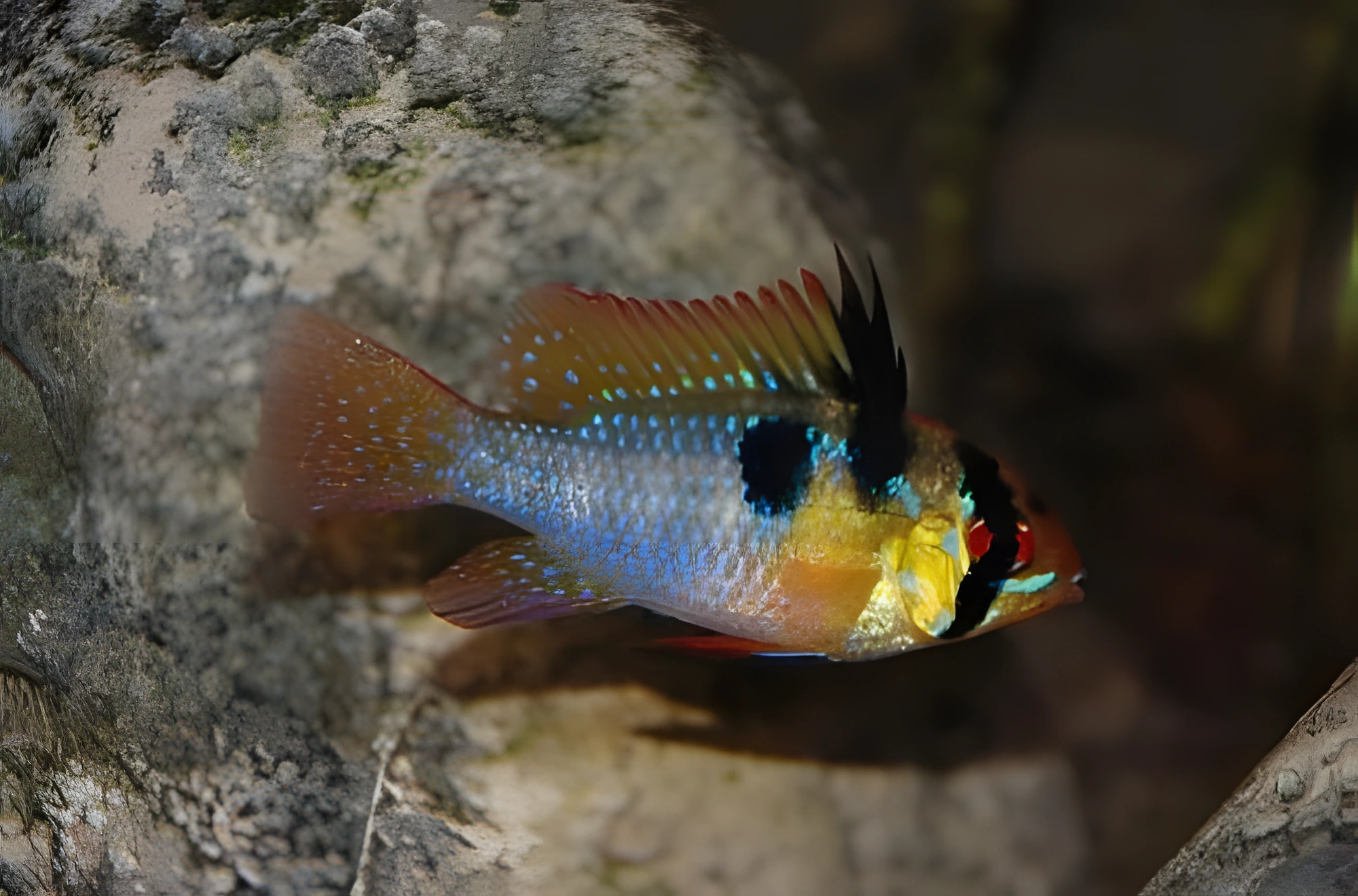
The fish's body is notably tall, with the second ray of the dorsal fin in males being somewhat longer than the others. Females, in turn, have a more rounded abdomen. The entire body surface and fins are adorned with rows of shimmering turquoise dots. The abdomen acquires a reddish tint, especially intense in females. The first rays of the dorsal and pelvic fins are distinctly black. A dark transverse band crosses the head, passing through the eye and gill covers. The fish's eyes are a rich red color. Orange-yellow color variations can also be found.
Habitat
The natural habitat of this species covers the Orinoco River basin in the subequatorial regions of South America, including parts of modern-day Colombia, Bolivia, and Venezuela. The fish inhabits numerous small tributaries, bodies of water, and temporarily flooded plains during high water periods.
Behavior and Compatibility
This fish exhibits a rather peaceful disposition and coexists well with many species of similar size. Given its miniature size, it should not be kept with large, territorial, or aggressive fish. Young individuals usually stay in schools, but as they age, they break into pairs and establish specific territories.
Care and Maintenance
For aquarium decor, it is recommended to use a sandy substrate, on which roots and branches of trees, as well as snags, are placed. These elements should create shelters – resembling caves, overhangs, or shaded areas. Several smooth flat stones will also be appropriate. Fallen dry leaves will help recreate a natural look and give the water a slight brownish tint. Plants can be either floating or rooted, with dense leaves. The water should be soft, slightly acidic, of high quality and purity; weekly water changes of no more than 10–15% of the total volume. Ramirez's Apistogramma tolerates sudden parameter changes poorly, and abundant meaty feeding significantly increases the risk of water pollution. Substrate cleaning is recommended weekly, and food remnants should be removed immediately after each feeding. More detailed information on water parameters and methods for their correction can be found in the "Hydrochemical composition of water" section. Standard equipment includes: a filter, lighting system, heater, and aerator.
Diet
In their natural habitat, the fish's diet consists of small crustaceans and insect larvae, which they find in bottom sediments. When kept in a home aquarium, it is preferable to feed them live foods such as Artemia, Daphnia, Grindal worms, and bloodworms. Frozen foods are also acceptable; although the fish may initially refuse them, they eventually get used to them and eat them with pleasure. Dry foods, whether granules or flakes, should only be used as a supplementary food source.
Breeding and Reproduction
Breeding is possible in home conditions, but it requires strict adherence to water parameters: it must be exceptionally clean and soft, otherwise, the eggs may become fungal or cease to develop altogether. It is recommended to feed the fish only live food. Spawning is preferably carried out in a separate tank, especially if there are other fish species in the main aquarium. The pair lays eggs on hard, smooth surfaces such as stones, glass, or dense plant leaves. Young individuals may sometimes eat their first offspring; however, this behavior usually stops with age. The female guards the clutch for some time. Fry hatch after 2–3 days and feed on egg yolk reserves for the first week, after which they switch to another type of food. Fry feeding should be done in stages, from infusoria to nauplii, as they grow.
Diseases
The fish is extremely sensitive to water and food quality; deviations from norms often provoke the development of hexamitosis. A more detailed description of symptoms and treatment methods is presented in the "Diseases of aquarium fish" section.
How to choose
When selecting individuals, attention should be paid to their activity and clarity of coloration. Healthy fish should be curious, have bright, rich colors, and even, undamaged fins. Avoid specimens with signs of emaciation, sunken bellies, whitish spots on the body, or a coating resembling semolina, as this may indicate parasitic diseases. It is also important to assess the conditions in the store: the water in the aquarium should be clear, without a strong odor, and the fish should not appear sluggish or hide in corners. Special attention should be paid to selective breeding forms, which often have weaker immunity and require careful inspection for hidden infections. It is recommended to purchase already formed pairs, as independent selection of partners at home can be difficult due to the species' selectivity.
Frequently asked questions
The essentials: size, tank volume, water parameters and care
How big does Ram cichlid get?
An adult reaches 5 cm in length. Plan the tank around the maximum size: the fish quickly outgrows a cramped setup.
What size aquarium does Ram cichlid need?
The minimum recommended volume is 60 L. A smaller tank speeds up nitrate build-up and raises stress levels.
What water parameters does Ram cichlid need?
Temperature 22–30 °C, pH 4–7, hardness 1–12 dGH. Stability matters more than exact values: sudden swings are harder on the fish than a small deviation from the ideal.
How long does Ram cichlid live?
Around 3 years when kept properly. Lifespan depends directly on tank volume, water quality and a varied diet.
Is Ram cichlid aggressive?
Temperament: semi-peaceful (including aggression during spawning / intraspecific conflicts). Keep this in mind when choosing tank mates.
How many Ram cichlid should be kept together?
Recommended setup: pair (male/female). Ignoring this is a common cause of stress and disease.
What does Ram cichlid eat?
Diet type: floating (any). Feed small portions that are finished within a couple of minutes — overfeeding does more harm than underfeeding.
What is the scientific name of Ram cichlid?
The scientific name of the species is Mikrogeophagus ramirezi, family Cichlids (Cichlidae). It also appears in the literature as: Apistogramma ramirezi, Microgeophagus ramirezi, Papiliochromis ramirezi.