Temperature20 – 25 °C
Natural range
- Cambodia area
LoachesConservation status: Data deficient DD
The fish Homaloptera confuzona, known by its scientific name Homaloptera confuzona, is a member of the Balitoridae family (River loaches). Although representatives of this group are often found among aquarium enthusiasts, precise identification of a specific species can be difficult due to similarities in coloration and body pattern. Keeping Homaloptera confuzona requires specific conditions, the key of which is the need to ensure a constant flow of very clean water and to create active internal current.
- Required aquarium volume
- 100 L
- Size in aquarium
- 7 – 8 cm
- Temperature
- 20 – 25 °C
- Temperament
- Peaceful (regular)
Parameters
Water pHSlightly acidic (6) – Neutral (7.5)
Water dHVery soft (2) – Hard (15)
Water salinityno salt (freshwater)
Size in aquarium7 – 8 cm
Lifespan5 years
TemperamentPeaceful (regular)
Toward small fishnot a predator
Required aquarium volume100 L
Lightingweak (low)
Substraterocky (rock formations, boulders, etc.)
Water flowmoderate or strong
FeedingAny (universal)
CareSmall group (5–6 individuals)
Description
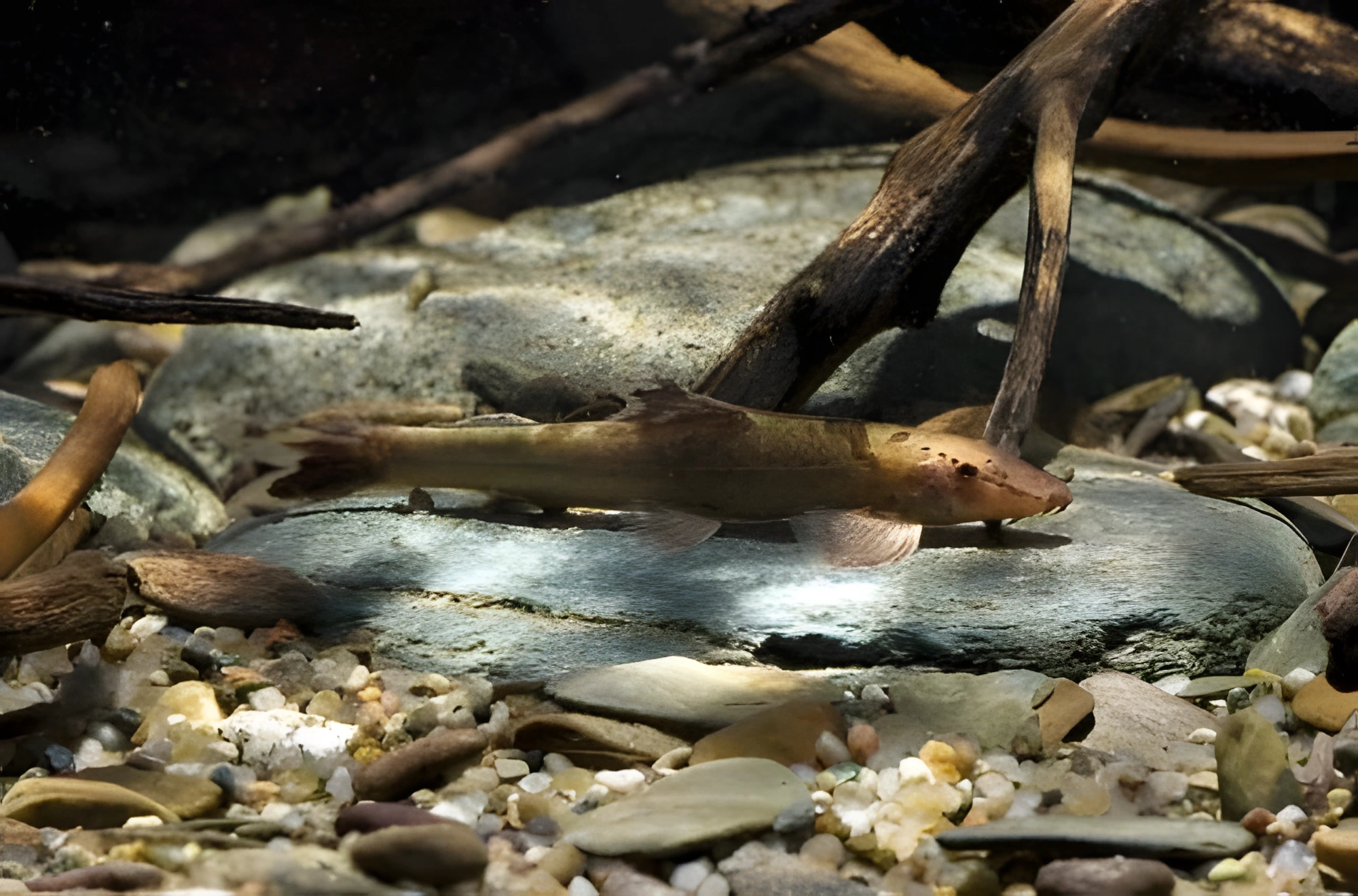
Adults grow to 7–8 cm in length. Their coloration varies from yellowish to reddish-brown, adorned with an ornament of four incomplete dark bands. The first band is located in the pectoral fin area, the second is triangular and found at the base of the dorsal fin. The third band is located above the anal fin, but can sometimes be absent. The last, fourth, band is visible on the caudal peduncle. All Homaloptera species are externally very similar, differing only in details of their body pattern, which often leads to difficulties in their accurate identification.
Habitat
The natural habitat of this species is Southeast Asia, specifically the Mekong River basin in modern-day Cambodia. The fish inhabit mountain streams and small rivers. Their typical biotopes are characterized by fairly fast currents, rocky bottoms, and an abundance of snags. Aquatic vegetation is usually absent in the riverbed itself, preferring to grow along the banks of the water bodies.
Behavior and Compatibility
These fish are peaceful towards each other; no intraspecific conflicts are observed. As they prefer to stay in groups, it is recommended to acquire at least 5–6 individuals. For aquarium companions, choose species that can comfortably exist in similar conditions with active water movement.
Care and Maintenance
For keeping a group of 5–6 fish, an aquarium of at least 100 L is desirable. The aquarium should not be too tall; 30 cm is quite sufficient. For successful long-term keeping of Homaloptera confuzona, it is critically important to provide clean, flowing, oxygen-rich water and to create a moderate or strong current that mimics the conditions of their natural habitat in mountain streams. It is recommended that the water makes 10–15 turnovers per hour; this means that for a 100 L aquarium, an internal filter with a capacity of 1000 L per hour will be required. It is important to remember that maintaining water quality depends not only on the filters but also on regular mandatory aquarium maintenance procedures. These include: weekly replacement of 30–40% of the water volume with fresh water, as well as timely removal of organic waste such as food remnants and excrement. The aquarium decor can be quite simple, including a substrate of stones, boulders, and snags. Although live aquatic plants are not mandatory, if desired, undemanding species such as Anubias, aquatic mosses, and ferns can be used.
Diet
These fish are omnivorous; in nature, they feed on small crustaceans, insect larvae, other invertebrates, and algae that abundantly cover stones and snags. In a home aquarium, their diet should include protein-rich food with essential plant supplements. If the fish are kept in an aquarium with a strong current, the choice of food may be limited, as many foods will be quickly carried away by the current, polluting the water. In such cases, it is preferable to use special gel or paste foods that can be applied directly to decor elements.
Breeding and Reproduction
At the time of preparing this material, the authors could not find reliable data on the successful breeding of Homaloptera confuzona in home aquariums.
Diseases
Health problems in these fish arise only in the presence of injuries or keeping in unsuitable conditions, which leads to a weakening of the immune system and the subsequent occurrence of various diseases. At the first signs of illness, it is necessary first to check the water parameters for exceeding permissible values or the presence of toxic substances (such as nitrites, nitrates, ammonia). If deviations are found, all indicators should be normalized, and then treatment should begin. More detailed information on symptoms and treatment methods is available in the "Diseases of Aquarium Fish" section.
How to choose
When purchasing, caution should be exercised, as this species often arrives in an emaciated state after transport and requires an adaptation period. Avoid individuals with signs of severe emaciation, such as sunken flanks, as well as fish with pale, unpigmented skin areas. It is important to ensure that the seller has pre-quarantined the fish, providing them with suitable conditions with good aeration.
- choose individuals that are active and adhere to surfaces, rather than lying motionless on the bottom;
- acquire a group of 5–6 fish, as solitary keeping causes them stress and reduces immunity;
- carefully inspect the scales for any ulcers, damage, or spots indicative of diseases.
Frequently asked questions
The essentials: size, tank volume, water parameters and care
How big does Homaloptera confuzona get?
An adult reaches 7–8 cm in length. Plan the tank around the maximum size: the fish quickly outgrows a cramped setup.
What size aquarium does Homaloptera confuzona need?
The minimum recommended volume is 100 L. A smaller tank speeds up nitrate build-up and raises stress levels.
What water parameters does Homaloptera confuzona need?
Temperature 20–25 °C, pH 6–7.5, hardness 2–15 dGH. Stability matters more than exact values: sudden swings are harder on the fish than a small deviation from the ideal.
How long does Homaloptera confuzona live?
Around 5 years when kept properly. Lifespan depends directly on tank volume, water quality and a varied diet.
Is Homaloptera confuzona aggressive?
Temperament: peaceful (regular). Keep this in mind when choosing tank mates.
How many Homaloptera confuzona should be kept together?
Recommended setup: small group (5–6 individuals). Ignoring this is a common cause of stress and disease.
What does Homaloptera confuzona eat?
Diet type: any (universal). Feed small portions that are finished within a couple of minutes — overfeeding does more harm than underfeeding.
What is the scientific name of Homaloptera confuzona?
The scientific name of the species is Homaloptera confuzona, family River Loaches (Balitoridae).