Temperature20 – 28 °C
Natural range
- Upper Amazon Basin
- Orinoco River system
- Ecuador area
- Peru area
CharacinsConservation status: Least concern LC
Other scientific names: Chaenotropus punctatus
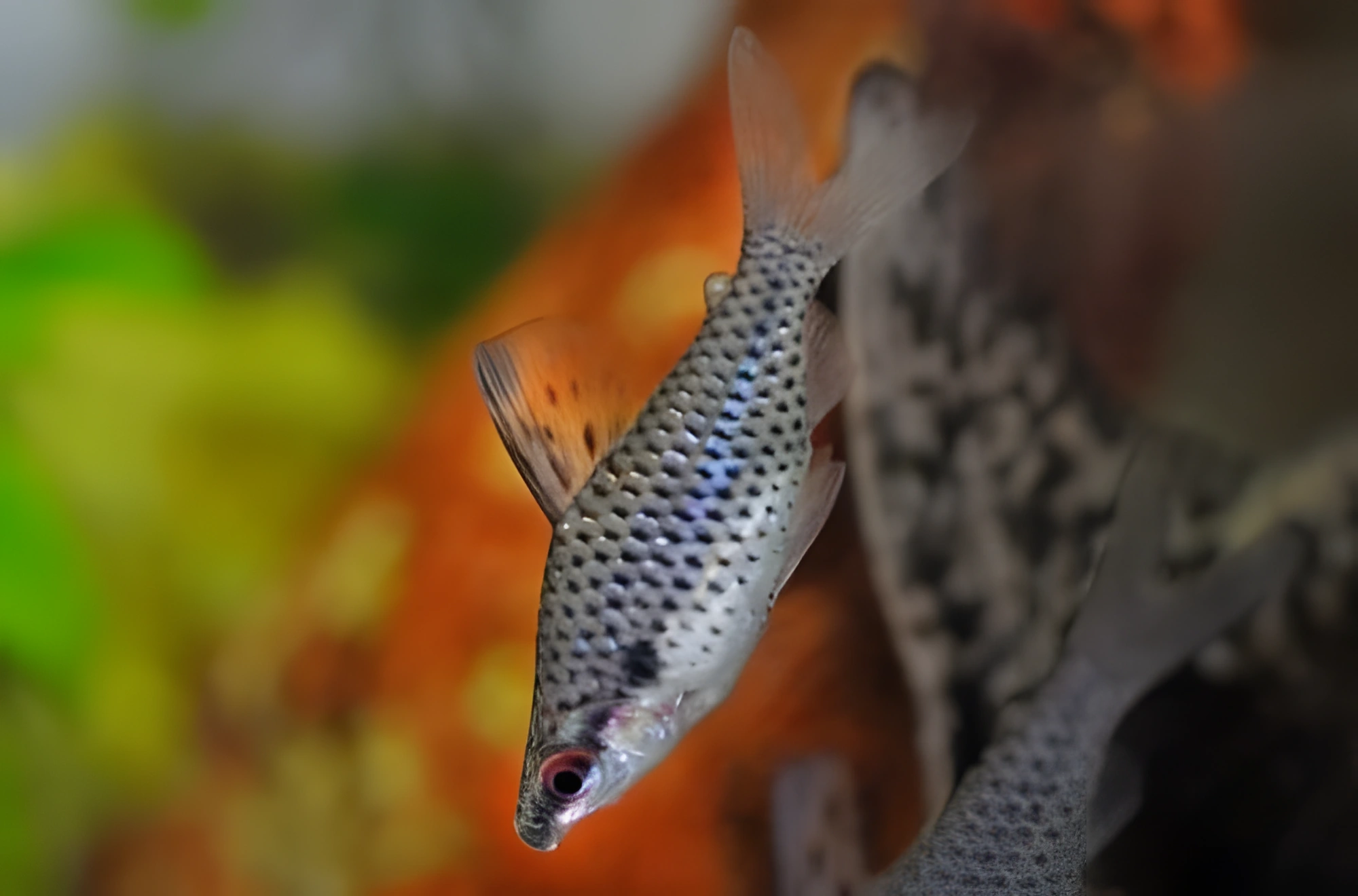
Chilodus, scientifically known as Chilodus punctatus, is a species belonging to the family Chilodontidae. The common name for this fish, literally meaning "headstander," reflects its unique mode of locomotion. Most of the time, the Chilodus spends in an unusual position: its tail is positioned higher than its head, causing its body to assume an inclined rather than horizontal posture.
- Required aquarium volume
- 200 L
- Size in aquarium
- 8 cm
- Temperature
- 20 – 28 °C
- Temperament
- Peaceful (regular)
Parameters
Water pHSlightly acidic (5) – Neutral (7.5)
Water dHVery soft (1) – Medium hardness (10)
Water salinityno salt (freshwater)
Size in aquarium8 cm
Lifespan10 years
TemperamentPeaceful (regular)
Toward small fishnot a predator
Required aquarium volume200 L
Lightingmoderate (regular)
Substratesandy (regular, light)
Water flowweak or moderate
FeedingAny (universal)
CareSchooling (usually from 5–6 individuals and more)
Description
This is an elegant, slender fish with a noticeable rise in its back, which culminates in the dorsal fin. The caudal fin is clearly divided into two lobes. The silvery body coloration is adorned with numerous dark speckles; in the central part, they are most densely arranged, forming a kind of horizontal line. The speckles continue onto the fins, which are usually transparent but sometimes acquire a reddish tint. Sexual dimorphism is weakly expressed. The dorsal fin of males is slightly higher than that of females, while females, in turn, are distinguished by more rounded forms.
Habitat
This fish is widely distributed in the upper reaches of the Amazon River basin, covering the territories of modern-day Ecuador, Peru, and Brazil, and is also found in the Orinoco River system in Colombia. Its habitats include slow-flowing streams, tributaries, rivers, as well as oxbow lakes and flooded forest areas.
Behavior and Compatibility
This is a peaceful but somewhat shy fish that requires calm and non-boisterous tankmates. Chilodus can be kept together with some South American cichlids, Corydoras catfish, and other peaceful Amazonian species. They prefer to stay in shoals of at least 10 individuals; with fewer numbers, especially in the presence of other fish, they may experience excessive stress.
Care and Maintenance
A sufficiently spacious aquarium will be required for a group of fish. A volume of at least 200 liters is recommended if you plan to keep about 10 individuals. In terms of aquascaping, it is important to find a harmonious combination of open swimming areas and dense plantings of aquarium plants, maintaining a ratio of approximately 50/50. The presence of floating plants will be a plus, creating natural shading in the aquarium. Sand is suitable as a substrate. Various shelters should be placed on it: snags, branches, or tree roots. Adding several dried leaves to the bottom of the aquarium helps enrich the water with tannins as they decompose. This also gives the water a slight tint, mimicking the natural habitat conditions of Chilodus. Leaves should be replaced weekly. The water in the aquarium should be soft and slightly acidic, as determined by dGH and pH values. Detailed information on water parameters and methods for their adjustment can be found in the section "Hydrochemical composition of water." Minimal equipment includes an aerator, heater, lighting system, and filtration. Special requirements are placed on filtration: it is advisable to choose the most productive filter that fits your financial capabilities. Peat fillers can be added to the filter. They not only purify the water but also contribute to its acidification.
Diet
The diet for Chilodus should be varied, including both meaty and plant-based components. For example, bloodworms, daphnia, and brine shrimp can be used, supplemented with spirulina flakes, small pieces of cucumber, lettuce leaves, and some types of fruits characteristic of the Upper Amazon. Experimenting with the diet is recommended only for experienced aquarists; for others, specialized, high-quality foods from trusted manufacturers will be the optimal choice.
Breeding and Reproduction
The breeding process for these fish is considered quite troublesome for most aquarists who, despite their love for their pets, are not willing to invest significant time and resources. Before spawning, the largest males and females are placed in separate tanks for 2–3 weeks, where they are fed live food intensively; dry packaged foods are not suitable during this period. They are then combined in a spawning tank — usually a container with a water level of up to 20 cm, which should be soft and acidic. No special decoration is required, but a fine-mesh net is recommended on the bottom to protect the eggs from being eaten. Essential equipment includes a simple sponge filter, an aerator, a low-power lighting system, and a heater. The water temperature is set 2–3 degrees higher than in the main aquarium. The future breeders are placed in the spawning tank in the evening to give them time to acclimate. Spawning may begin the next day, but sometimes a wait is necessary; in such a case, remember to feed them. After a brief courtship, each female lays up to 300 eggs. Without a protective net, the eggs will be eaten! The parents are returned to the main aquarium, and the eggs are transferred to a three-liter jar. The water level is maintained up to 5 cm, a weak aeration is set, and the temperature is kept around 28°C. Fry appear within 4–5 days; their growth is uneven, with some significantly outstripping others, but cannibalism has not been observed.
Diseases
Chilodus are sensitive to water quality, particularly high nitrate content. Under poor keeping conditions, fish often exhibit bacterial fin rot, manifesting as their destruction or decay. To prevent diseases, effective filtration, regular aeration, and weekly partial water changes are necessary. The fish are susceptible to stress, so the presence of dense plant thickets where they can hide is an important condition for maintaining their immunity.
How to choose
When purchasing, choose active fish with clean scales and clear fins without signs of film or damage. Healthy individuals should display typical species behavior: swimming in a shoal, holding their body at an angle with their head down, and actively exploring the bottom or middle layers of the water. Avoid specimens that appear emaciated, stay alone, or have unnatural spots on their body. It is recommended to acquire a group of 10–15 individuals at once, as fish experience severe stress and become extremely timid when alone.
Frequently asked questions
The essentials: size, tank volume, water parameters and care
How big does Chilodus get?
An adult reaches 8 cm in length. Plan the tank around the maximum size: the fish quickly outgrows a cramped setup.
What size aquarium does Chilodus need?
The minimum recommended volume is 200 L. A smaller tank speeds up nitrate build-up and raises stress levels.
What water parameters does Chilodus need?
Temperature 20–28 °C, pH 5–7.5, hardness 1–10 dGH. Stability matters more than exact values: sudden swings are harder on the fish than a small deviation from the ideal.
How long does Chilodus live?
Around 10 years when kept properly. Lifespan depends directly on tank volume, water quality and a varied diet.
Is Chilodus aggressive?
Temperament: peaceful (regular). Keep this in mind when choosing tank mates.
How many Chilodus should be kept together?
Recommended setup: schooling (usually from 5–6 individuals and more). Ignoring this is a common cause of stress and disease.
What does Chilodus eat?
Diet type: any (universal). Feed small portions that are finished within a couple of minutes — overfeeding does more harm than underfeeding.
What is the scientific name of Chilodus?
The scientific name of the species is Chilodus punctatus, family Chilodontidae. It also appears in the literature as: Chaenotropus punctatus.