Temperature24 – 31 °C
Natural range
- New Guinea area
- Wewak-Vanimo area
RainbowfishConservation status: Near threatened NT
Other scientific names: Rhombatractus lorentzii
The Chilatherina rainbowfish, scientifically known as Chilatherina lorentzii, belongs to the family Melanotaeniidae. It became known as an aquarium fish in 2012. Its habitat is the island of New Guinea, located north of Australia. These fish prefer mountain streams and rivers with moderate currents and rocky bottoms. They can be found near submerged snags and other natural shelters.
- Required aquarium volume
- 150 L
- Size in aquarium
- 10 cm
- Temperature
- 24 – 31 °C
- Temperament
- Peaceful (regular)
Parameters
Water pHNeutral (7) – Slightly alkaline (8.4)
Water dHHard (15) – Very hard (20)
Water salinityno salt (freshwater)
Size in aquarium10 cm
Lifespan5 years
TemperamentPeaceful (regular)
Toward small fishnot a predator
Required aquarium volume150 L
Lightingmoderate or bright
Substrateany (no restrictions)
Water flowmoderate
FeedingAny (universal)
CareMedium group (6–8 individuals)
Description
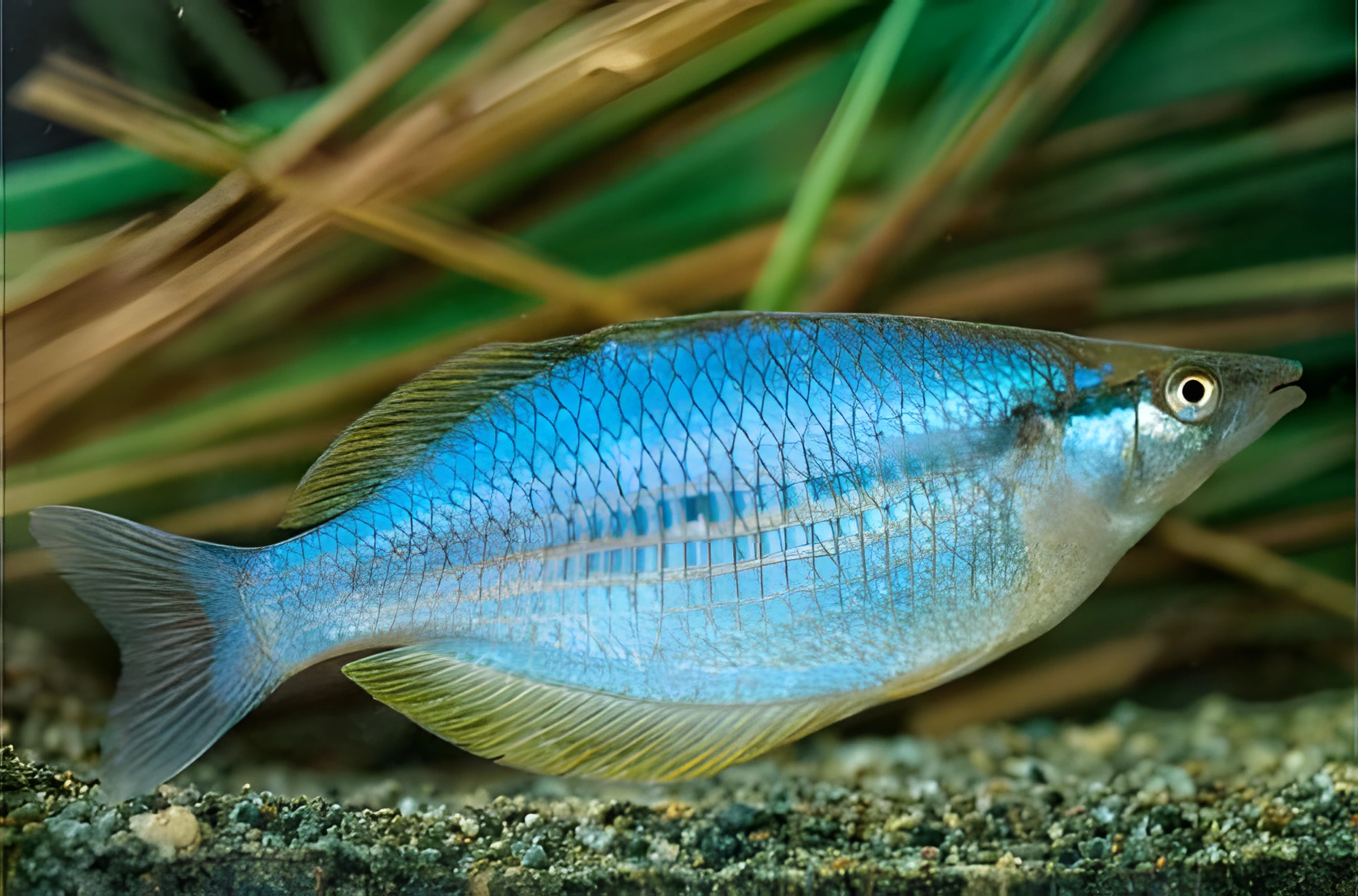
Adults grow to about 10 cm in length. Males have a blue coloration that smoothly transitions to a silvery-blue hue on the belly. Their lateral line is adorned with a distinct dark blue stripe. Females also exhibit blue tones in their coloration, but these are complemented by brownish-green shades on the back. Along the dark blue lateral stripe, females may show yellow streaks. The dorsal, caudal, and anal fins can also have a yellow sheen. For some time, this species was mistakenly considered a variety of the Fasciata Rainbowfish, as they inhabit the same river systems and share a similar appearance.
Habitat
The species inhabits rivers on the northern coast of New Guinea, including the Sermowai and Tawarin river basins in Indonesia, as well as water bodies near Wanim in Papua New Guinea [aquainfo.nl]. The fish populate sections of rivers with slow currents flowing through tropical forests, where the bottom is covered with a layer of fallen leaves [aquainfo.nl]. In their natural habitat, they prefer to stay in deeper areas of water bodies near aquatic vegetation and snags, at water temperatures of 26–30°C and an alkaline environment [fishbase.org].
Behavior and Compatibility
These fish are distinguished by their peaceful and active nature. They feel most comfortable in groups of 6–8 individuals. Chilatherina rainbowfish coexist well with other non-aggressive species of similar size.
Care and Maintenance
For a school of 6–8 fish, the optimal aquarium volume starts from 150 liters. Any composition is acceptable for aquarium decor, the main thing is to provide two different zones: open water for swimming and places for shelter. Natural snags and dense thickets of aquatic plants are perfect for the latter. The fish prefer warm water with medium to high hardness and pH values above neutral. Given that high temperatures are necessary for long-term keeping, it is important to ensure a sufficient amount of dissolved oxygen and regularly maintain the aquarium, preventing the accumulation of organic waste. It is recommended to install an efficient filtration system combined with aeration. Such equipment solves three tasks at once: it maintains low levels of pollution, saturates the water with oxygen, and creates a slight current, imitating the natural conditions of mountain streams. Chilatherina rainbowfish are omnivorous. They readily consume a variety of foods, including live and fresh zooplankton, and can be accustomed to dry foods. Information sources: FishBase, rainbowfish.angfaqld.org.au
Diet
This species is considered omnivorous. These fish accept various foods, including live and fresh zooplankton, and can be quite easily accustomed to dry foods.
Breeding and Reproduction
Based on available sources, a separate block cannot be compiled: the data is insufficient or contradictory. The entry can be updated later when verified information becomes available.
Diseases
Species-specific diseases are not described in the literature, however, as a member of the family Melanotaeniidae, the fish may be susceptible to typical aquarium fish ailments [fishfish.fr]. Common problems include bacterial infections, manifesting as fin damage, and parasitic infestations, accompanied by the appearance of white spots on the body or exophthalmia [fishfish.fr]. Prevention involves maintaining stable water parameters and ensuring quality filtration.
How to choose
The species is rarely found in general sale, as live specimens are extremely seldom collected for aquaristic purposes [aquainfo.nl]. When potentially acquiring, one should assess the fish's overall activity, fin integrity, and the absence of signs of emaciation or skin lesions [fishfish.fr]. It is important to note that any offers for sale require thorough verification of the origin of the specimens due to the rarity of the species and its status in nature.
Frequently asked questions
The essentials: size, tank volume, water parameters and care
How big does Chilatherina rainbowfish get?
An adult reaches 10 cm in length. Plan the tank around the maximum size: the fish quickly outgrows a cramped setup.
What size aquarium does Chilatherina rainbowfish need?
The minimum recommended volume is 150 L. A smaller tank speeds up nitrate build-up and raises stress levels.
What water parameters does Chilatherina rainbowfish need?
Temperature 24–31 °C, pH 7–8.4, hardness 15–20 dGH. Stability matters more than exact values: sudden swings are harder on the fish than a small deviation from the ideal.
How long does Chilatherina rainbowfish live?
Around 5 years when kept properly. Lifespan depends directly on tank volume, water quality and a varied diet.
Is Chilatherina rainbowfish aggressive?
Temperament: peaceful (regular). Keep this in mind when choosing tank mates.
How many Chilatherina rainbowfish should be kept together?
Recommended setup: medium group (6–8 individuals). Ignoring this is a common cause of stress and disease.
What does Chilatherina rainbowfish eat?
Diet type: any (universal). Feed small portions that are finished within a couple of minutes — overfeeding does more harm than underfeeding.
What is the scientific name of Chilatherina rainbowfish?
The scientific name of the species is Chilatherina lorentzii, family Rainbowfishes (Melanotaeniidae). It also appears in the literature as: Rhombatractus lorentzii.