Temperature19 – 29 °C
Natural range
- Mekong River Basin
- Chao Phraya River Basin
- Southeast Asia area
- Cambodia area
Predators CatfishConservation status: Least concern LC
Other scientific names: Macrones wyckioides, Mystus aubentoni, Mystus wyckioides, Mystus wyckoides
The Asian Red-tailed Catfish, known scientifically as Hemibagrus wyckioides, is a member of the Bagridae family (Bagrid Catfishes). This is a very large and aggressive predatory fish, rarely suitable for beginner aquarists.
- Required aquarium volume
- 1000 L
- Size in aquarium
- 100 cm
- Temperature
- 19 – 29 °C
- Temperament
- Aggressive / incompatible / unfriendly
Parameters
Water pHSlightly acidic (6) – Slightly alkaline (8)
Water dHVery soft (1) – Very hard (21)
Water salinityno salt (freshwater)
Size in aquarium100 cm
Lifespan20 years
TemperamentAggressive / incompatible / unfriendly
Toward small fishpredator
Required aquarium volume1000 L
Lightingdimmed
Substrateany (no restrictions)
Water flownone or stagnant (no flow)
FeedingFor carnivores (live fish, insects, etc.)
CareSolitary
Description
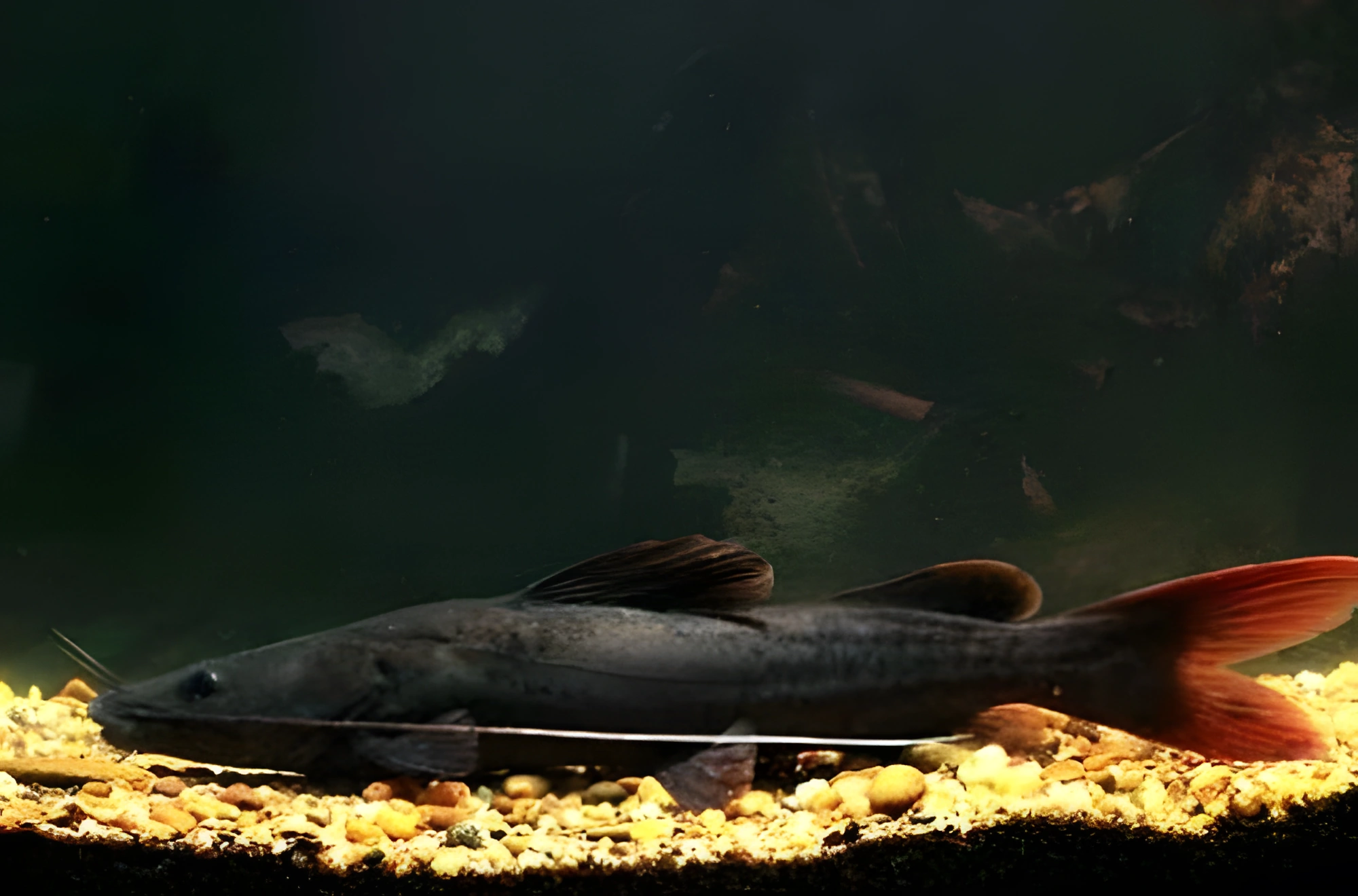
Adults of this species can reach about a meter in length, and their weight sometimes reaches 70–80 kg. The largest recorded specimen was 1.3 meters long. The coloration is usually dark or gray. The fins often have reddish edges, and the caudal fin is entirely red. Young catfish are characterized by a dark gray coloration. Sexual dimorphism is weakly expressed, so males and females are practically indistinguishable externally.
Habitat
The natural habitat of this species covers Southeast Asia. Although some descriptions mention Cambodia as the primary place of origin, this catfish is widespread in the basins of large rivers such as the Mekong and Chao Phraya (Menam Chao Phraya). Consequently, it can be found in the territories of southern China, Laos, Vietnam, Cambodia, and Thailand. These fish prefer the main river channels, including areas with strong currents. During the wet season, they may move to flooded coastal areas of tropical forests.
Behavior and Compatibility
This fish has an aggressive and territorial nature, which makes it incompatible with most other species. Any fish that can fit into its mouth will likely become food for the predator.
Care and Maintenance
Due to its impressive size, the Asian Red-tailed Catfish requires very large aquariums with a volume exceeding 1000 liters. The design of such a tank should mimic the features of a riverbed, i.e., include sandy substrate, piles of stones and boulders, and many snags. Such a large fish produces a significant amount of waste. In addition, food remnants can also be a source of pollution. To maintain a stable balance in the aquarium ecosystem, it is necessary to regularly replace part of the water with fresh water and use high-performance filtration systems. As a rule, all necessary equipment along with communications takes up no less space than the tank itself. The installation and subsequent maintenance of such aquariums require significant financial costs and extensive experience, which is beyond the capabilities of most hobbyists.
Diet
In its natural environment, the Asian Red-tailed Catfish is a predator, and its diet mainly consists of other fish and crustaceans. In aquarium conditions, feeding should correspond to these natural characteristics. Young catfish can eat large earthworms. Feeding is usually done 1–2 times a week. It is important to avoid using animal products such as chicken or beef, as they are poorly digested and can lead to excessive fat deposition and even degeneration of digestive organs in the long term.
Breeding and Reproduction
At the time of writing, there have been no recorded cases of successful breeding of the Asian Red-tailed Catfish in aquarium conditions. On an industrial scale, reproduction is carried out using hormonal injections. In such conditions, the incubation period is 30–38 hours. The hatched fry are only 5 mm long and feed on the yolk sac reserves for the first three days. After approximately one month, young catfish reach a size of 4 cm or more.
Diseases
When kept in favorable conditions, fish rarely experience health deterioration. The occurrence of diseases usually indicates problems in keeping, such as polluted water, poor quality food, or injuries. In most cases, eliminating the root cause leads to recovery. However, sometimes medication may be required. Detailed information on symptoms and treatment methods can be found in the section "Diseases of aquarium fish."
How to choose
When choosing a Red-tailed Hemibagrus, it should be noted that this is an extremely large and aggressive predator requiring specialized keeping conditions. In the store, it is important to assess the physical condition of the specimen: the body should be clean, without visible ulcers, damage, white plaque, or spots on the skin. A healthy fish is active, swims smoothly, and reacts to external stimuli. Avoid specimens that appear emaciated, have a sunken belly, or constantly stay near the water surface, unless this is caused by stress from transportation.
Before purchasing, you must ensure that you have a sufficiently large aquarium, as even young specimens grow quickly. Ask the seller about the fish's current diet and its behavior during feeding — a healthy catfish should show interest in food. Given the territorial nature of the species, only one specimen should be acquired, unless the aquarium is a public or extremely large tank. Check for all fins and the integrity of the barbels, as their damage may indicate poor water quality or aggressive tank mates in the store.
Frequently asked questions
The essentials: size, tank volume, water parameters and care
How big does Red-tailed Hemibagrus get?
An adult reaches 100 cm in length. Plan the tank around the maximum size: the fish quickly outgrows a cramped setup.
What size aquarium does Red-tailed Hemibagrus need?
The minimum recommended volume is 1000 L. A smaller tank speeds up nitrate build-up and raises stress levels.
What water parameters does Red-tailed Hemibagrus need?
Temperature 19–29 °C, pH 6–8, hardness 1–21 dGH. Stability matters more than exact values: sudden swings are harder on the fish than a small deviation from the ideal.
How long does Red-tailed Hemibagrus live?
Around 20 years when kept properly. Lifespan depends directly on tank volume, water quality and a varied diet.
Is Red-tailed Hemibagrus aggressive?
Temperament: aggressive / incompatible / unfriendly. This is a predatory species — any fish small enough to fit in its mouth will eventually be eaten.
How many Red-tailed Hemibagrus should be kept together?
Recommended setup: solitary. Ignoring this is a common cause of stress and disease.
What does Red-tailed Hemibagrus eat?
Diet type: for carnivores (live fish, insects, etc.). Feed small portions that are finished within a couple of minutes — overfeeding does more harm than underfeeding.
What is the scientific name of Red-tailed Hemibagrus?
The scientific name of the species is Hemibagrus wyckioides, family Bagrid Catfishes (Bagridae). It also appears in the literature as: Macrones wyckioides, Mystus aubentoni, Mystus wyckioides.