Temperature23 – 27 °C
Natural range
- Mekong River Basin
- Chao Phraya River Basin
- Mae Klong River Basin
- Thailand area
CyprinidsConservation status: Endangered EN
Other scientific names: Chela caeruleostigmata, Chela mouhoti, Laubuca caeruleostigmata, Laubuca mouhoti
Laubuka caeruleostigmata, also known as the blue-spotted chela, is a member of the carp family (Cyprinidae). This species originates from extensive regions of Southeast Asia, where it inhabits the Mekong and Chao Phraya river basins within Thailand, Cambodia, and Laos. The fish prefers to stay in the upper water layers; it can be found in the main river channels as well as in calmer backwaters and flooded areas of tropical forests during seasonal floods.
- Required aquarium volume
- 120 L
- Size in aquarium
- 7 cm
- Temperature
- 23 – 27 °C
- Temperament
- Peaceful (regular)
Parameters
Water pHSlightly acidic (6.4) – Neutral (7.5)
Water dHVery soft (1) – Hard (12)
Water salinityno salt (freshwater)
Size in aquarium7 cm
Lifespan3 years
TemperamentPeaceful (regular)
Toward small fishnot a predator
Required aquarium volume120 L
Lightingdimmed or moderate
Substrateany (no restrictions)
Water flowweak or moderate
FeedingFloating (protein)
CareMedium group (6–8 individuals)
Description
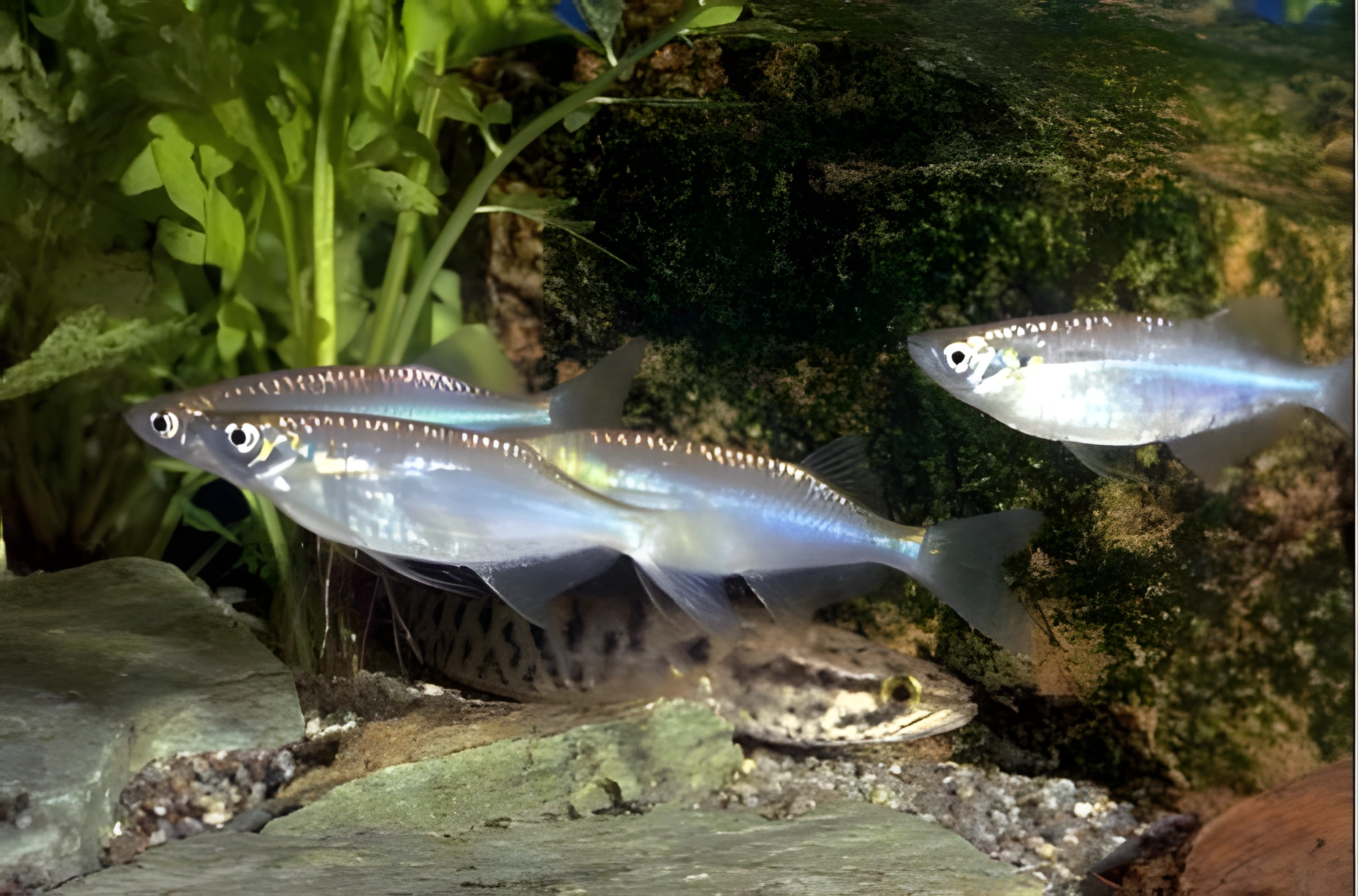
This species reaches a length of about 7 cm in adults. Its body is deep and laterally compressed, which gives it a resemblance to hatchetfish or rainbowfish. The coloration is typically grey-silver or olive, and bluish iridescence and 4 to 5 dark markings are clearly visible on the sides, the most prominent of which is located just behind the gill cover.
Habitat
The species inhabits the Mekong, Chao Phraya, and Mae Klong river systems in Thailand, Laos, and Cambodia. In nature, the fish prefer to stay in schools in the upper water layers of large river channels and their tributaries, often entering flooded forest zones during flood season. They prefer bodies of water with flowing, oxygen-rich water, where they actively hunt insects near the surface.
Behavior and Compatibility
This active fish has a peaceful disposition. It is comfortable in the company of its own kind, so it is recommended to keep them in a school. Alone or in a small group, it can become timid. It coexists well with most other species of similar size and temperament.
Care and Maintenance
For a school of 6–8 blue-spotted chelas, the minimum aquarium volume should be 100–120 L. When setting up the aquarium, key attention should be paid to the upper water layers. It is recommended to place groups of plants that root in the substrate but reach the surface, as well as to use floating plants. However, care should be taken to ensure that floating plants do not overgrow. The blue-spotted chela is prone to jumping out of the water. Although floating plants can serve as a natural barrier, it is advisable to use an aquarium lid in any case. These fish adapt well to a fairly wide range of hydrochemical parameters, which significantly simplifies the water preparation process during regular maintenance.
Diet
In its natural habitat, the diet of the blue-spotted chela consists of small insects it collects from the water's surface. In a home aquarium, it should also be offered protein-rich food. Common dry flake foods will be a good choice. To enrich the daily diet, live or frozen foods such as bloodworms, daphnia, and artemia can be added.
Breeding and Reproduction
Breeding in captivity is difficult and requires specific conditions. To stimulate spawning, the water level in the aquarium is recommended to be lowered to 15 cm, using soft water with a slightly acidic reaction. Fine-leaved plants are used as a spawning substrate. Parents generally do not show pronounced cannibalism towards their own eggs, but successful rearing of fry requires an abundance of live foods, such as Artemia nauplii or rotifers.
Diseases
The fish are extremely sensitive to water quality and the accumulation of organic waste, making them susceptible to bacterial infections if keeping conditions are violated. The main signs of illness are refusal to eat, lethargy, and fin damage. Prevention involves regular water changes, maintaining stable environmental parameters, and ensuring powerful filtration that simulates current. The species does not tolerate high nitrate levels.
How to choose
When purchasing, choose active fish that stay in a school and show interest in food. It is important to avoid individuals with signs of emaciation, scale damage, or unnatural behavior, such as passively hovering near the bottom. Since the species is rarely available for sale, it is necessary to ensure the absence of external parasites and the cleanliness of the aquarium in the store, as transport stress and poor keeping conditions can quickly lead to the death of individuals.
Frequently asked questions
The essentials: size, tank volume, water parameters and care
How big does Blue-spotted Chela get?
An adult reaches 7 cm in length. Plan the tank around the maximum size: the fish quickly outgrows a cramped setup.
What size aquarium does Blue-spotted Chela need?
The minimum recommended volume is 120 L. A smaller tank speeds up nitrate build-up and raises stress levels.
What water parameters does Blue-spotted Chela need?
Temperature 23–27 °C, pH 6.4–7.5, hardness 1–12 dGH. Stability matters more than exact values: sudden swings are harder on the fish than a small deviation from the ideal.
How long does Blue-spotted Chela live?
Around 3 years when kept properly. Lifespan depends directly on tank volume, water quality and a varied diet.
Is Blue-spotted Chela aggressive?
Temperament: peaceful (regular). Keep this in mind when choosing tank mates.
How many Blue-spotted Chela should be kept together?
Recommended setup: medium group (6–8 individuals). Ignoring this is a common cause of stress and disease.
What does Blue-spotted Chela eat?
Diet type: floating (protein). Feed small portions that are finished within a couple of minutes — overfeeding does more harm than underfeeding.
What is the scientific name of Blue-spotted Chela?
The scientific name of the species is Laubuka caeruleostigmata, family Cyprinids (Cyprinidae). It also appears in the literature as: Chela caeruleostigmata, Chela mouhoti, Laubuca caeruleostigmata.