Temperature23 – 28 °C
Natural range
- Lake Malawi area
- East Africa area
CichlidsConservation status: Least concern LC
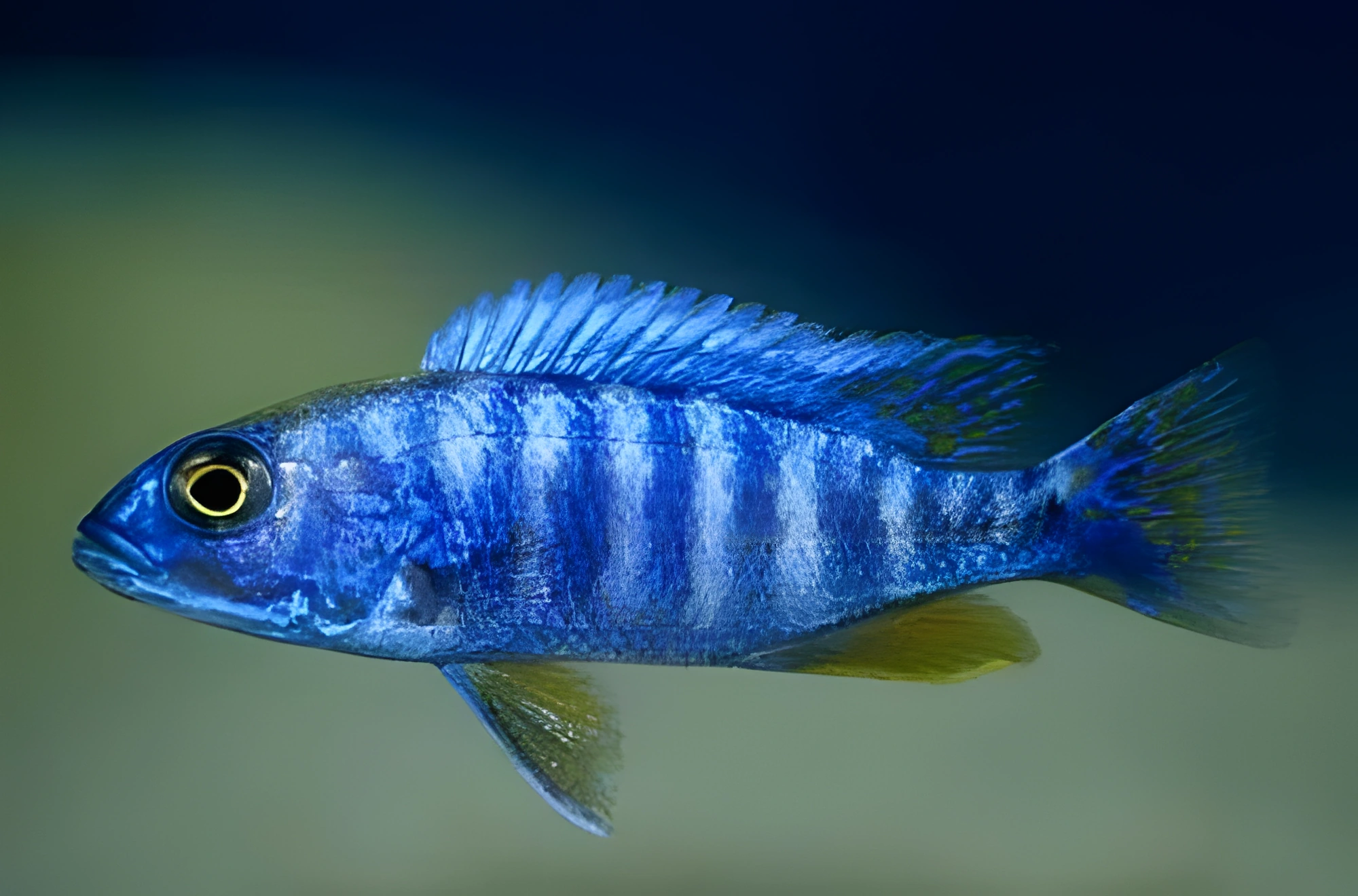
The Electric Blue Hap, known scientifically as Sciaenochromis fryeri, belongs to the Cichlidae family. This is an energetic and brightly colored fish, however, its temperament can be quite complex. For this reason, it is generally not recommended for beginner aquarists.
- Required aquarium volume
- 300 L
- Size in aquarium
- 19 cm
- Temperature
- 23 – 28 °C
- Temperament
- Semi-peaceful (including aggression during spawning / intraspecific conflicts)
Parameters
Water pHNeutral (7.2) – Alkaline (8.8)
Water dHMedium hardness (10) – Very hard (25)
Water salinityno salt (freshwater)
Size in aquarium19 cm
Lifespan10 years
TemperamentSemi-peaceful (including aggression during spawning / intraspecific conflicts)
Toward small fishnot a predator
Required aquarium volume300 L
Lightingmoderate (regular)
Substratesandy (regular, light)
Water flowweak or moderate
FeedingPlant-based (algae, vegetables)
CareHarem (1 male and several females)
Description
There has been some confusion in the history of this fish's identification. Dr. Ernst Ahl is considered the discoverer, having found it in 1926 and named it Haplochromis serranoides. However, it was later found that this name was already in use for another species. Therefore, in 1935, the fish was renamed Haplochromis ahli, honoring its discoverer. Much later, in 1989, as a result of extensive research into the ichthyofauna of African rift lakes, it was decided to transfer this fish from the genus Haplochromis to the genus Sciaenochromis. A few years later, in 1993, ichthyologist Trewavas announced the discovery of a new species of Malawian cichlid – Sciaenochromis fryeri, named after Dr. Geoffrey Fryer, who dedicated himself to studying the fish of Lake Nyasa. Both cichlids are virtually indistinguishable externally and show significant variations in coloration and body pattern, depending on their region of capture. Many researchers have expressed doubt about the validity of Trewavas's discovery, believing that these fish are nothing more than subspecies or geographical variations of the same species. For most aquarists, such scientific discussions are not of great importance, as these fish require identical keeping conditions and have similar habitat requirements. Thus, within the scope of this article, the scientific names Sciaenochromis fryeri and Sciaenochromis ahli are considered synonyms for the Electric Blue Hap when describing its requirements and keeping conditions.
Adults grow up to 20 cm in length. A distinctive feature of this fish is its stocky, elongated body with a relatively large head and large eyes. Several isolated populations have formed in the lake, so the coloration and body pattern can vary significantly depending on the specific habitat. In aquaristics, fish from the eastern part of the lake are most widespread. These specimens have a very bright blue or deep blue coloration with a characteristic metallic sheen. Along the sides of the body, from head to tail, 9–12 short vertical dark stripes are evenly spaced. During the breeding season, these lateral stripes may "dissolve," and the fish acquires a more uniform coloration. All the characteristics listed above mainly apply to males. Females are much smaller (up to 15 cm) and have a predominantly gray, drab, or silvery coloration; only occasionally can hints of a pale blue hue be seen in them. Young specimens, like females, do not have bright coloration.
Habitat
This fish is endemic to Lake Nyasa, one of the largest bodies of water on the African continent. It can be found throughout the lake, primarily in rocky coastal areas, as well as in intermediate sandy areas, at depths of up to 40 meters.
Behavior and Compatibility
Although the Electric Blue Hap can be classified as a predator, it cannot be called an aggressive species. It is quite peaceful towards fish of similar size. However, it should be noted that fry and other small tank mates may be at risk. These fish coexist well with members of the Utaka group, Aulonocara, and other species capable of existing in a similar environment. In large aquariums, cohabitation with territorial Mbuna is permissible. In smaller tanks, it is recommended to maintain a group of one male and several females to minimize intraspecific competition.
Care and Maintenance
For a group of 2–3 Haplochromis electric blue cichlids, aquariums of at least 300 liters will be required. It should be remembered that the width and length of the tank are much more important than its depth. It is important to provide these fish with enough free swimming space, so when decorating the aquarium, the main focus is on the bottom layer. A layer of sandy substrate is usually laid on the bottom, and secure stone or wooden shelters are created from pieces of rock, piles of stones, snags, and the like. The presence of aquatic vegetation is not mandatory. The water in Lake Nyasa is characterized by a high content of dissolved minerals and quite high pH values, which significantly distinguishes it from most freshwater biotopes. A similar environment will need to be recreated and constantly maintained in a home aquarium. High water quality directly depends on the uninterrupted operation of all installed equipment and regular aquarium maintenance. The latter includes weekly partial water changes with fresh water and timely removal of accumulated organic waste – this can be food remnants or excrement.
Diet
In natural conditions, the diet of these fish primarily consists of fry of other Malawian cichlids. However, in a home aquarium, in the absence of such prey, predatory instincts towards smaller individuals weaken. Their diet will consist of any protein-rich foods, such as dry flakes, pellets, as well as frozen or live bloodworms and Artemia.
Breeding and Reproduction
Spawning behavior differs significantly between natural habitats and aquariums. In nature, males meticulously construct sand mounds with a hollow at the top, resembling miniature volcanoes. In aquarium conditions, such constructions are rare. Usually, areas with inclined stones serve as spawning sites, under the base of which small depressions may be dug. After choosing a spot, the male begins to actively court the female, trying to attract her. Sometimes his courtship is so persistent that females are forced to temporarily seek refuge in shelters. During spawning, the female lays up to 70 eggs alternately. The male catches them on his anal fin and fertilizes them, after which the female takes the eggs into her mouth for incubation. The incubation period lasts approximately 3 weeks. From the first days of life, the hatched fry are already able to accept finely crushed dry foods, as well as Artemia nauplii and other similar products.
Diseases
Maintaining fish in suitable conditions minimizes the risk of diseases. Conversely, deviations in the hydrochemical composition of the water, injuries, or inadequate nutrition can lead to immune suppression. A weakened fish organism quickly becomes vulnerable to various diseases. At the first signs of illness, it is necessary to first check (and if necessary, adjust) the living conditions, and only then proceed with treatment. More detailed information on symptoms and treatment methods is presented in the "Aquarium Fish Diseases" section.
How to choose
When purchasing, choose active, mobile individuals with clean bodies free of visible damage, ulcers, film, or bloated bellies. Avoid fish that stay near the surface, appear apathetic, or have sunken bellies, which may indicate chronic diseases or improper nutrition. Given the species' tendency to hybridize, purchase fish from reputable breeders to minimize the risk of obtaining hybrids with atypical coloration or body shape.
Frequently asked questions
The essentials: size, tank volume, water parameters and care
How big does Electric Blue Hap get?
An adult reaches 19 cm in length. Plan the tank around the maximum size: the fish quickly outgrows a cramped setup.
What size aquarium does Electric Blue Hap need?
The minimum recommended volume is 300 L. A smaller tank speeds up nitrate build-up and raises stress levels.
What water parameters does Electric Blue Hap need?
Temperature 23–28 °C, pH 7.2–8.8, hardness 10–25 dGH. Stability matters more than exact values: sudden swings are harder on the fish than a small deviation from the ideal.
How long does Electric Blue Hap live?
Around 10 years when kept properly. Lifespan depends directly on tank volume, water quality and a varied diet.
Is Electric Blue Hap aggressive?
Temperament: semi-peaceful (including aggression during spawning / intraspecific conflicts). Keep this in mind when choosing tank mates.
How many Electric Blue Hap should be kept together?
Recommended setup: harem (1 male and several females). Ignoring this is a common cause of stress and disease.
What does Electric Blue Hap eat?
Diet type: plant-based (algae, vegetables). Feed small portions that are finished within a couple of minutes — overfeeding does more harm than underfeeding.
What is the scientific name of Electric Blue Hap?
The scientific name of the species is Sciaenochromis fryeri, family Cichlidae.