Temperature24 – 27 °C
Natural range
- Lake Malawi area
- Malawi area
- Mozambique area
- Tanzania area
Predators CichlidsConservation status: Least concern LC
Other scientific names: Copadichromis caeruleus, Cyrtocara caeruleus, Haplochromis bellicosus, Haplochromis boultoni, Haplochromis caeruleus, Paratilapia caerulea
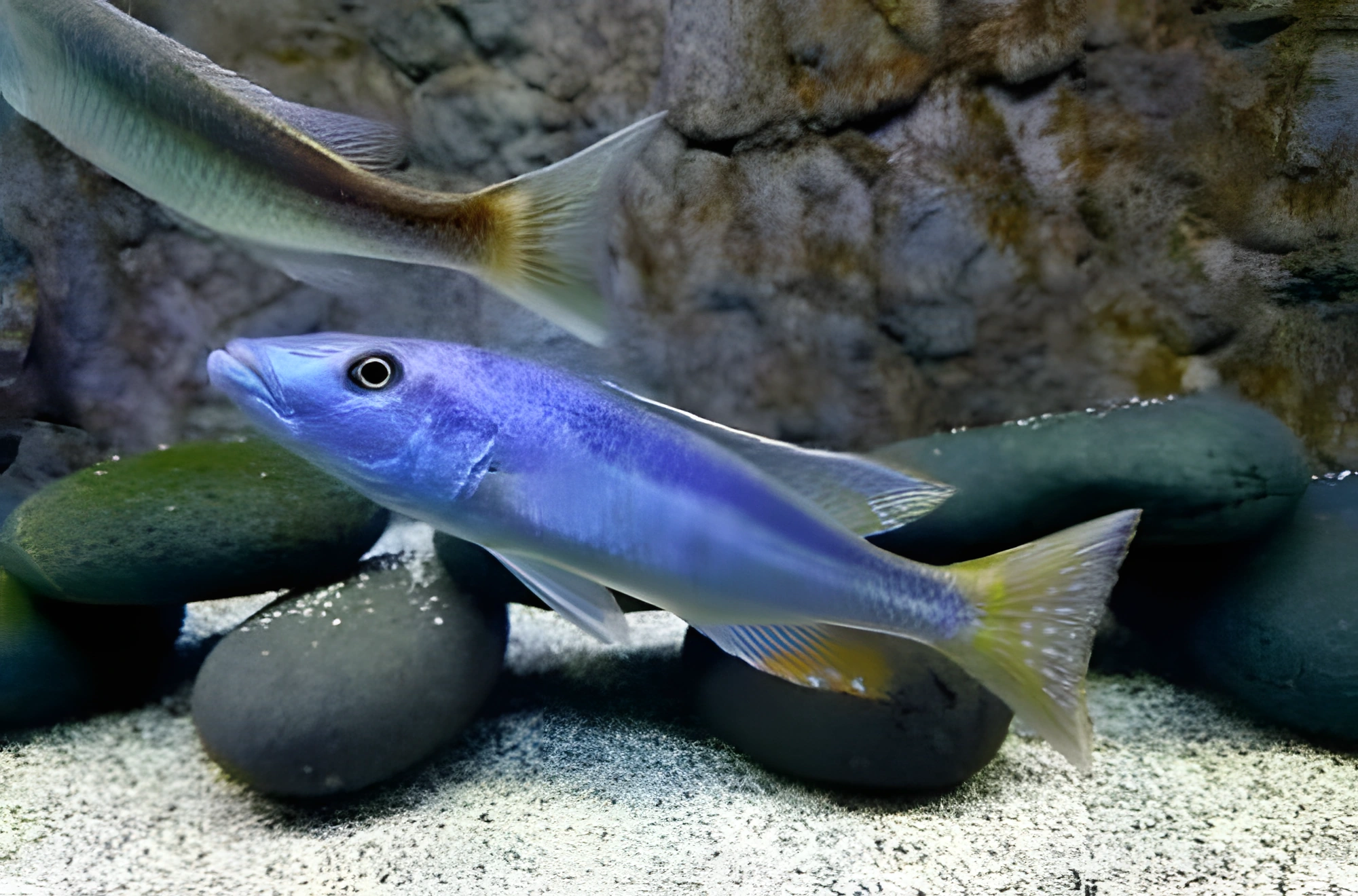
Champsochromis, also known as the Trout Cichlid, bears the scientific name Champsochromis caeruleus and belongs to the family Cichlidae. This species is endemic to Lake Nyasa, formerly known as Lake Malawi. The lake is located in the eastern part of the African continent, in the Great Rift Valley, and its borders touch Malawi, Mozambique, and Tanzania.
- Required aquarium volume
- 400 L
- Size in aquarium
- 32 cm
- Temperature
- 24 – 27 °C
- Temperament
- Semi-peaceful (dangerous to smaller ones)
Parameters
Water pHNeutral (7.5) – Slightly alkaline (8.5)
Water dHMedium hardness (10) – Very hard (30)
Water salinityno salt (freshwater)
Size in aquarium32 cm
Lifespan8 years
TemperamentSemi-peaceful (dangerous to smaller ones)
Toward small fishpredator
Required aquarium volume400 L
Lightingdimmed
Substratesandy (regular, light)
Water flowweak
FeedingMeat / protein (live, frozen, fresh)
CareHarem (1 male and several females)
Description
Adults of this fish can reach up to 32 cm in length. A distinctive feature is their robust, slender body, equipped with large dorsal and anal fins positioned closer to the caudal peduncle. This arrangement allows the fish to make fast and powerful bursts, essential for pursuing prey. Males are larger and exhibit more vibrant coloration, most often a metallic blue. Red or orange speckles may appear on their body and fins, particularly noticeable during the breeding season. Females, in contrast, are more subdued: they are smaller and have a uniform gray coloration, and their fins are significantly shorter.
Habitat
Endemic to Lake Malawi in Africa. In nature, it is found throughout the lake, primarily inhabiting open pelagic areas, as well as zones over sandy or rocky bottoms. It prefers depths of 3 to 15 meters. It is an active predator that often follows schools of small fish in the water column.
Behavior and Compatibility
In its natural environment, Champsochromis is a predator. However, towards other aquarium inhabitants, it behaves peacefully, provided that its tankmates are large enough not to become its prey. Thus, this fish successfully coexists with many large and calm species that also prefer alkaline water. An interesting example of such cohabitation could be Frontosa, a predator from the neighboring Lake Tanganyika. Male Champsochromis tend to exhibit territorial behavior, so it is recommended to keep no more than one male with one or more females in a single aquarium.
Care and Maintenance
For keeping a single pair of fish, the minimum aquarium volume should be about 400 liters. The aquascape can be quite simple: for the Trout Cichlid, the main requirement is ample open swimming space. The aquarium can be decorated using a sandy substrate and forming rock piles on the bottom. For long-term keeping, it is critically important to constantly maintain a stable water chemistry, especially high pH and KH values, corresponding to the lake's conditions. It should be noted that feeding practices can affect these parameters. Fish waste products and uneaten food residues, upon decomposition, acidify the water, leading to changes in pH levels. Moreover, without proper care, dangerous nitrogenous compounds, which are extremely toxic, can accumulate in alkaline water. To prevent water quality deterioration, the aquarium must be equipped with a powerful filtration system and a portion of the water should be replaced weekly with fresh water, combined with siphoning the substrate to remove accumulated waste. In nature, their diet primarily consists of Lake Malawi sardines (Engraulicypris sardella). In aquarium conditions, the fish can be accustomed to alternative foods, eliminating the need to use live fish. Feeding fish meat, shrimp, or mussels is acceptable. Dry foods can also be included in the diet as a source of vitamins and minerals.
Diet
The diet of Champsochromis in nature primarily consists of Lake Malawi sardines (Engraulicypris sardella). In aquarium conditions, these fish can be accustomed to a variety of alternative foods, which avoids the need for live fish. Suitable meat products for feeding include fish, shrimp, and mussels. High-quality dry foods can be used as an additional source of important trace elements and vitamins.
Breeding and Reproduction
This species belongs to mouthbrooding cichlids. Spawning occurs on a sandy substrate, where the male builds a large depression-nest. In an aquarium, it is recommended to keep them in a harem of one male and several females. After fertilization, the female collects the eggs into her mouth and incubates them for 3–4 weeks. Fry, upon leaving the mother's mouth, are quite large and capable of immediately feeding on small foods.
Diseases
The species is susceptible to diseases typical of Malawian cichlids, which arise from improper keeping conditions or stress. The most common are Malawi bloat, bacterial infections, and parasitic infestations (ichthyophthiriasis, skin and gill flukes). Prevention includes regular water changes, maintaining stable environmental parameters, and avoiding overfeeding with protein-rich foods.
How to choose
When purchasing, choose active individuals with clear eyes and intact fins. It is important to assess for any signs of emaciation or a bloated abdomen. Due to the territorial behavior of males and the large size of adult fish, it is recommended to acquire young individuals to form a group. Avoid purchasing fish that show signs of apathy or constantly hide in the corners of the aquarium.
Frequently asked questions
The essentials: size, tank volume, water parameters and care
How big does Champsochromis get?
An adult reaches 32 cm in length. Plan the tank around the maximum size: the fish quickly outgrows a cramped setup.
What size aquarium does Champsochromis need?
The minimum recommended volume is 400 L. A smaller tank speeds up nitrate build-up and raises stress levels.
What water parameters does Champsochromis need?
Temperature 24–27 °C, pH 7.5–8.5, hardness 10–30 dGH. Stability matters more than exact values: sudden swings are harder on the fish than a small deviation from the ideal.
How long does Champsochromis live?
Around 8 years when kept properly. Lifespan depends directly on tank volume, water quality and a varied diet.
Is Champsochromis aggressive?
Temperament: semi-peaceful (dangerous to smaller ones). This is a predatory species — any fish small enough to fit in its mouth will eventually be eaten.
How many Champsochromis should be kept together?
Recommended setup: harem (1 male and several females). Ignoring this is a common cause of stress and disease.
What does Champsochromis eat?
Diet type: meat / protein (live, frozen, fresh). Feed small portions that are finished within a couple of minutes — overfeeding does more harm than underfeeding.
What is the scientific name of Champsochromis?
The scientific name of the species is Champsochromis caeruleus, family Cichlids (Cichlidae). It also appears in the literature as: Copadichromis caeruleus, Cyrtocara caeruleus, Haplochromis bellicosus.