Temperature21 – 28 °C
Natural range
- Indostan Peninsula area
- South Asia area
Labyrinth fish
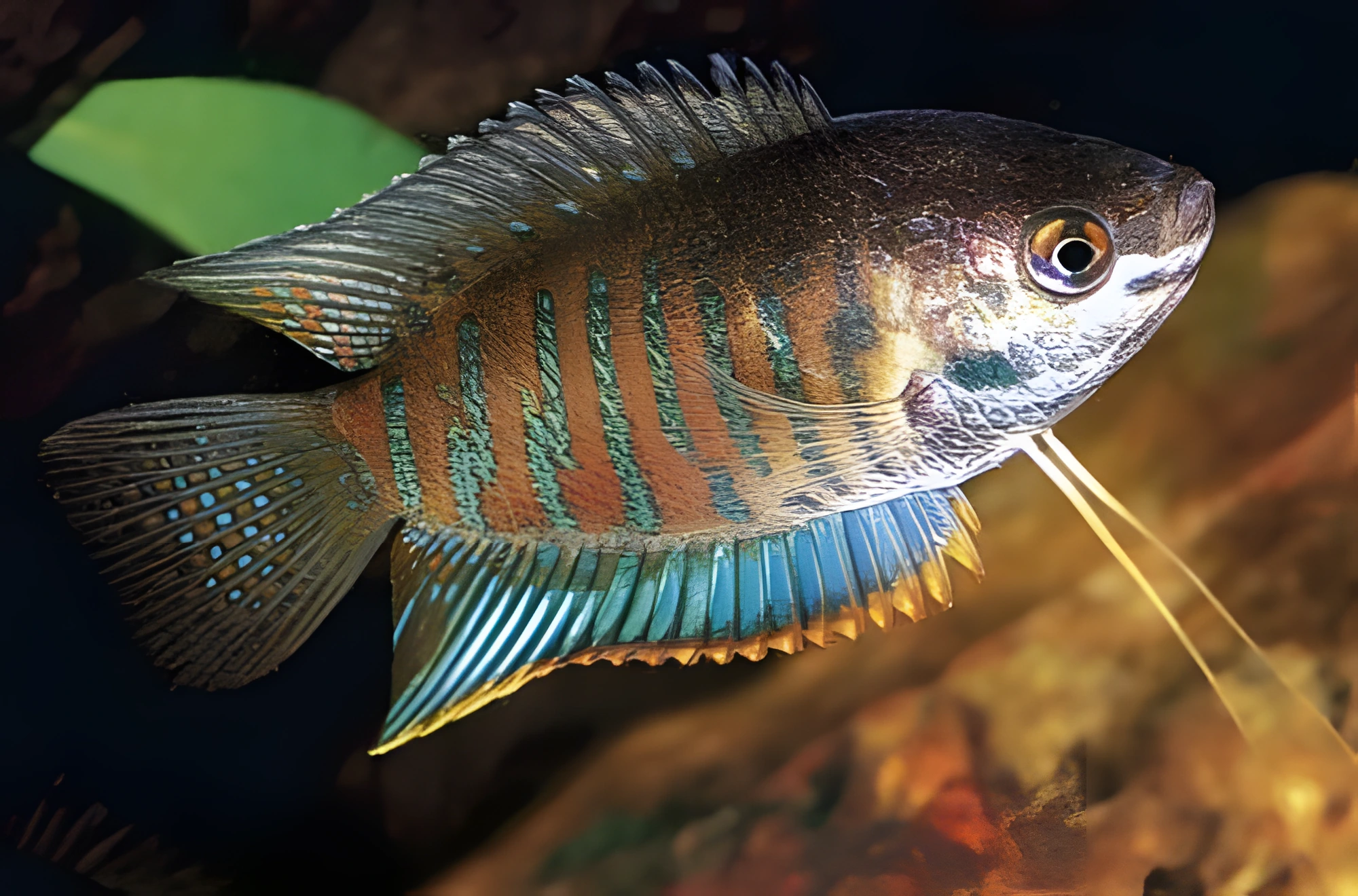
Trichogaster fasciata, also known as the Banded Gourami or Striped Gourami, belongs to the family Osphronemidae. This fish possesses a range of qualities that make it an excellent choice for beginner aquarists: it is undemanding, easy to keep, breeds successfully, and coexists well with other species. Its vibrant coloration adds to its appeal, making the Banded Gourami a wonderful addition to a home aquarium.
- Required aquarium volume
- 70 L
- Size in aquarium
- 10 cm
- Temperature
- 21 – 28 °C
- Temperament
- Peaceful (regular)
Parameters
Water pHSlightly acidic (6) – Neutral (7.5)
Water dHVery soft (1) – Hard (15)
Water salinityno salt (freshwater)
Size in aquarium10 cm
Lifespan5 years
TemperamentPeaceful (regular)
Toward small fishnot a predator
Required aquarium volume70 L
Lightingdimmed
Substrateany, but dark
Water flownone or stagnant (no flow)
FeedingAny (universal)
CareBoth solitary and in group (flexible)
Description
Adult males can reach approximately 10 cm in length; they are distinguished by their bright coloration, which harmoniously combines orange and blue tones. The body pattern consists of diagonal stripes, and the tail and fins have speckles. The fin tips of males are pointed. Females are typically smaller than males and have less pronounced coloration.
Habitat
This species originates from the extensive territories of the Indochinese Peninsula in Southeast Asia. Its natural habitat includes slow-flowing waters with dense floating vegetation; it can also be found in irrigation canals and rice paddies.
Behavior and Compatibility
This species is relatively peaceful, except during the spawning period, when males can exhibit noticeable aggression towards each other. They can be kept individually or in mixed groups (male/female). Schooling, peaceful fish from the characin and carp families are good tank mates. However, cohabitation with a close relative—the Labiosa Gourami—should be avoided to prevent hybrid offspring.
Care and Maintenance
For a single pair of these fish, an aquarium of at least 70 liters is optimal. When setting up the tank, it is recommended to use dense thickets of floating shade-loving plants, as well as a dark substrate and various shelters. Suitable shelters include driftwood, ceramic pots lying on their sides, or decorative elements mimicking sunken ships and castles. It is important to maintain a low light level and use gentle filtration to avoid excessive internal current. Water parameters should be within a neutral pH, with low to medium hardness (dGH). To prevent fish from accidentally jumping out, the aquarium must be equipped with a lid. This also helps maintain a warm, humid air layer above the water surface, which is crucial for the respiration of labyrinth fish. Aquarium care includes regular cleaning of the substrate from organic waste and weekly water changes of 10–15% of the volume with fresh water.
Diet
The Banded Gourami is completely undemanding regarding food and readily accepts most common dry, frozen, and live foods. Maintaining a varied diet, including different types of products, positively affects the intensity of these fish's coloration.
Breeding and Reproduction
It is recommended to conduct spawning in a separate tank. A small aquarium of 30–40 liters, filled only halfway to simulate shallow water, and decorated with numerous floating plants, is suitable for this purpose. The water parameters in it should match the conditions of the main aquarium. Necessary equipment includes a simple air-driven filter, a heater, and a low-power lamp. A lid on the aquarium is mandatory. In artificial conditions, the breeding season can begin regardless of the time of year. Therefore, when some fish become noticeably rounded and others acquire a more intense coloration, this will be a signal to prepare the spawning tank. First, the female is transferred, and the male joins a couple of days later and, as a rule, immediately begins to build a bubble nest among dense vegetation, which can reach 5 cm or more in diameter. Spawning itself is accompanied by special “embraces,” during which eggs and milt are released. The male collects the fertilized eggs and transfers them to the nest. After this, the female no longer participates in caring for the offspring, and she can be returned to the main aquarium. The male remains to guard the clutch and newborn fry during their first days of life until they begin to swim freely in search of food. This takes about 4–5 days, after which he can also be returned to the other fish.
Diseases
The main cause of most diseases in Leaf Fish is unsuitable keeping conditions and poor-quality nutrition. If initial symptoms are observed, it is first necessary to check water parameters and the concentration of dangerous substances such as ammonia, nitrites, and nitrates. If the indicators deviate from the norm, they should be brought back into order, and only then should treatment begin. More detailed information on symptoms and treatment methods can be found in the "Aquarium Fish Diseases" section.
How to choose
When choosing a Banded Gourami in a store, pay attention to the fish's overall activity: healthy individuals should swim in the water column, show curiosity, and not exhibit signs of apathy. Avoid specimens with damaged fins, film on scales, visible ulcers, or an unnaturally swollen abdomen. It is important to check the condition of the eyes—they should be clear, without cloudiness. Given that it is a labyrinth fish, make sure it does not take overly frequent and convulsive breaths at the surface, which may indicate respiratory problems or past stress. Acquire individuals that look well-fed but not emaciated, as fish kept in poor conditions for a long time may be susceptible to hidden infections.
Frequently asked questions
The essentials: size, tank volume, water parameters and care
How big does Banded Gourami get?
An adult reaches 10 cm in length. Plan the tank around the maximum size: the fish quickly outgrows a cramped setup.
What size aquarium does Banded Gourami need?
The minimum recommended volume is 70 L. A smaller tank speeds up nitrate build-up and raises stress levels.
What water parameters does Banded Gourami need?
Temperature 21–28 °C, pH 6–7.5, hardness 1–15 dGH. Stability matters more than exact values: sudden swings are harder on the fish than a small deviation from the ideal.
How long does Banded Gourami live?
Around 5 years when kept properly. Lifespan depends directly on tank volume, water quality and a varied diet.
Is Banded Gourami aggressive?
Temperament: peaceful (regular). Keep this in mind when choosing tank mates.
How many Banded Gourami should be kept together?
Recommended setup: both solitary and in group (flexible). Ignoring this is a common cause of stress and disease.
What does Banded Gourami eat?
Diet type: any (universal). Feed small portions that are finished within a couple of minutes — overfeeding does more harm than underfeeding.
What is the scientific name of Banded Gourami?
The scientific name of the species is Trichogaster fasciata, family Osphronemidae.