Temperature17 – 28 °C
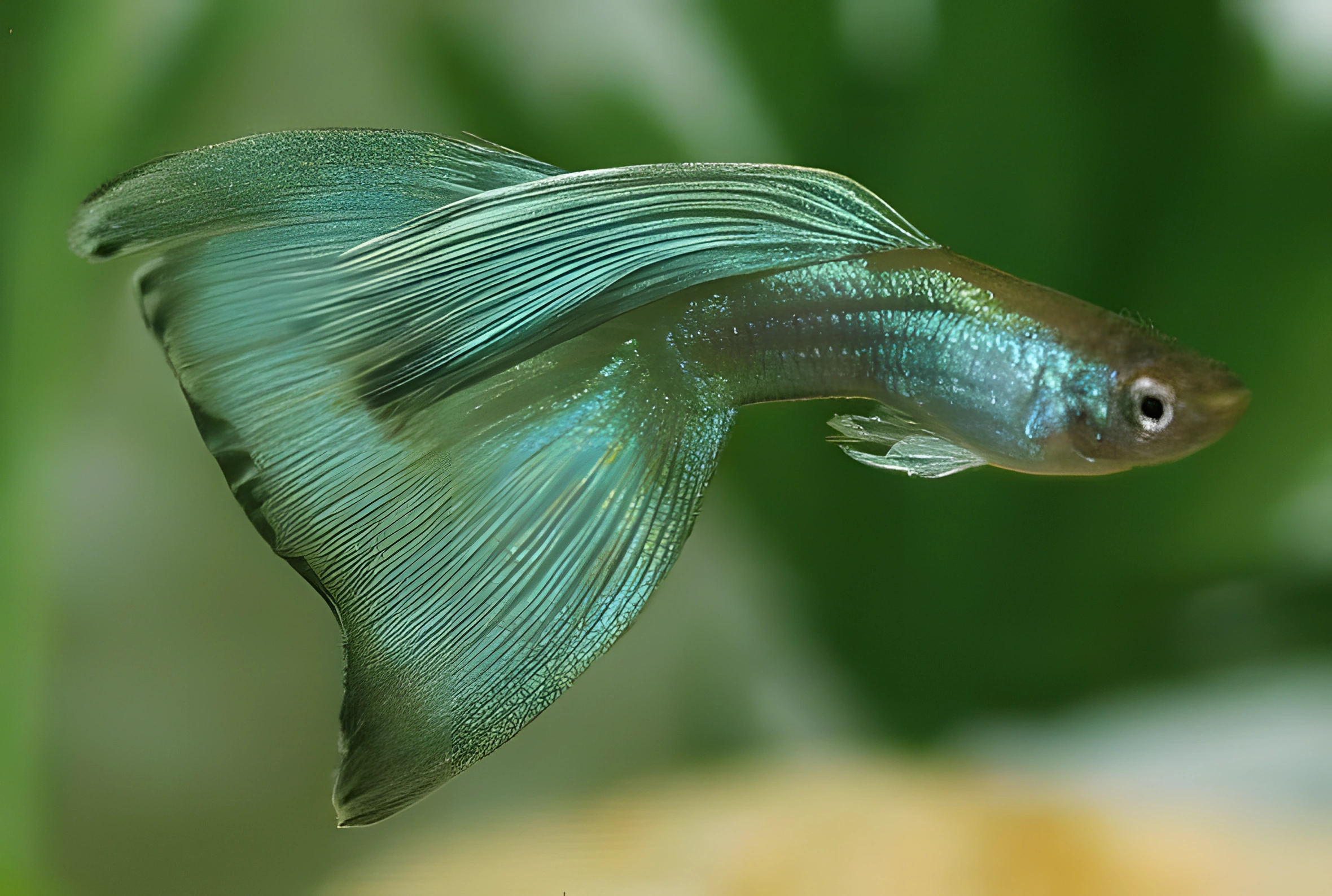
LivebearersConservation status: Least concern LC
Other scientific names: Acanthophacelus guppii, Acanthophacelus reticulatus, Girardinus guppii, Girardinus reticulatus, Haridichthys reticulatus, Heterandria guppyi
Green Guppies, or their scientific name Poecilia reticulata (Green variety), belong to the family Poeciliidae. This name is used as a collective term to denote a number of artificially bred strains that display a dominant green coloration either in the body or in the fins. Such coloration is most often found in Neon Guppy and Moscow Guppy (European sample) strains, and to a lesser extent in Cobra Guppies.
- Required aquarium volume
- 40 L
- Size in aquarium
- 3 – 6 cm
- Temperature
- 17 – 28 °C
- Temperament
- Peaceful (regular)
Parameters
Water pHNeutral (7) – Slightly alkaline (8.5)
Water dHMedium hardness (10) – Very hard (30)
Water salinitylow (3–5 g/L)
Size in aquarium3 – 6 cm
Lifespan3 years
TemperamentPeaceful (regular)
Toward small fishnot a predator
Required aquarium volume40 L
Lightingweak (low)
Substrateany (no restrictions)
Water flowweak or moderate
FeedingAny (universal)
CareMixed (solitary / pair / group)
Description
Green Guppies are a selective variety of Poecilia reticulata, combining strains with a predominance of green pigment in the coloration of the body and fins. Males reach 3–4 cm, are distinguished by a bright metallic sheen and well-developed fins, the shape of which varies from fan-shaped to veil-like. Females are larger, growing up to 5–6 cm, have a more modest coloration and a rounded abdomen.
Habitat
In nature, wild guppies inhabit fresh and brackish waters of Central and South America, as well as the Caribbean. They prefer areas with dense vegetation and slow currents. Green forms are the result of artificial selection and are not found in natural conditions.
Behavior and Compatibility
These are peaceful, schooling fish, suitable for community tanks. Males may show intraspecific competition, displaying their fins to each other, but without causing injuries. They are compatible with most peaceful species of comparable size. When kept with aggressive or very active fish, there is a risk of their long fins being nipped.
Care and Maintenance
For successful keeping of Green Guppies, the key factors are tank cleanliness, peaceful tankmates, and a well-balanced diet. These requirements, universal for most aquarium fish, require a more detailed understanding.
Due to their modest size and unpretentiousness to environmental conditions, Guppies can live in a relatively small aquarium, equipped with a minimal set of equipment, provided regular care. This care includes timely removal of organic residues, be it uneaten food or excrement, as well as weekly partial water changes with fresh water, possibly more often. If the number of inhabitants does not exceed 2–3 fish per 10 liters, a simple airlift filter can be used. However, with denser stocking, a full-fledged internal or external filter will be required. The water preparation process usually does not cause difficulties, as Guppies show high adaptability to a wide range of hydrochemical parameters. Often it is enough to let the water stand before pouring it into the aquarium.
As for feeding, the daily diet can consist exclusively of dry foods, but it is important to ensure that they contain all the necessary vitamins and trace elements. Specialized foods developed for this type of fish will be an excellent choice. It is also desirable to introduce frozen and live foods into the diet, such as Artemia, bloodworms, or daphnia.
Aqvium flake food for aquarium fish. Check out our new product, which has become a bestseller on Ozon with a rating of 4.9. Flake food is suitable for most aquarium fish. The raw materials are produced in accordance with the new standards of the European Union (EU 2018/848). The product contains vitamins A, C, D3, E and Omega 3-6. Buy on Ozon.
In terms of behavior, these fish are distinguished by a peaceful disposition. Although males compete for the attention of females, this usually does not lead to serious skirmishes. Their "display of strength" is limited to spreading their fins and swimming slowly opposite each other. Guppies get along well with most other species of comparable size, more details of which can be found in a separate article.
Diet
Omnivorous species. In the aquarium, they accept all types of dry, frozen, and live foods. To maintain bright coloration and health, it is recommended to diversify the diet, including plant supplements. Feed small portions several times a day to avoid overeating and water pollution.
Breeding and Reproduction
Live-bearing fish, whose reproduction does not require special conditions. Fertilization occurs inside the female, after which she gives birth to fully formed fry. To preserve the offspring, it is recommended to use dense plant thickets or to move the pregnant female to a separate aquarium, as adult individuals tend to eat the fry.
Diseases
The species is hardy, but with poor water quality, it is susceptible to typical diseases such as ich and fin rot. The key factor in prevention is maintaining cleanliness in the aquarium, regular water changes, and a balanced diet. They are sensitive to sharp changes in hydrochemical parameters.
How to choose
When purchasing, choose active individuals with clean fins without signs of plaque or damage. Avoid fish with clamped fins, sluggish behavior, or an unnaturally swollen abdomen. It is recommended to purchase individuals from a single source to reduce the risk of infection.
Frequently asked questions
The essentials: size, tank volume, water parameters and care
How big does Green Guppies get?
An adult reaches 3–6 cm in length. Plan the tank around the maximum size: the fish quickly outgrows a cramped setup.
What size aquarium does Green Guppies need?
The minimum recommended volume is 40 L. A smaller tank speeds up nitrate build-up and raises stress levels.
What water parameters does Green Guppies need?
Temperature 17–28 °C, pH 7–8.5, hardness 10–30 dGH. Stability matters more than exact values: sudden swings are harder on the fish than a small deviation from the ideal.
How long does Green Guppies live?
Around 3 years when kept properly. Lifespan depends directly on tank volume, water quality and a varied diet.
Is Green Guppies aggressive?
Temperament: peaceful (regular). Keep this in mind when choosing tank mates.
How many Green Guppies should be kept together?
Recommended setup: mixed (solitary / pair / group). Ignoring this is a common cause of stress and disease.
What does Green Guppies eat?
Diet type: any (universal). Feed small portions that are finished within a couple of minutes — overfeeding does more harm than underfeeding.
What is the scientific name of Green Guppies?
The scientific name of the species is Poecilia reticulata (разновидность Green), family Poeciliidae. It also appears in the literature as: Acanthophacelus guppii, Acanthophacelus reticulatus, Girardinus guppii.