Temperature17 – 28 °C
Natural range
- Venezuela area
- Guyana area
- Suriname area
- French Guiana area
LivebearersConservation status: Least concern LC
Other scientific names: Acanthophacelus guppii, Acanthophacelus reticulatus, Girardinus guppii, Girardinus reticulatus, Haridichthys reticulatus, Heterandria guppyi
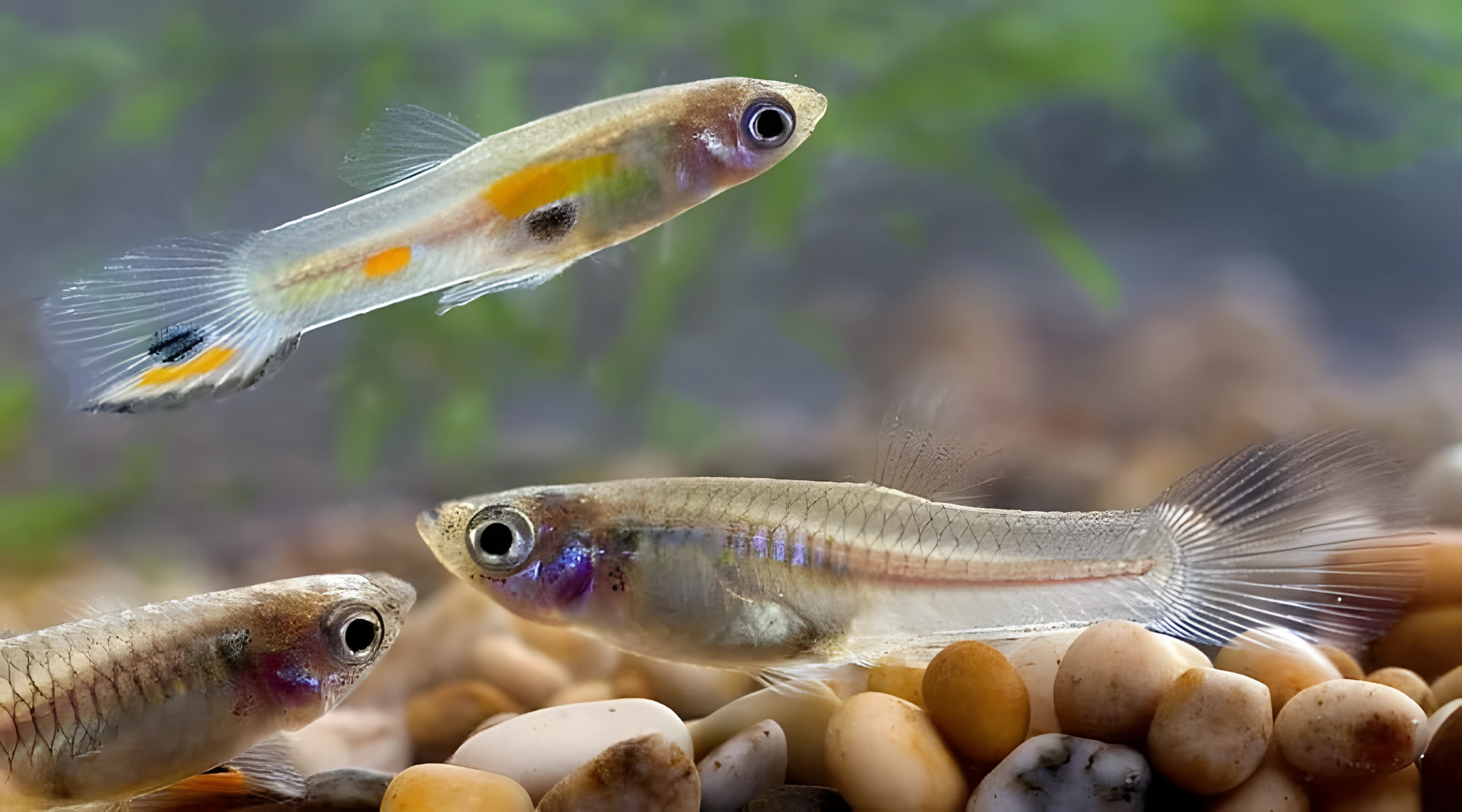
The Common Guppy, also known as the Wild Guppy (scientific name Poecilia reticulata), belongs to the family Poeciliidae. It is distinguished from the numerous selective breeding forms developed by humans by its more modest coloration, characteristic of wild populations. Consequently, it is not as frequently encountered among aquarists.
- Required aquarium volume
- 40 L
- Size in aquarium
- 3 – 6 cm
- Temperature
- 17 – 28 °C
- Temperament
- Peaceful (regular)
Parameters
Water pHNeutral (7) – Slightly alkaline (8.5)
Water dHMedium hardness (10) – Very hard (30)
Water salinitylow (3–5 g/L)
Size in aquarium3 – 6 cm
Lifespan3 years
TemperamentPeaceful (regular)
Toward small fishnot a predator
Required aquarium volume40 L
Lightingweak (low)
Substrateany (no restrictions)
Water flowweak or moderate
FeedingAny (universal)
CareMixed (solitary / pair / group)
Description
Adults reach a length of 3 to 6 cm. Males are smaller and more slender, their coloration includes orange, turquoise, and black spots. Females, on the other hand, are larger, their bodies are uniformly gray, and their bellies have a prominent silvery hue.
Habitat
Originally, these fish inhabited waters in the northeastern part of South America, including Venezuela, Guyana, Suriname, and French Guiana, as well as island nations in the southern Caribbean, such as Trinidad and Tobago, Barbados, and Antigua and Barbuda. Now their habitat range has expanded significantly: the fish have been introduced to many other countries, including European ones, to combat mosquito larvae. These inhabitants prefer shallow waters densely overgrown with aquatic vegetation and can be found in a wide variety of biotopes — from flowing forest streams to murky tropical swamps and brackish river estuaries.
Behavior and Compatibility
The Common Guppy is a peaceful and calm fish. It coexists well with many other species of similar size and temperament, making it suitable for a community tank.
Care and Maintenance
The minimum recommended aquarium volume for a group of 3–5 Common Guppies is 40 liters. However, these fish are often successfully kept in much smaller tanks; for example, a pair can adapt well to life even in a three-liter jar. Although aquarium decor is not critically important, it is advisable to provide several shelters in the form of dense plant thickets. These will become a refuge for fry, whose appearance is inevitable when adult males and females are present. Guppies adapt well to various conditions and can even live in brackish water. With regular aquarium maintenance and a small number of individuals, long-term keeping is possible without a heater or filtration system.
Diet
These fish readily accept most common foods of appropriate size — both dry and frozen or live. Aqvium flake food for aquarium fish is specially developed for most aquarium fish. Check out our new product, which has become a bestseller on Ozon and has a rating of 4.9. The raw materials for its production comply with new European Union standards (EU 2018/848), and its composition is enriched with vitamins A, C, D3, E, and Omega 3-6. You can purchase it on Ozon.
Breeding and Reproduction
For fry to appear, only one condition is sufficient — the presence of a female and a male, as they successfully reproduce on their own. Fry appear regularly. Due to poorly developed parental instincts, juveniles can become prey for adult fish, so it is recommended to timely transfer the offspring to a separate tank.
Diseases
This species is considered one of the most resilient even among all Guppy varieties. Diseases occur quite rarely, mainly in neglected aquariums, due to injuries, or through contact with already sick fish.
How to choose
When purchasing, choose active and mobile individuals that show interest in food. Avoid fish with clamped fins, film on the body, spots, or signs of emaciation. A healthy guppy should have clean, transparent fins without signs of damage or 'clumping'.
- Inspect the aquarium in the store: the presence of dead or clearly sick fish in adjacent tanks is a reason to refuse the purchase.
- Choose individuals with bright, clean coloration appropriate for their sex and age.
- Avoid fish with an unnaturally bloated or, conversely, severely sunken belly, which may indicate internal diseases.
Frequently asked questions
The essentials: size, tank volume, water parameters and care
How big does Common Guppy get?
An adult reaches 3–6 cm in length. Plan the tank around the maximum size: the fish quickly outgrows a cramped setup.
What size aquarium does Common Guppy need?
The minimum recommended volume is 40 L. A smaller tank speeds up nitrate build-up and raises stress levels.
What water parameters does Common Guppy need?
Temperature 17–28 °C, pH 7–8.5, hardness 10–30 dGH. Stability matters more than exact values: sudden swings are harder on the fish than a small deviation from the ideal.
How long does Common Guppy live?
Around 3 years when kept properly. Lifespan depends directly on tank volume, water quality and a varied diet.
Is Common Guppy aggressive?
Temperament: peaceful (regular). Keep this in mind when choosing tank mates.
How many Common Guppy should be kept together?
Recommended setup: mixed (solitary / pair / group). Ignoring this is a common cause of stress and disease.
What does Common Guppy eat?
Diet type: any (universal). Feed small portions that are finished within a couple of minutes — overfeeding does more harm than underfeeding.
What is the scientific name of Common Guppy?
The scientific name of the species is Poecilia reticulata, family Poeciliidae. It also appears in the literature as: Acanthophacelus guppii, Acanthophacelus reticulatus, Girardinus guppii.