Temperature17 – 28 °C
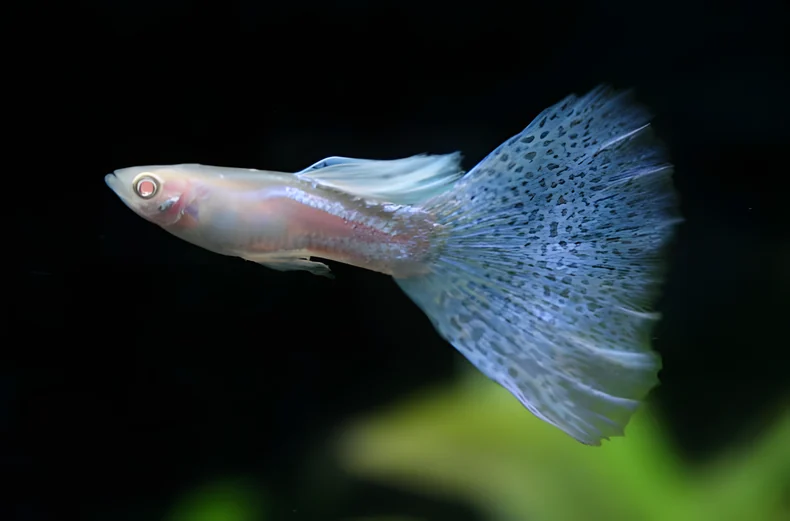
variety Albino
Other scientific names: Acanthophacelus guppii, Acanthophacelus reticulatus, Girardinus guppii, Girardinus reticulatus, Haridichthys reticulatus, Heterandria guppyi
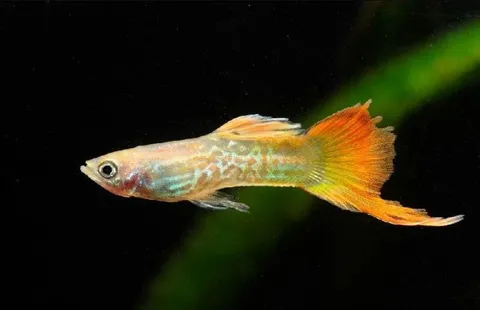
The Albino Guppy, belonging to the Poeciliidae family, is known by its scientific name Poecilia reticulata (Albino variety). A distinctive feature of this fish is the congenital absence of melanin – the black pigment in its body coloration, which also manifests in its red eyes. It is important to note that albino fish are not always purely white; their coloration can be extremely diverse, combining many colors and shades. For this reason, additional designations such as 'platinum' or 'red' are often found in their names. Varieties with well-developed veil fins are particularly popular. Males are generally smaller than females but are more graceful and brightly colored.
Albino Guppies are a selectively bred form characterized by a complete absence of black pigment (melanin) in their bodies, which gives them their specific appearance: red eyes and a light, often translucent body coloration. Despite the name, they are not always purely white and can display diverse color combinations, including platinum, red, and other shades. Males are usually smaller than females, with a more graceful build and developed veil fins.
In nature, Poecilia reticulata inhabits fresh and brackish waters of northeastern South America and the Caribbean islands. Albino forms are the result of artificial selection and are virtually non-existent in the natural environment, as the lack of pigmentation makes them vulnerable to predators. In an aquarium, they prefer stable conditions with a temperature of 17–28 °C, pH 7.0–8.5, and hardness of 10–30 dGH.
These are peaceful and active fish that prefer to stay in groups, although they are not strictly schooling. They get along well with other calm species of comparable size. It is not recommended to keep them with aggressive fish or species prone to fin-nipping, as the long, veiled tails of albinos become an easy target. Due to the absence of melanin, these fish often have weakened eyesight, which makes it difficult for fry to find shelter.
This fish is known for its unpretentiousness and high endurance. It can successfully live even in small aquariums that do not require heating or complex decor. For successful and long-term keeping, key factors include maintaining high water quality, providing a balanced diet, and proper selection of tank mates. Weekly partial water changes with fresh water, prompt removal of organic waste such as uneaten food and excrement, and stable filtration all ensure the well-being of the aquatic environment. If the aquarium is spacious enough and the number of inhabitants is small, filtration can be omitted, provided thorough regular maintenance. If a sexually mature male and female are kept in the aquarium, fry will appear regularly. To protect them from predation by adult fish, it is recommended to move the fry to a separate tank. Typically, fry hide in dense plant thickets to avoid dangerous encounters; however, Albino Guppies have weakened eyesight (due to the absence of melanin), especially at a young age, making it difficult for them to find reliable shelter. Regarding feeding, it is recommended to use foods that enhance fish coloration. The daily diet can consist of dry foods – flakes, granules, pellets – as well as live or frozen brine shrimp, bloodworms, daphnia, mosquito larvae, and others. Fish prefer to stay in groups but are not schooling. They can be kept individually or in pairs. They are compatible with many other fish species of comparable size and temperament. It is highly undesirable to keep them with overly active species or those prone to fin-nipping, such as some barbs. Keeping them with other Guppy breeds can lead to hybrid offspring.
Guppies are omnivorous and undemanding regarding their diet. In the aquarium, they accept all types of food: dry flakes, granules, as well as live or frozen foods such as brine shrimp, bloodworms, and daphnia. To maintain vibrant coloration, it is recommended to use specialized foods with carotenoids. Feeding should be balanced and regular, and portions should be limited to avoid water pollution from food remnants.
Reproduction occurs through ovoviviparity, making the process accessible even for beginners. The female carries the offspring internally for about 3–4 weeks, after which fully formed fry are born. Due to the poor eyesight of albino fry and the tendency of adult fish towards cannibalism, dense plant thickets or isolating the pregnant female in a separate aquarium are recommended to preserve the offspring.
Like other selectively bred guppy forms, albinos can be more sensitive to water quality and stress factors than their wild counterparts. Spinal problems, such as scoliosis caused by inbreeding, are not uncommon. Prevention of diseases includes weekly partial water changes, maintaining effective filtration, and avoiding overpopulation of the aquarium.
When purchasing, choose active fish with clean fins, free from signs of rot or damage. Special attention should be paid to posture: fish with a curved spine (humpbacked) have genetic defects and are prone to premature death. Healthy individuals should show interest in food and have no cloudy eyes or white spots on their bodies.
The essentials: size, tank volume, water parameters and care
An adult reaches 3–6 cm in length. Plan the tank around the maximum size: the fish quickly outgrows a cramped setup.
The recommended volume is 40 L. A smaller tank speeds up nitrate build-up and raises stress levels.
Temperature 17–28 °C, pH 7–8.5, hardness 10–30 dGH. Stability matters more than exact values: sudden swings are harder on the fish than a small deviation from the ideal.
Around 3 years when kept properly. Lifespan depends directly on tank volume, water quality and a varied diet.
Temperament: peaceful (regular). Keep this in mind when choosing tank mates.
Recommended setup: mixed (solitary / pair / group). Ignoring this is a common cause of stress and disease.
Diet type: any (universal). Feed small portions that are finished within a couple of minutes — overfeeding does more harm than underfeeding.
The scientific name of the species is Poecilia reticulata, family Poeciliidae. It also appears in the literature as: Acanthophacelus guppii, Acanthophacelus reticulatus, Girardinus guppii.
Matched by family, categories and overlapping keeping conditions
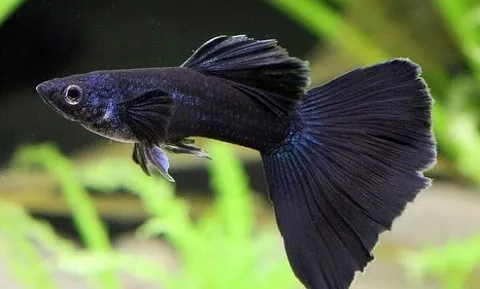
Poecilia reticulata
Black Monk Guppies, also known as Black Guppies, are a breed of Poecilia reticulata (Black strain) from the Poeciliidae family. One of the main features of this variety is the pronounced dark body coloration in males.…
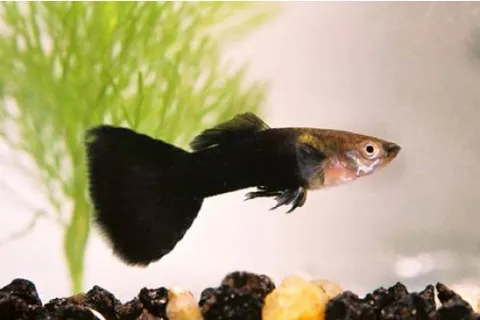
Poecilia reticulata
The Guppy 'Black Prince', also known as the Half Black Guppy with the scientific name Poecilia reticulata (Half Black subspecies), is a member of the Poeciliidae family. This designation likely encompasses several…
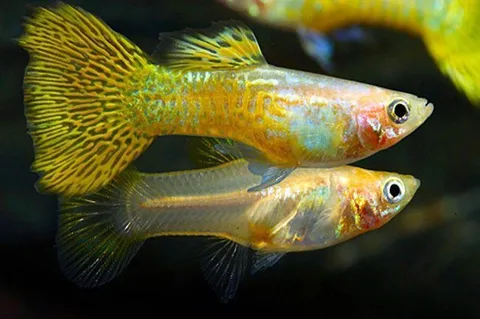
Poecilia reticulata
The Cobra Guppy, scientifically known as Poecilia reticulata (Cobra variety), belongs to the family Poeciliidae. Its distinctive feature is a pattern of vertical stripes running along the posterior part of its body. The…
Poecilia reticulata
Swordtail Guppies (scientific name Poecilia reticulata, Swordtail variety) belong to the Poeciliidae family. A distinctive feature, which gave these fish their name, is the special structure of the caudal fin. It has…