Temperature20 – 27 °C
Natural range
- Malay Peninsula area
- Sumatra area
CatfishConservation status: Least concern LC
Other scientific names: Kryptopterus micropus, Silurus cryptopterus
The Blue Glass Catfish, also known as the Smoky Glass Catfish (scientific name Kryptopterus cryptopterus), belongs to the family Siluridae. Despite being a miniature predator, it is undemanding to keep and gets along well with similarly sized large fish species, making it relatively easy to care for.
- Required aquarium volume
- 150 L
- Size in aquarium
- 14 cm
- Temperature
- 20 – 27 °C
- Temperament
- Peaceful (regular)
Parameters
Water pHSlightly acidic (6) – Neutral (7.5)
Water dHVery soft (2) – Hard (15)
Water salinityno salt (freshwater)
Size in aquarium14 cm
Lifespan7 years
TemperamentPeaceful (regular)
Toward small fishnot a predator
Required aquarium volume150 L
Lightingdimmed
Substrateany (no restrictions)
Water flownone or stagnant (no flow)
FeedingSinking (any)
CareSmall group (3–4 individuals)
Description
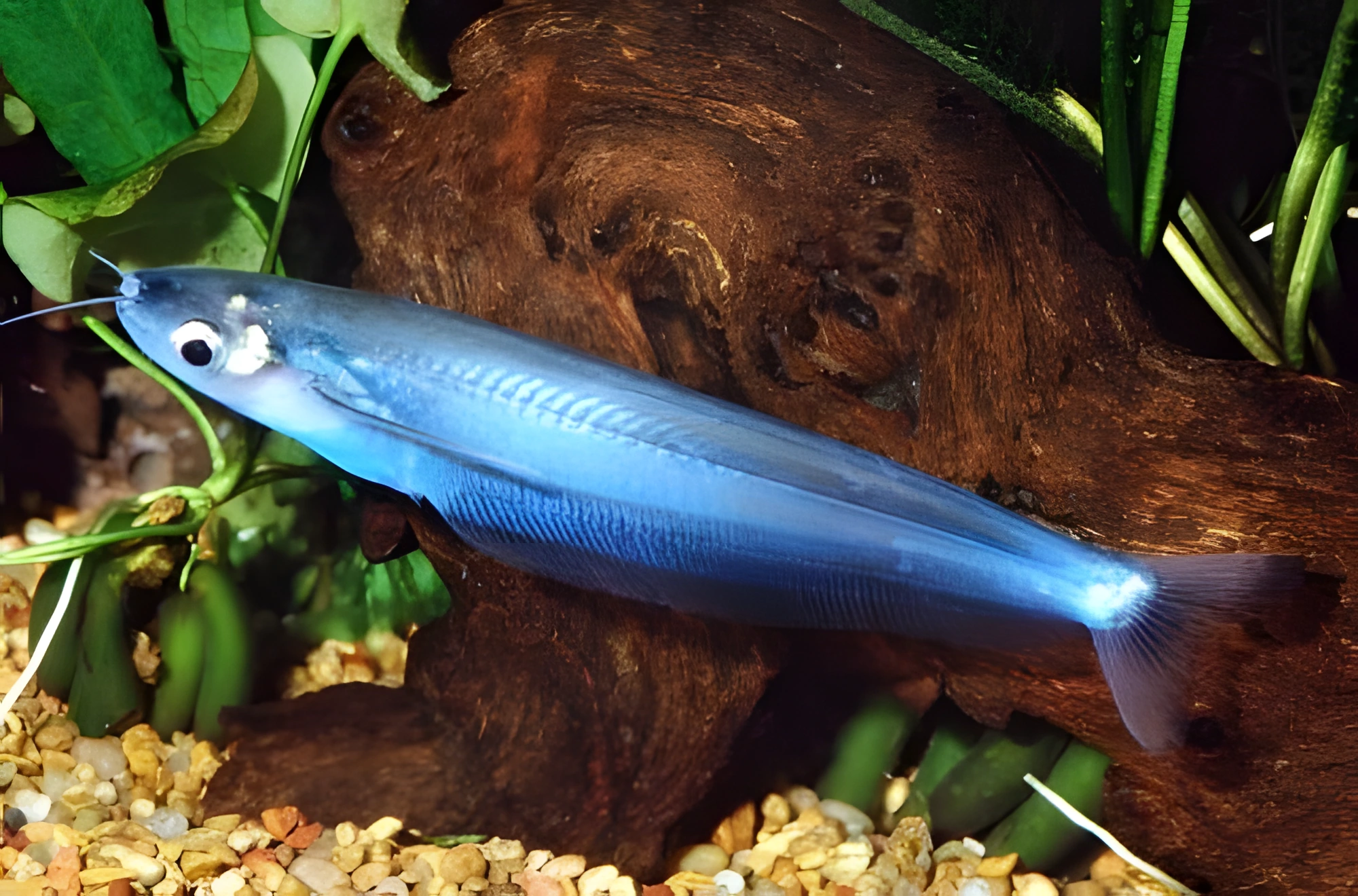
Outwardly, this catfish resembles its close relatives — the Glass Catfish and the Spotted Glass Catfish. A distinguishing feature of the Blue Glass Catfish is its larger size, as well as its unique blue or bluish body tint. Adult specimens can reach up to 14 cm in length. Their body is elongated and flat, with a long anal fin extending from the belly to the tail. Two expressive large barbels on the head are actively used to search for food in murky water. Sexual dimorphism in the species is weakly expressed: obvious external differences between male and female are practically absent.
Habitat
Its natural habitat extends across Southeast Asia, covering the Malay Peninsula (southern regions of Thailand and northern Malaysia), as well as the Greater Sunda Islands, including Sumatra, Borneo, and Java. These fish prefer to live in rivers and streams where the water is highly turbid and the bottom is rich with submerged snags.
Behavior and Compatibility
Despite its predatory nature, this fish has a peaceful and calm disposition, coexisting perfectly with other non-aggressive species of similar size. However, it is worth remembering that any small fish capable of fitting into the catfish's mouth will inevitably be eaten. They prefer to live in groups of 3–4 individuals, which contributes to their psychological comfort.
Care and Maintenance
For comfortable keeping of a group of 3–4 individuals, an aquarium of at least 150 L is recommended. The choice of decor is not critical, but experience shows that catfish will feel calmer with dim lighting and the presence of several shelters, which will help them not become overly timid. It is important to maintain stable water parameters, as the Blue Glass Catfish is demanding regarding conditions. Sharp fluctuations in temperature and hydrochemical indicators are unacceptable. This requires regular aquarium and equipment maintenance, as well as preventing the accumulation of organic waste.
Diet
This carnivorous predator feeds on small invertebrates, crustaceans, and small fish in nature. However, in aquarium conditions, it readily switches to popular dry foods such as flakes and granules. For a complete diet, it is recommended to include live or frozen foods several times a week, such as Artemia, Daphnia, bloodworms, or small earthworms.
Breeding and Reproduction
To date, successful cases of breeding the Blue Glass Catfish in home aquariums have not been recorded. These fish are supplied for sale from specialized commercial fish farms.
Diseases
When kept in favorable conditions, fish rarely experience health deterioration. The occurrence of diseases usually indicates problems in keeping, such as polluted water, poor quality food, or injuries. In most cases, eliminating the root cause leads to recovery. However, sometimes medication may be required. Detailed information on symptoms and treatment methods can be found in the section "Diseases of aquarium fish."
How to choose
When purchasing, choose individuals with a completely transparent body without visible cloudiness, white spots, or skin damage. A healthy fish should show activity as part of a group, as solitary catfish often experience severe stress and can be weakened. Avoid specimens with sunken bellies or signs of emaciation, as they adapt very poorly to new conditions. Given that the species is predominantly supplied from farms, it is important to check for signs of bacterial infections, which often manifest as redness or erosions on the fins.
Frequently asked questions
The essentials: size, tank volume, water parameters and care
How big does Blue Glass Catfish get?
An adult reaches 14 cm in length. Plan the tank around the maximum size: the fish quickly outgrows a cramped setup.
What size aquarium does Blue Glass Catfish need?
The minimum recommended volume is 150 L. A smaller tank speeds up nitrate build-up and raises stress levels.
What water parameters does Blue Glass Catfish need?
Temperature 20–27 °C, pH 6–7.5, hardness 2–15 dGH. Stability matters more than exact values: sudden swings are harder on the fish than a small deviation from the ideal.
How long does Blue Glass Catfish live?
Around 7 years when kept properly. Lifespan depends directly on tank volume, water quality and a varied diet.
Is Blue Glass Catfish aggressive?
Temperament: peaceful (regular). Keep this in mind when choosing tank mates.
How many Blue Glass Catfish should be kept together?
Recommended setup: small group (3–4 individuals). Ignoring this is a common cause of stress and disease.
What does Blue Glass Catfish eat?
Diet type: sinking (any). Feed small portions that are finished within a couple of minutes — overfeeding does more harm than underfeeding.
What is the scientific name of Blue Glass Catfish?
The scientific name of the species is Kryptopterus cryptopterus, family Sheatfishes (Siluridae). It also appears in the literature as: Kryptopterus micropus, Silurus cryptopterus.