Temperature22 – 28 °C
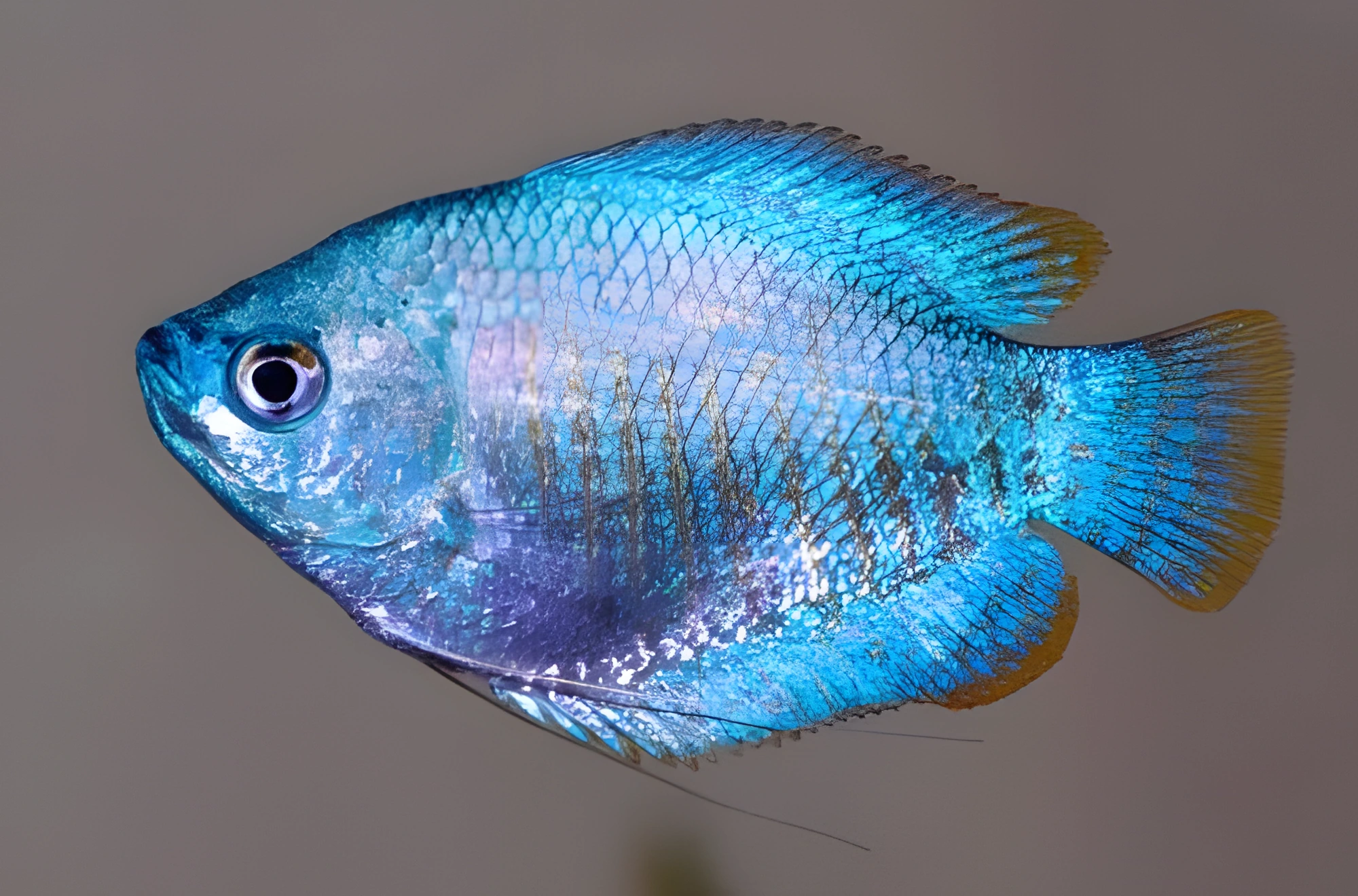
Labyrinth fishConservation status: Least concern LC
Other scientific names: Colisa lalia, Colisa unicolor, Colisha lalius, Polyacanthus lalius, Trichopodus lalius
The Blue Dwarf Gourami, scientifically known as Trichogaster lalius, belongs to the family Osphronemidae. This beautiful miniature fish is an artificially bred variety of the common Dwarf Gourami. It stands out for its more uniform blue coloration, which has a “granular” effect achieved by small red-brown specks and the uneven shimmer of its scales.
- Required aquarium volume
- 40 L
- Size in aquarium
- 8 cm
- Temperature
- 22 – 28 °C
- Temperament
- Semi-peaceful (including aggression during spawning / intraspecific conflicts)
Parameters
Water pHSlightly acidic (6) – Slightly alkaline (8)
Water dHSoft (5) – Very hard (19)
Water salinityno salt (freshwater)
Size in aquarium8 cm
Lifespan7 years
TemperamentSemi-peaceful (including aggression during spawning / intraspecific conflicts)
Toward small fishnot a predator
Required aquarium volume40 L
Lightingmoderate (regular)
Substrateany, but dark
Water flownone or stagnant (no flow)
FeedingAny (universal)
CarePair (male/female)
Description
In body structure, the Blue Dwarf Gourami is identical to its ancestor, the Dwarf Gourami: it has a somewhat laterally compressed body and large, rounded fins. The pectoral fins are thin and filamentous, equipped with sensitive sensory cells that allow the fish to explore surrounding objects through tactile contact. In the oral cavity, there is a special organ that enables the fish to absorb atmospheric oxygen directly from the air when it gulps bubbles from the water surface. The coloration is predominantly uniformly blue, with muted shades of red and red-brown dots that form barely discernible vertical stripes.
Males are distinguished by their brighter coloration and pointed dorsal fin. Females, on the other hand, are paler in color, and their dorsal fin is rounded or curved.
Habitat
This variety was artificially created and, therefore, does not occur in the wild. The largest breeding centers for these fish are located in Southeast Asia and Eastern Europe, from where the Blue Dwarf Gourami is supplied to global markets.
Behavior and Compatibility
This is a peaceful and friendly species that coexists well with other calm fish of comparable size. Overly active or aggressive tank mates can frighten the Blue Dwarf Gourami and cause stress, which will negatively affect its well-being. When introduced to a new aquarium, the fish initially behave very shyly and timidly, preferring to spend most of their time in hiding places or among dense plant thickets. Intraspecific relationships are much more complex: two males show intolerance towards each other, may engage in fights for territory and females, and females also often become objects of aggressive behavior from males. The most suitable option for keeping them is a pair or a group with one male and several females (a harem).
Care and Maintenance
For keeping one or a pair of fish, a small aquarium of 40–50 liters is sufficient; a larger number will require a correspondingly larger tank. The minimum equipment set should include a filter, heater, aerator, and lighting system. It is important to set up the filter to ensure minimal water movement, as Gouramis inhabit still or very slow-moving waters. For decor, dense thickets of rooted plants are preferred, arranged in groups and along the back and side walls, as well as shelters made of natural or artificial materials (e.g., driftwood, grottoes, castles, sunken objects). The number of shelters should correspond to the number of fish. The substrate should be dark, and its particle size is not critical.
Diet
The Blue Dwarf Gourami readily consumes all types of dry commercial foods, including flakes, granules, and tablets. High-quality specialized foods designed for Gouramis will be an optimal choice. As a supplementary diet, bloodworms, mosquito larvae, or similar live/frozen foods can be offered. Feeding frequency is one to two times a day, unless a special food with individual recommendations on the packaging is used.
Breeding and Reproduction
Breeding is relatively simple, although the unpredictable behavior of the male introduces its own peculiarities. If other species besides the Blue Dwarf Gourami inhabit the aquarium, spawning is recommended to be carried out in a separate tank, replicating the conditions (water parameters, decor) of the main aquarium. A stimulus for spawning is a gradual lowering of the water level to 15–20 cm over a week, while simultaneously raising the temperature to 29°C. The pH level should be brought to 6.0–6.5; the optimal method is to use a filter with a peat insert. Meat products — live or frozen — must be included in the daily diet. Lighting should be dimmed. After some time, the female will begin to mature her eggs, and the male will start building a bubble nest from air bubbles and fragments of floating plants. During the construction period and for some time afterward, the male may show aggression towards the female, so the presence of shelters and dense plant thickets becomes extremely important. The courtship process is short but very fascinating: the male spreads his fins, swims around the female, presses against her, touching her mouth, and nips her back or tail. Then the female releases eggs, which are immediately fertilized and transferred to the nest. The total number of laid eggs can vary from 300 to 800. The male remains to guard the clutch, while the female returns to the main aquarium. Fry hatch within the next day, and after another three days, they begin to swim freely. At this point, the male leaves his offspring and joins the female. The Blue Dwarf Gourami quickly loses its parental instincts and perceives its young as a food source. Fry should be fed specialized micro-foods, artemia, and infusoria.
Diseases
In a balanced aquarium with an established biological system, health problems generally do not arise. Poor nutrition, deteriorating living conditions, or contact with sick fish can provoke the development of diseases. More detailed information on symptoms and treatment methods can be found in the “Diseases of Aquarium Fish” section.
How to choose
When choosing a Blue Dwarf Gourami, attention should be paid to the fish's activity and the condition of its skin. Healthy specimens should be active, with bright, clean coloration without visible spots, film, or fin damage. Avoid purchasing fish that appear emaciated, have a sunken belly, or are gasping at the water surface, as this may be a sign of chronic diseases or stress. Observe their behavior in the store: the fish should show curiosity, not be apathetic or timid to the point of panic.
Keep in mind that this species is prone to intraspecific aggression, so when purchasing several individuals, it is important to assess their interaction in the general aquarium. It is recommended to buy fish from reputable suppliers, as selective forms can be sensitive to water quality and transport conditions. Be sure to check their eyes for clarity and ensure there are no signs of frayed scales, which is an alarming symptom of bacterial infections.
Frequently asked questions
The essentials: size, tank volume, water parameters and care
How big does Blue Dwarf Gourami get?
An adult reaches 8 cm in length. Plan the tank around the maximum size: the fish quickly outgrows a cramped setup.
What size aquarium does Blue Dwarf Gourami need?
The minimum recommended volume is 40 L. A smaller tank speeds up nitrate build-up and raises stress levels.
What water parameters does Blue Dwarf Gourami need?
Temperature 22–28 °C, pH 6–8, hardness 5–19 dGH. Stability matters more than exact values: sudden swings are harder on the fish than a small deviation from the ideal.
How long does Blue Dwarf Gourami live?
Around 7 years when kept properly. Lifespan depends directly on tank volume, water quality and a varied diet.
Is Blue Dwarf Gourami aggressive?
Temperament: semi-peaceful (including aggression during spawning / intraspecific conflicts). Keep this in mind when choosing tank mates.
How many Blue Dwarf Gourami should be kept together?
Recommended setup: pair (male/female). Ignoring this is a common cause of stress and disease.
What does Blue Dwarf Gourami eat?
Diet type: any (universal). Feed small portions that are finished within a couple of minutes — overfeeding does more harm than underfeeding.
What is the scientific name of Blue Dwarf Gourami?
The scientific name of the species is Trichogaster lalius, family Osphronemidae. It also appears in the literature as: Colisa lalia, Colisa unicolor, Colisha lalius.