Temperature23 – 28 °C
Other scientific names: Colisa maculatus, Labrus trichopterus, Labrvs trichoptervs, Nemaphoerus maculosus, Osphromenus insulatus, Osphromenus siamensis
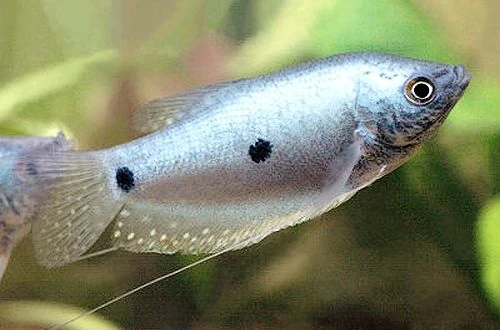
Trichopodus trichopterus, known as the Blue Gourami, belongs to the family Osphronemidae. This particular variety is a direct descendant of wild specimens of the species, although many artificially bred color variations exist. The Blue Gourami can be found in the natural habitats of Southeast Asian waters, where locals actively use it as a food fish.
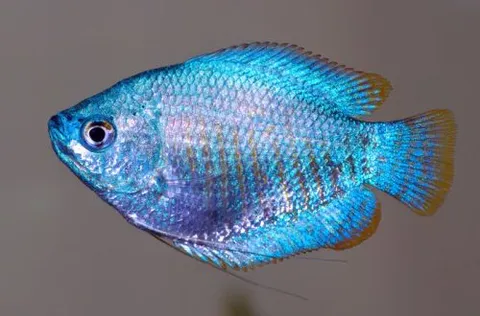
The fish has an elongated body, slightly compressed laterally. Its ventral fins are transformed into filamentous appendages equipped with sensitive sensory cells; with their help, the fish explores its surroundings by touching objects. The coloration is usually bluish or whitish-blue, with irregular dark pigmentation and barely noticeable stripes. A characteristic feature is two spots: one located approximately in the middle of the body, and the other at the base of the caudal fin. In the wild, a color strain known as the Brown Gourami is also found; these are identical species, differing only in coloration and usually inhabiting different bodies of water. Males are distinguished by their larger size and longer, pointed dorsal fin, while females are usually shorter and have a more rounded shape.
In mainland Southeast Asia and Indonesia, the Blue Gourami is widespread, covering countries such as China, Vietnam, Laos, Cambodia, Thailand, Myanmar, and Malaysia. However, today this species has been found outside its original range, for example, in the Philippines, Taiwan, Papua New Guinea, Réunion Island, Seychelles, Namibia, the Dominican Republic, Puerto Rico, and Colombia. It is believed that aquarium fish were released into local waters where they successfully adapted, leading to their spread across almost all continents. In nature, these fish prefer lowland swampy areas, as well as small streams and canals. They inhabit shallow zones with slow currents and abundant aquatic vegetation. During the rainy season, Gouramis migrate to flooded forests and fields. Their diet consists mainly of crustaceans, insect larvae, and zooplankton.
Young Blue Gouramis peacefully coexist with other calm species, but with age, individual character traits emerge that can be quite polar. The fish can become either aggressive and intolerant of neighbors or, conversely, exceptionally friendly, which requires readiness to adapt the aquarium community. It is not recommended to keep them with small fish that could become easy prey. Problems can also arise with species prone to fin-nipping, such as barbs. It is worth noting the presence of strong intraspecific competition; keeping several Gouramis is only permissible in spacious aquariums with a sufficient number of hiding places.
A spacious aquarium with a tightly fitting lid is necessary for keeping Blue Gouramis. An air layer with increased humidity and a temperature above room temperature forms under the lid, which minimizes potential problems with the labyrinth organ, used by fish to gulp atmospheric air. Essential equipment should include a lighting system, an air pump, a heater, and a powerful filter. When positioning the filtration system, it is important to consider that the fish tolerates strong currents poorly, so the filter outlets are recommended to be directed towards the aquarium walls to disperse the stream. High water quality is maintained by weekly water changes of a quarter of the volume. Abundant aquatic vegetation, both rooted and floating, arranged in groups, is welcome in the aquarium's design. Hiding places are essential, which can be in the form of grottoes, driftwood, sunken objects, or castles. The substrate can be of any texture, but a dark color is preferable as it enhances the fish's coloration.
Most Gouramis sold have been kept in artificial aquarium conditions for decades, which has significantly affected their diet. In addition to traditional live foods, these fish readily accept all types of dry commercial foods; furthermore, there are specialized foods developed to meet their vitamin and trace element needs. It should be noted that Gouramis also do not refuse parasitic creatures such as hydras: in just a few days, a Blue Gourami can completely rid an aquarium of this problem. Their feeding habits are not limited to this — when hunting for prey, such as flies or small moths, the fish can squirt a stream of water to knock insects down and then collect them from the surface.
Like many members of the Gourami genus, the male builds a foam nest on the water surface from tiny sticky bubbles, where the eggs are then laid. For successful breeding, it is recommended to prepare a separate spawning aquarium of approximately 80 liters or slightly less. It should be filled with water from the main aquarium to a height of 13–15 cm, with water parameters fully matching the main tank. Standard equipment includes a lighting system, an air pump, a heater, and a filter providing a very weak water flow. Among decorative elements, it is desirable to use floating plants with small leaves, such as Riccia, as they will be used in nest construction. The stimulus for spawning is the addition of meaty foods (live or frozen food) to the daily diet. After a certain time, when the female noticeably rounds out, the pair is moved to a separate spawning tank, where the male begins to build the nest. After construction is complete, the male begins courtship, swimming back and forth near the female, holding his tail above his head and touching her with his fins. The female lays up to 800 eggs in the nest, after which she is returned to the main aquarium. The male remains to guard the clutch and only joins the female after the fry appear.
The Blue Gourami, being close to its wild relatives living in natural environments, possesses strong immunity. In a balanced aquarium, health problems usually do not occur with these fish.
When choosing a Blue Gourami, opt for active individuals with clean, undamaged fins and no film or sores on their bodies. Avoid fish with sunken bellies, signs of lethargy, or unnaturally clamped fins, as these may indicate stress or hidden diseases. Note that in retail aquariums, fish may exhibit territorial aggression, so carefully observe the behavior of individuals in a group: dominant specimens often appear brighter and larger, while subordinates may have injuries from skirmishes.
The essentials: size, tank volume, water parameters and care
An adult reaches 14 cm in length. Plan the tank around the maximum size: the fish quickly outgrows a cramped setup.
The recommended volume is 150 L. A smaller tank speeds up nitrate build-up and raises stress levels.
Temperature 23–28 °C, pH 6–8, hardness 5–19 dGH. Stability matters more than exact values: sudden swings are harder on the fish than a small deviation from the ideal.
Around 4 years when kept properly. Lifespan depends directly on tank volume, water quality and a varied diet.
Temperament: semi-peaceful (including aggression during spawning / intraspecific conflicts). Keep this in mind when choosing tank mates.
Recommended setup: pair (male/female). Ignoring this is a common cause of stress and disease.
Diet type: any (universal). Feed small portions that are finished within a couple of minutes — overfeeding does more harm than underfeeding.
The scientific name of the species is Trichopodus trichopterus, family Osphronemidae. It also appears in the literature as: Colisa maculatus, Labrus trichopterus, Labrvs trichoptervs.
Matched by family, categories and overlapping keeping conditions
Trichopodus trichopterus
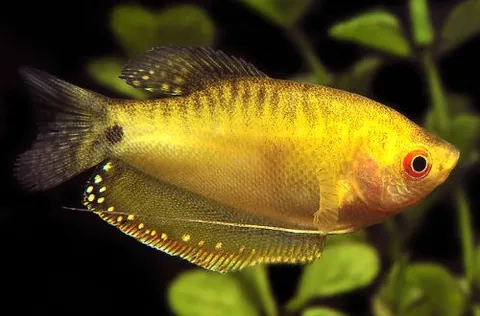
The Gold Gourami, scientifically known as Trichopodus trichopterus, belongs to the Osphronemidae family. Its vibrant yellow hues are the result of selective breeding; such coloration does not occur in its natural…
Trichopodus trichopterus
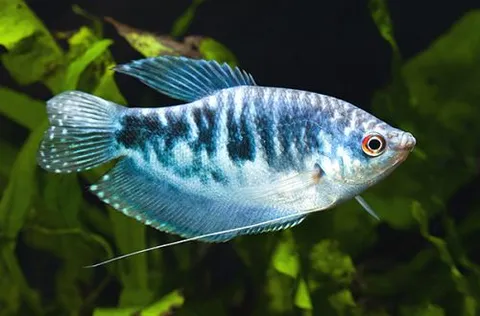
The Marble Gourami, known by its scientific name Trichopodus trichopterus, is a member of the Osphronemidae family. Its distinctive feature is a unique body pattern combining blue and dark blue hues, reminiscent of…
Trichopodus trichopterus
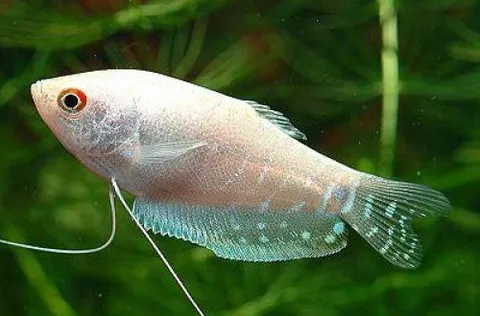
The Platinum Gourami, scientifically known as Trichopodus trichopterus, is a member of the Osphronemidae family. This variety, magnificent in its coloration, originated from the Blue Gourami. Through long-term selective…
Trichogaster lalius
The Blue Dwarf Gourami, scientifically known as Trichogaster lalius, belongs to the family Osphronemidae. This beautiful miniature fish is an artificially bred variety of the common Dwarf Gourami. It stands out for its…