Temperature24 – 28 °C
Natural range
- Lake Malawi area
- East Africa area
- Malawi area
- Mozambique area
CichlidsConservation status: Vulnerable VU
Other scientific names: Haplochromis moori
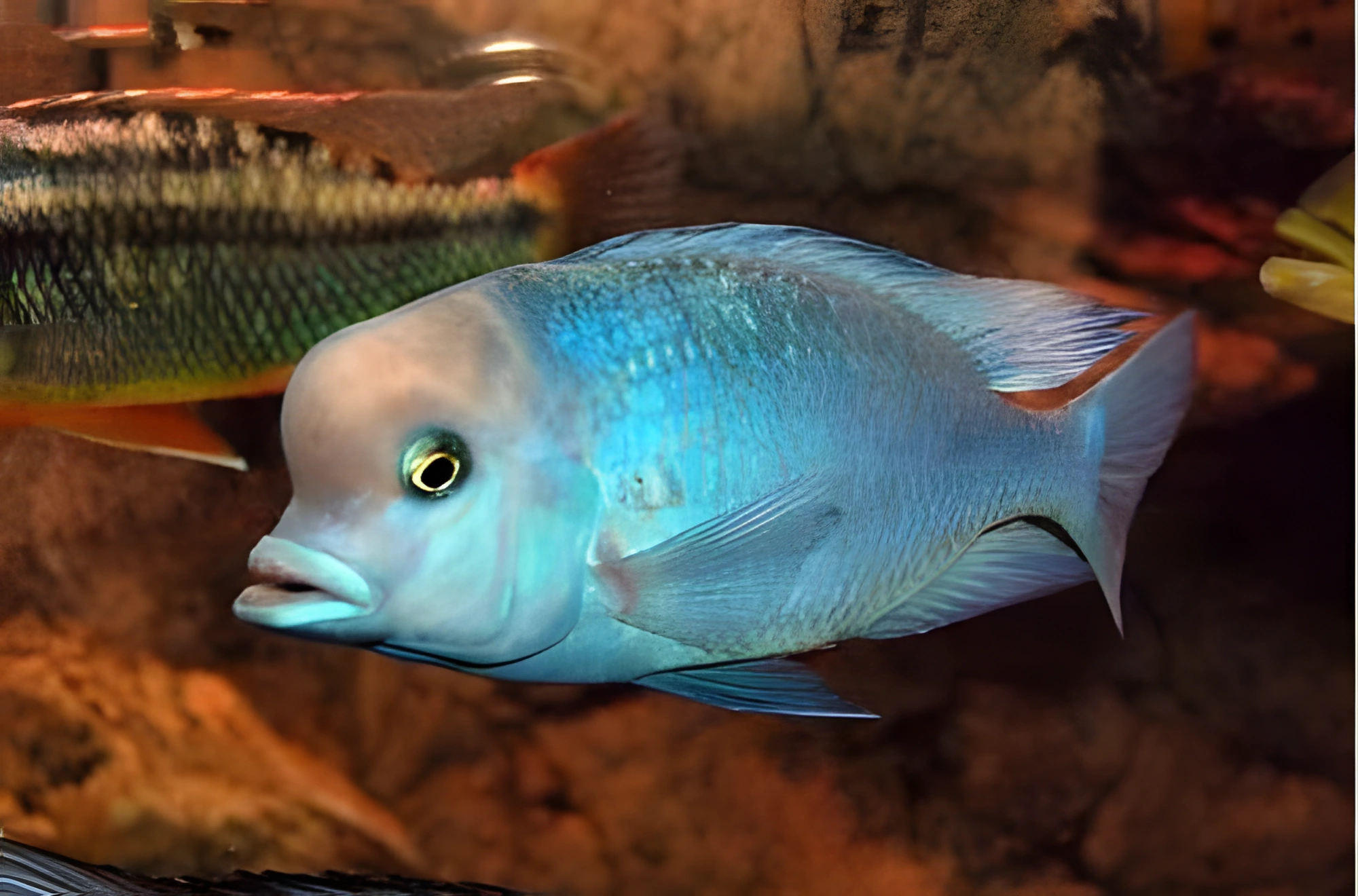
Cyrtocara moorii, also known as the Blue Dolphin Cichlid, belongs to the Cichlidae family. The fish gets its name from its distinctive head shape: the presence of a nuchal hump and an elongated mouth give it a resemblance to a dolphin. It is worth noting that the genus name itself, Cyrtocara, emphasizes this morphological feature, as in Greek, "cyrtos" means "convex" and "kara" means "face."
- Required aquarium volume
- 300 L
- Size in aquarium
- 20 cm
- Temperature
- 24 – 28 °C
- Temperament
- Semi-peaceful (including aggression during spawning / intraspecific conflicts)
Parameters
Water pHSlightly alkaline (7.6) – Alkaline (9)
Water dHMedium hardness (10) – Very hard (25)
Water salinityno salt (freshwater)
Size in aquarium20 cm
Lifespan12 years
TemperamentSemi-peaceful (including aggression during spawning / intraspecific conflicts)
Toward small fishnot a predator
Required aquarium volume300 L
Lightingmoderate (regular)
Substratesandy (regular, light)
Water flowweak
FeedingAny (universal)
CareHarem (1 male and several females)
Description
Males of these fish can grow up to 20 cm in length, while females are usually slightly smaller, reaching 16–17 cm. Their body coloration is a vibrant blue. Depending on the specific habitat, dark vertical stripes or irregularly shaped spots may be visible on their sides. Fry have a duller coloration, their bodies are predominantly gray. Blue tones begin to appear as they grow, when the fish reach a size of about 4 cm.
Habitat
This species is endemic to Lake Nyasa in Africa, one of the continent's largest freshwater bodies. It inhabits sandy substrates along the coastline at depths of up to 10 meters.
Behavior and Compatibility
These cichlids are considered relatively peaceful, which allows them to be kept with other non-aggressive inhabitants of Lake Nyasa. Utaka cichlids, Aulonocara, and other fish of comparable size that can live in alkaline water environments are excellent choices. To avoid excessive intraspecific competition in a confined aquarium space, it is recommended to form groups consisting of one male and several females.
Care and Maintenance
Lake Malawi is known for its stable hydrochemical composition, characterized by high general hardness (dGH) and alkaline pH levels. In a home aquarium, it is important to replicate conditions similar to their natural environment. The tank setup can be quite flexible, but the fish will look most natural surrounded by rock formations along the perimeter and a sandy substrate. Using limestone decor elements is a good solution, as they help increase carbonate hardness and maintain pH stability. The presence of live aquatic plants in such an aquarium is not mandatory. Aquarium maintenance largely depends on the equipment installed. However, some procedures are always essential: weekly partial water changes and regular removal of organic waste, such as food remnants and excrement.
Diet
In their natural habitat, these fish have developed a unique foraging strategy. They follow larger cichlids that sift through the sand at the bottom in search of small invertebrates, such as insect larvae, crustaceans, and worms. Anything left uneaten by these "hunters" is then consumed by the Blue Dolphin Cichlid. In a home aquarium, their feeding behavior changes, and the fish readily accept a variety of available foods. These can include popular sinking dry flakes and pellets, as well as live or frozen daphnia, bloodworms, brine shrimp, and other foods.
Breeding and Reproduction
These fish reach sexual maturity when they are 10–12 cm in size. Under favorable conditions, spawning can occur several times a year. The approach of the breeding season can be noticed by the male's behavior, as he begins to actively prepare a spawning site. This can involve digging small depressions (pits) in the substrate or thoroughly cleaning the surface of flat stones. After a brief courtship, the female alternately lays several dozen oval, yellowish eggs. After fertilization, the eggs are immediately taken into the female's mouth, where they will remain throughout the incubation period, which lasts 18–21 days.
Diseases
Under favorable conditions, these fish rarely encounter health problems. The main cause of ailments is often unsatisfactory water quality, which can provoke various skin diseases, the appearance of parasites, and other issues. More detailed information on symptoms and treatment methods can be found in the "Aquarium Fish Diseases" section.
How to choose
When selecting individuals, preference should be given to young fish around 4–6 cm in size, as they adapt more easily to new conditions. A healthy Blue Dolphin Cichlid should have clean skin without spots, ulcers, or film, be active, and show interest in food. Avoid fish with sunken bellies, damaged fins, or signs of emaciation, as well as those that stay isolated near the surface or at the bottom, breathing heavily.
- Check the eyes: they should be clear, without cloudiness, which may indicate water quality problems in the store.
- Pay attention to behavior: healthy fish swim in schools or move actively, showing no signs of timidity or apathy.
- Ask the seller about the age and keeping conditions, as fish require quality nutrition and spacious volumes from an early age to develop the characteristic fatty hump on their head.
Frequently asked questions
The essentials: size, tank volume, water parameters and care
How big does Blue Dolphin Cichlid get?
An adult reaches 20 cm in length. Plan the tank around the maximum size: the fish quickly outgrows a cramped setup.
What size aquarium does Blue Dolphin Cichlid need?
The minimum recommended volume is 300 L. A smaller tank speeds up nitrate build-up and raises stress levels.
What water parameters does Blue Dolphin Cichlid need?
Temperature 24–28 °C, pH 7.6–9, hardness 10–25 dGH. Stability matters more than exact values: sudden swings are harder on the fish than a small deviation from the ideal.
How long does Blue Dolphin Cichlid live?
Around 12 years when kept properly. Lifespan depends directly on tank volume, water quality and a varied diet.
Is Blue Dolphin Cichlid aggressive?
Temperament: semi-peaceful (including aggression during spawning / intraspecific conflicts). Keep this in mind when choosing tank mates.
How many Blue Dolphin Cichlid should be kept together?
Recommended setup: harem (1 male and several females). Ignoring this is a common cause of stress and disease.
What does Blue Dolphin Cichlid eat?
Diet type: any (universal). Feed small portions that are finished within a couple of minutes — overfeeding does more harm than underfeeding.
What is the scientific name of Blue Dolphin Cichlid?
The scientific name of the species is Cyrtocara moorii, family Cichlids (Cichlidae). It also appears in the literature as: Haplochromis moori.