Temperature25 – 32 °C
Natural range
- Northern Territory area
- Queensland area
RainbowfishConservation status: Least concern LC
Pseudomugil tenellus, known as the Delicate Blue-eye or Slender Blue-eye, belongs to the family Pseudomugilidae. This beautiful and slender fish fully lives up to its name. It is easy to keep and breed, and it can adapt to various water conditions. These qualities, along with its peaceful nature, make it an excellent choice for almost any tropical aquarium.
- Required aquarium volume
- 80 L
- Size in aquarium
- 5 cm
- Temperature
- 25 – 32 °C
- Temperament
- Peaceful (regular)
Parameters
Water pHSlightly acidic (5.5) – Slightly alkaline (8)
Water dHSoft (5) – Very hard (21)
Water salinityno salt (freshwater)
Size in aquarium5 cm
Lifespan3 years
TemperamentPeaceful (regular)
Toward small fishnot a predator
Required aquarium volume80 L
Lightingweak or moderate
Substrateany (no restrictions)
Water flowweak or moderate
FeedingHigh protein (predominantly meat)
CareGroup (8–10 individuals)
Description
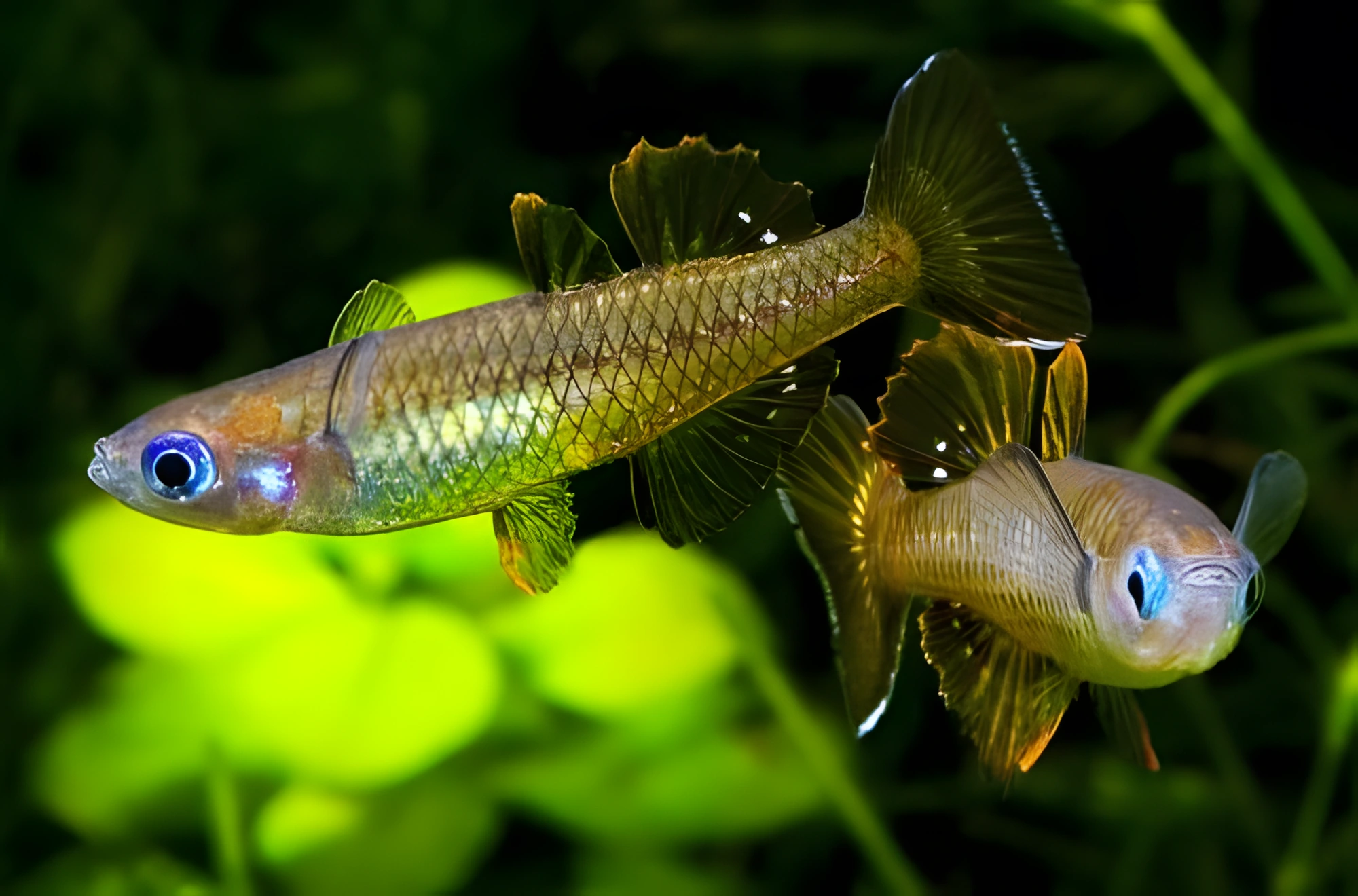
Adults reach approximately 4–5 cm in length. A distinctive feature of the fish is its blue eyes, which is reflected in its name. The main body coloration is yellowish with a silvery sheen, and the fins are translucent and short. Shades may vary depending on the region of origin. Sexual dimorphism is weakly expressed: males are slightly larger than females and have more elongated fins.
Habitat
The habitats of these fish are located in the northern part of the Australian continent, in a narrow coastal strip where remnants of humid tropical forests bordering savannas are preserved. The distribution range is limited to the area from Darwin to Port Douglas on the Cape York Peninsula. Varieties of this species are also found on the islands of New Guinea and Aru. Blue-eyes inhabit riverbeds and deltas flowing into the sea, as well as coastal freshwater and brackish water bodies, including tidal estuaries and salt marshes. They prefer stagnant waters abundantly overgrown with aquatic vegetation.
Behavior and Compatibility
This fish is peaceful and active. Thanks to its ability to adapt to diverse water conditions, the Delicate Blue-eye can successfully coexist with various fish species of similar size and behavior. Keeping them in groups is recommended, with a group consisting of at least 8–10 individuals of both sexes.
Care and Maintenance
For a group of ten fish, an aquarium of at least 80 liters will be required. The decor should include a large number of plants (both live and artificial), arranged in groups, which will allow for open swimming areas. The presence of shelters such as snags, roots, or branches is welcome. The substrate can be anything, its choice depends on the needs of the plants. Lighting should be subdued. Floating plants can serve as an additional means of shading. When keeping Delicate Blue-eyes, water purity, oxygen saturation, and stability of hydrochemical parameters are of particular importance. It is important to avoid sharp fluctuations in temperature, as well as pH and dGH values. Keeping fish in brackish aquariums is permissible, with salinity not exceeding 15 g per 1 liter of water.
Diet
Accepts all types of food of suitable size, including dry floating, live, and frozen, with the mandatory addition of vegetable components. Ideally, the diet should be based on products such as small bloodworms, daphnia, and artemia.
Breeding and Reproduction
Breeding this species is quite simple and does not require special preparations. Spawning can occur at any time of the year. Raising the temperature to the upper permissible values (28–30°C) serves as a stimulus for the start of the breeding period. Females lay eggs among plant thickets; fine-leaved and low-growing species, such as Java moss, or artificial spawning mops are best suited for these purposes. Typically, a dominant male fertilizes several clutches from different females. Parental instincts are absent in these fish, so immediately after spawning, they may eat their own eggs. To preserve future offspring, fertilized eggs must be promptly moved to a separate aquarium with identical water conditions. Fry will remain there until they reach a sufficient size (usually about six months). This separate tank is equipped with the same set of equipment as the main aquarium. The exception is the filtration system: in this case, a simple air-driven sponge filter is recommended. Such a filter will provide sufficient purification and prevent accidental suction of fry. The incubation period lasts about 10 days, depending on the temperature. In the first days of life, fry will need micro-food, such as infusoria. After a week, artemia nauplii can be introduced.
Diseases
Health problems usually arise only as a result of injuries or keeping in unsuitable conditions, which leads to a weakening of the immune system and, as a rule, provokes the development of various diseases. At the first signs of illness, the primary task is to check the water parameters for excesses or dangerous concentrations of toxic substances (nitrates, nitrites, ammonia, etc.). After bringing all indicators back to normal, treatment can begin. More detailed information on symptoms and treatment methods is presented in the "Aquarium Fish Diseases" section.
How to choose
When selecting individuals, preference should be given to active fish with clean fins and no visible damage or sores on the body. It is important to ensure there is no film, spots, or signs of emaciation, as this species is sensitive to stress during transportation and changes in keeping conditions. In the store, the fish should exhibit schooling behavior; individuals that keep to themselves, appear sluggish, or constantly hide may be sick or severely weakened. It is recommended to purchase a group of 8–10 specimens to minimize stress and help them adapt more quickly to new conditions.
Frequently asked questions
The essentials: size, tank volume, water parameters and care
How big does Delicate Blue-eye get?
An adult reaches 5 cm in length. Plan the tank around the maximum size: the fish quickly outgrows a cramped setup.
What size aquarium does Delicate Blue-eye need?
The minimum recommended volume is 80 L. A smaller tank speeds up nitrate build-up and raises stress levels.
What water parameters does Delicate Blue-eye need?
Temperature 25–32 °C, pH 5.5–8, hardness 5–21 dGH. Stability matters more than exact values: sudden swings are harder on the fish than a small deviation from the ideal.
How long does Delicate Blue-eye live?
Around 3 years when kept properly. Lifespan depends directly on tank volume, water quality and a varied diet.
Is Delicate Blue-eye aggressive?
Temperament: peaceful (regular). Keep this in mind when choosing tank mates.
How many Delicate Blue-eye should be kept together?
Recommended setup: group (8–10 individuals). Ignoring this is a common cause of stress and disease.
What does Delicate Blue-eye eat?
Diet type: high protein (predominantly meat). Feed small portions that are finished within a couple of minutes — overfeeding does more harm than underfeeding.
What is the scientific name of Delicate Blue-eye?
The scientific name of the species is Pseudomugil tenellus, family Blue-eyes (Pseudomugilidae).