Temperature20 – 24 °C
Natural range
- Fujian Province area
- Taiwan area
- China area
Loaches
Other scientific names: Crossostoma lacustre, Crossostoma tengi, Formosania gilberti, Formosania lacustris, Homaloptera formosanum
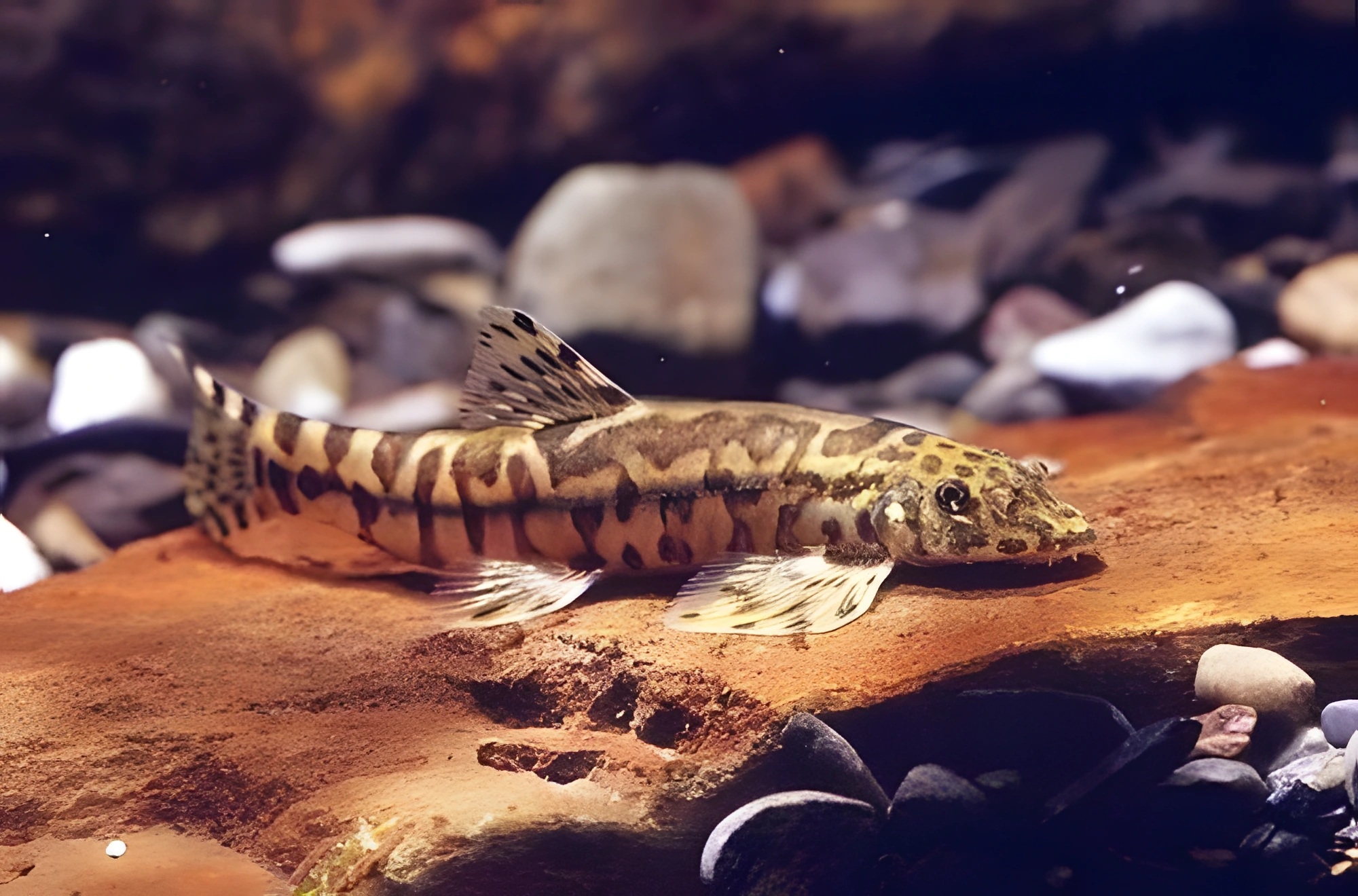
Formosania lacustre, also known as the Brushmouth Loach, belongs to the family Balitoridae, known as river loaches. The fish owes its name to its body structure: it is elongated and slender, but has a rather large tail, which somewhat resembles an artist's brush. Keeping this species can be challenging, as it requires strictly maintaining high water quality and ensuring a constant strong current. For this reason, it is not recommended for beginner aquarists.
- Required aquarium volume
- 100 L
- Size in aquarium
- 10 – 12 cm
- Temperature
- 20 – 24 °C
- Temperament
- Peaceful (regular)
Parameters
Water pHSlightly acidic (6) – Neutral (7.5)
Water dHVery soft (1) – Hard (12)
Water salinityno salt (freshwater)
Size in aquarium10 – 12 cm
Lifespan8 years
TemperamentPeaceful (regular)
Toward small fishnot a predator
Required aquarium volume100 L
Lightingweak (low)
Substraterocky (rock formations, boulders, etc.)
Water flowmoderate or strong
FeedingSinking (any)
CareSmall group (3–4 individuals)
Description
Adult Formosania lacustre reach 10–12 cm in length. The Brushmouth Loach is perfectly adapted to life in fast-flowing water, which is reflected in its appearance. Its body is greatly elongated, and its pointed, elongated head is equipped with a sucker mouth. The paired fins are positioned horizontally and shifted closer to the belly, allowing the fish to firmly cling to hard surfaces. Most of the time, they do not swim but rather "crawl" along the bottom, searching for food. Body coloration and patterns can vary among populations found in mainland China and Taiwan. Fish from the island have more complex patterns: they consist of symmetrical brown pigmentation on a yellowish background and a dark stripe running along the lateral line. Continental representatives of the species more often have a uniform gray coloration.
Habitat
The natural habitat of these fish covers the eastern regions of China, particularly Fujian province, as well as the island of Taiwan. They inhabit the headwaters of mountain rivers and streams, where the water flow is fast and sometimes even turbulent. These fish prefer shallow areas with good lighting, where the bottom is covered with stones coated in a layer of algae. Aquatic vegetation is mainly found along the banks of water bodies, only occasionally growing into the riverbed itself.
Behavior and Compatibility
Formosania lacustre exhibit territorial behavior and a tendency for competition among conspecifics. The main reason for rivalry is the struggle for food. In the wild, where resources are limited, these fish very jealously defend their territories. In a home aquarium, this problem can be minimized by distributing food across the entire bottom area. They are well compatible with other non-aggressive fish species that are also adapted to life in turbulent current conditions.
Care and Maintenance
For a group of 3-4 Brushmouth Loaches, an aquarium of at least 100 liters is considered optimal, while the height of the tank can be small, 30 cm is sufficient. The main condition for their successful keeping is the presence of clean, flowing water with constantly maintained optimal temperature and hydrochemical parameters. It is equally important to provide a sufficiently strong current, imitating the water flow of a mountain river. The recommended water turnover in the aquarium should be 10–15 volumes per hour. To ensure these conditions, a powerful internal filter with excess capacity will be suitable; for example, for a 100-liter aquarium, a filter pumping about 1000 liters of water per hour will be needed. Maintaining high water quality also depends on regularly performing essential aquarium maintenance procedures, including weekly partial water changes and timely removal of organic waste. It is best to decorate the aquarium simply, focusing mainly on the substrate. Fine fractions, such as sand, which can be picked up by the current and clog the filter, should be avoided. The substrate should consist of coarse gravel, stones, boulders, and various rocks. Live plants are generally not used.
Diet
In their natural habitat, the diet of the Brushmouth Loach consists of small crustaceans, insect larvae, and other invertebrates. It is important to note that, unlike many related species, algae are not part of their daily menu. In a home aquarium, these fish prefer high-protein foods, such as live or frozen brine shrimp, daphnia, and bloodworms. When feeding, it is recommended to temporarily reduce the power of the filters to weaken the current and prevent the rapid dispersal of food. It is advisable to distribute food to different areas of the bottom to avoid competition among individuals for food. If gel or paste-like foods are used, such adjustment of filter operation will not be necessary.
Breeding and Reproduction
At the time of writing this article, the authors have not been able to find reliable information about successful cases of breeding Brushmouth Loaches in home aquariums.
Diseases
Health problems in these fish arise only in the presence of injuries or keeping in unsuitable conditions, which leads to a weakening of the immune system and the subsequent occurrence of various diseases. At the first signs of illness, it is necessary first to check the water parameters for exceeding permissible values or the presence of toxic substances (such as nitrites, nitrates, ammonia). If deviations are found, all indicators should be normalized, and then treatment should begin. More detailed information on symptoms and treatment methods is available in the "Diseases of Aquarium Fish" section.
How to choose
When purchasing a Brushmouth Loach, choose active individuals that exhibit natural behavior characteristic of bottom-dwelling fish: they should cling to glass surfaces or decorations using their mouth apparatus. It is important to carefully inspect the fish for signs of emaciation, fin damage, or skin lesions, as this species is sensitive to transportation and keeping conditions.
- avoid specimens with sunken bellies, which often indicates feeding problems or internal diseases
- prefer individuals with clean, undamaged scales without visible spots, ulcers, or film
- purchase a group of 4 or more individuals, as this reduces stress levels and promotes natural fish behavior
Frequently asked questions
The essentials: size, tank volume, water parameters and care
How big does Brushmouth Loach get?
An adult reaches 10–12 cm in length. Plan the tank around the maximum size: the fish quickly outgrows a cramped setup.
What size aquarium does Brushmouth Loach need?
The minimum recommended volume is 100 L. A smaller tank speeds up nitrate build-up and raises stress levels.
What water parameters does Brushmouth Loach need?
Temperature 20–24 °C, pH 6–7.5, hardness 1–12 dGH. Stability matters more than exact values: sudden swings are harder on the fish than a small deviation from the ideal.
How long does Brushmouth Loach live?
Around 8 years when kept properly. Lifespan depends directly on tank volume, water quality and a varied diet.
Is Brushmouth Loach aggressive?
Temperament: peaceful (regular). Keep this in mind when choosing tank mates.
How many Brushmouth Loach should be kept together?
Recommended setup: small group (3–4 individuals). Ignoring this is a common cause of stress and disease.
What does Brushmouth Loach eat?
Diet type: sinking (any). Feed small portions that are finished within a couple of minutes — overfeeding does more harm than underfeeding.
What is the scientific name of Brushmouth Loach?
The scientific name of the species is Formosania lacustre, family River Loaches (Balitoridae). It also appears in the literature as: Crossostoma lacustre, Crossostoma tengi, Formosania gilberti.