Temperature21 – 24 °C
Natural range
- Northern India area
- Nepal area
- Bangladesh area
- Myanmar area
CyprinidsConservation status: Least concern LC
Other scientific names: Danio aequipinnatus, Danio aequipinnulus, Danio lineolatus, Leuciscus aequipinnatus, Leuciscus lineolatus, Perilampus aequipinnatus
Devario aequipinnatus, known as the Giant Danio, is a member of the Cyprinidae family. This name accurately reflects its characteristic: this species is indeed larger than its other relatives. Thanks to its exceptional hardiness and unpretentiousness, the Giant Danio can become an ideal first inhabitant of a new aquarium, easily coping with possible mistakes of a beginner aquarist.
- Required aquarium volume
- 100 L
- Size in aquarium
- 10 – 15 cm
- Temperature
- 21 – 24 °C
- Temperament
- Peaceful, active/mobile
Parameters
Water pHSlightly acidic (6) – Slightly alkaline (8)
Water dHSoft (5) – Very hard (19)
Water salinityno salt (freshwater)
Size in aquarium10 – 15 cm
Lifespan7 years
TemperamentPeaceful, active/mobile
Toward small fishnot a predator
Required aquarium volume100 L
Lightingdimmed
Substrategravel (regular)
Water flownone or stagnant (no flow)
FeedingSmall / appropriate size / pieces
CareSchooling (usually from 5–6 individuals and more)
Description
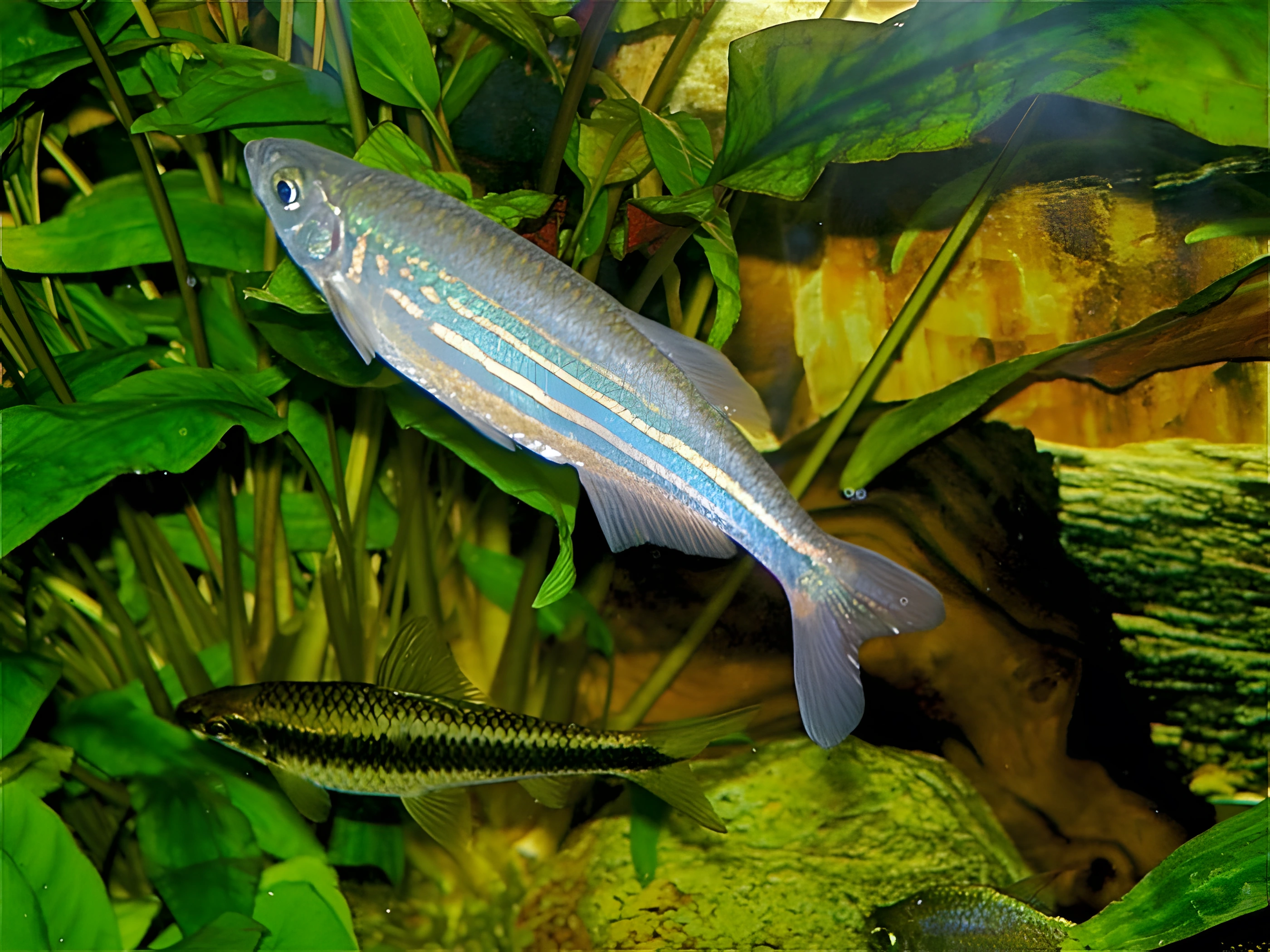
The Giant Danio has a large, elongated body. At its mouth, at the tip of each lip, small barbels can be seen. This species is the largest among its relatives; in the wild, it can reach about 15 cm in length, but in an aquarium, its size rarely exceeds 10 cm. The fish's coloration varies significantly depending on the region of habitat and environmental conditions, but a grayish hue is most often observed. Along the sides of the body runs an ornament of irregularly shaped stripes and spots with yellow or greenish pigment. Albino forms of this species are also known, which are usually the result of a random mutation and are not fixed in subsequent generations. Outwardly, the Giant Danio resembles the Malabar and Royal Danios, which often leads to confusion.
Habitat
The first description of the Giant Danio was made by researcher John McClelland in 1839 during his study of Indian fauna. This species is widespread in the northern regions of India, and also found in Nepal, Bangladesh, Sri Lanka, Myanmar, and northern Thailand. In their natural habitat, these fish inhabit mid-mountain rivers at altitudes up to 300 meters above sea level. River conditions in these areas are diverse, but shaded areas often prevail, sometimes with trees whose branches hang down to the water. Danios prefer to stay in the upper layers of the water, where they actively feed on insects and their larvae. The following conditions are important for keeping these fish:
Aquarium volume — from 100 L Temperature — 21–24 °C pH value — 6.0–8.0 Water hardness — 5 to 19 GH (soft to medium hard) Substrate type — dark gravel or sand Lighting — subdued Brackish water — absent Water movement — strong or moderate Size — up to 10 cm Diet — any appropriately sized foods Lifespan — 5–7 years
Description
The Giant Danio is characterized by a large, elongated body. Small barbels are visible at the mouth, at the tip of each lip. Among related species, it stands out for its size: in the wild, individual specimens can reach 15 cm in length, although in aquarium conditions they rarely grow larger than 10 cm. The coloration of these fish can vary significantly depending on the region of origin and environmental conditions, but a grayish hue most often prevails. Along the sides of their body, there is an ornament of irregularly shaped stripes and spots with yellow or greenish pigment. Albino forms of this species also exist, which are usually the result of a random mutation and are rarely fixed in subsequent generations. Outwardly, the Giant Danio resembles the Malabar and Royal Danios, which often leads to their confusion. Feeding This species is omnivorous and readily consumes both dry and live or frozen foods. It is important that the food floats on the surface of the water. Unlike many other omnivorous species, the Giant Danio does not require a varied diet; it can be fed with a single type of food.
Check out our new product: Aqvium flake food for aquarium fish, a bestseller on Ozon with a rating of 4.9. It is suitable for most aquarium fish and is made from raw materials that comply with new European Union standards (EU 2018/848). It contains vitamins A, C, D3, E, and Omega 3-6. Available for purchase on Ozon.
Care and Maintenance For successful keeping of the Giant Danio, several conditions are crucial: clean water with regular weekly changes of at least 25% of the total volume, and sufficient space for free swimming. Since the fish is sensitive to oxygen content in the water, aeration with compressors or universal filters is recommended, which, among other things, will help create the desired gentle current. Lighting should be moderate. If the room temperature is sufficient, a heater may not be needed, as the fish does not require high water temperatures. The aquarium should have dense plant thickets in one of the corners or along a side wall, thus creating hiding places for the fish. Floating plants will provide additional shading. Dark fractions of smooth fine gravel or coarse sand are preferred as substrate. Behavior and Compatibility This is an active and peaceful schooling species that requires a community of at least 8 individuals. With fewer numbers, the fish may become restless, attack conspecifics, and chase smaller neighbors. However, such behavior is not aggression, but rather a search for playmates. Coexistence is possible with fish of similar size and temperament. Breeding / Reproduction Males differ from females by a more slender body shape and more intense coloration. Breeding Giant Danios in a home aquarium is not difficult. Sexual maturity is reached at a body length of 7 cm. Although two Danios can maintain a pair throughout their lives, this does not affect their parental instincts: after spawning, the future offspring are left unattended. It is recommended to breed these fish in a separate tank, the bottom of which is densely planted with small plants. A gravel substrate with particles about 1 cm in diameter will help protect the eggs from being eaten. The female should be placed in the aquarium a day before the male. When the pair forms, the temperature should be gradually raised to 27–28 °C, which will initiate the courtship process. Under favorable conditions, the female lays 5–20 eggs directly into the water after each mating, and the male fertilizes them; the total number of eggs laid can reach about 300. After spawning is complete, the parents should be moved back to the main aquarium. More about Danio reproduction. Diseases Under conditions favorable for their existence, these fish are rarely susceptible to diseases. However, sharp changes in the habitat can provoke disease outbreaks, among which ichthyophthiriosis is one of the most common. Detailed information on symptoms and treatment methods can be found in the "Fish Diseases" section.
Behavior and Compatibility
This is an active and peaceful species, characterized by schooling behavior. It requires a community of at least 8 individuals. If there are fewer fish in the school, they may become restless, attack conspecifics, or chase smaller inhabitants. However, such behavior should not be considered aggression; rather, the Danio is looking for playmates. Coexistence is possible with fish of similar size and temperament.
Care and Maintenance
Essential conditions for successful keeping of the Giant Danio include: clean water, with regular weekly changes of at least 25% of the total volume, and sufficient swimming space. The fish is sensitive to the oxygen level in the water, so aeration with compressors or universal filters should be provided, which can also create the desired gentle current. Lighting should be moderate. If the room temperature is comfortable enough, a heater may not be needed, as the fish does not require high water temperatures. In the aquarium setup, it is recommended to create plant thickets in one of the corners or along the side wall, where the fish can find shelter if needed. Floating plants will provide additional shading. Dark substrate, consisting of smooth fine gravel or coarse sand, is preferred.
Diet
This species belongs to omnivorous fish and readily accepts dry, live, or frozen foods. The key condition is that the food must remain on the water surface. Unlike many other omnivorous species, the Giant Danio does not require a wide variety in its diet; it is perfectly acceptable to feed it with only one type of food.
Breeding and Reproduction
Males differ from females by their noticeable slenderness and more intense coloration. Breeding these fish in a home aquarium presents no difficulties. Sexual maturity is reached at a body length of 7 cm. Although two fish can maintain a pair throughout their lives, this does not affect their parental instincts; after spawning, the offspring are left unattended. For breeding, it is recommended to use a separate tank, the bottom of which is densely planted with small plants. A gravel substrate with particles about 1 cm in diameter will help protect the eggs from being eaten. The female should be placed in the aquarium a day before the male. When the pair forms, the temperature should be gradually raised to 27–28 °C, which stimulates the onset of courtship. Under favorable conditions, the female releases 5–20 eggs directly into the water after each mating, which are then fertilized by the male; the total number of eggs laid can be about 300. After spawning is complete, the parents are returned to the main aquarium. Details on Danio reproduction can be found in a separate section.
Diseases
Under favorable conditions, these fish rarely suffer from diseases. However, changes in the habitat can provoke disease outbreaks, among which ichthyophthiriosis is the most common. More detailed information on symptoms and treatment methods can be found in the "Fish Diseases" section.
How to choose
When choosing Giant Danios, pay attention to the activity of the individuals: healthy fish are constantly in motion and exhibit pronounced schooling behavior. Avoid specimens with damaged fins, body film, signs of emaciation, or an unnaturally bloated abdomen. Given the high mobility of the species, in the store, the fish should show interest in food and react quickly to external stimuli. Since Giant Danios are prone to stress during transport, it is recommended to purchase a group of 6–8 individuals at once, which will help them adapt more quickly to the new aquarium.
Frequently asked questions
The essentials: size, tank volume, water parameters and care
How big does Giant Danio get?
An adult reaches 10–15 cm in length. Plan the tank around the maximum size: the fish quickly outgrows a cramped setup.
What size aquarium does Giant Danio need?
The minimum recommended volume is 100 L. A smaller tank speeds up nitrate build-up and raises stress levels.
What water parameters does Giant Danio need?
Temperature 21–24 °C, pH 6–8, hardness 5–19 dGH. Stability matters more than exact values: sudden swings are harder on the fish than a small deviation from the ideal.
How long does Giant Danio live?
Around 7 years when kept properly. Lifespan depends directly on tank volume, water quality and a varied diet.
Is Giant Danio aggressive?
Temperament: peaceful, active/mobile. Keep this in mind when choosing tank mates.
How many Giant Danio should be kept together?
Recommended setup: schooling (usually from 5–6 individuals and more). Ignoring this is a common cause of stress and disease.
What does Giant Danio eat?
Diet type: small / appropriate size / pieces. Feed small portions that are finished within a couple of minutes — overfeeding does more harm than underfeeding.
What is the scientific name of Giant Danio?
The scientific name of the species is Devario aequipinnatus, family Cyprinids (Cyprinidae). It also appears in the literature as: Danio aequipinnatus, Danio aequipinnulus, Danio lineolatus.