Temperature20 – 28 °C
Natural range
- South America area
CichlidsConservation status: Least concern LC
Other scientific names: Geophagus jurupari, Satanoperca jurapari
Jurupari, or Geophagus Jurupari, scientifically known as Satanoperca jurupari, belongs to the extensive Cichlidae family. "Demon fish" is the literal, somewhat ominous translation of its Latin name, while the word "Jurupari" in the dialects of indigenous South American peoples refers to an evil forest spirit. These folk beliefs, however, are in no way related to the fish's character; on the contrary, it is distinguished by a peaceful disposition. The reason lies in its natural habits: in the wild, Jurupari often buries its head in a layer of fallen leaves and other debris on the bottom of water bodies, remaining unnoticed there. This fish species places high demands on both the quality of the aquatic environment and its specific feeding behavior, making its keeping quite challenging. For this reason, it is not recommended for aquarists without sufficient experience.
- Required aquarium volume
- 500 L
- Size in aquarium
- 15 – 18 cm
- Temperature
- 20 – 28 °C
- Temperament
- Peaceful (regular)
Parameters
Water pHSlightly acidic (5.5) – Neutral (7.5)
Water dHVery soft (2) – Hard (12)
Water salinityno salt (freshwater)
Size in aquarium15 – 18 cm
Lifespan8 years
TemperamentPeaceful (regular)
Toward small fishnot a predator
Required aquarium volume500 L
Lightingdimmed
Substratesandy (regular, light)
Water flowweak
FeedingHigh protein (predominantly meat)
CareMedium group (6–8 individuals)
Description
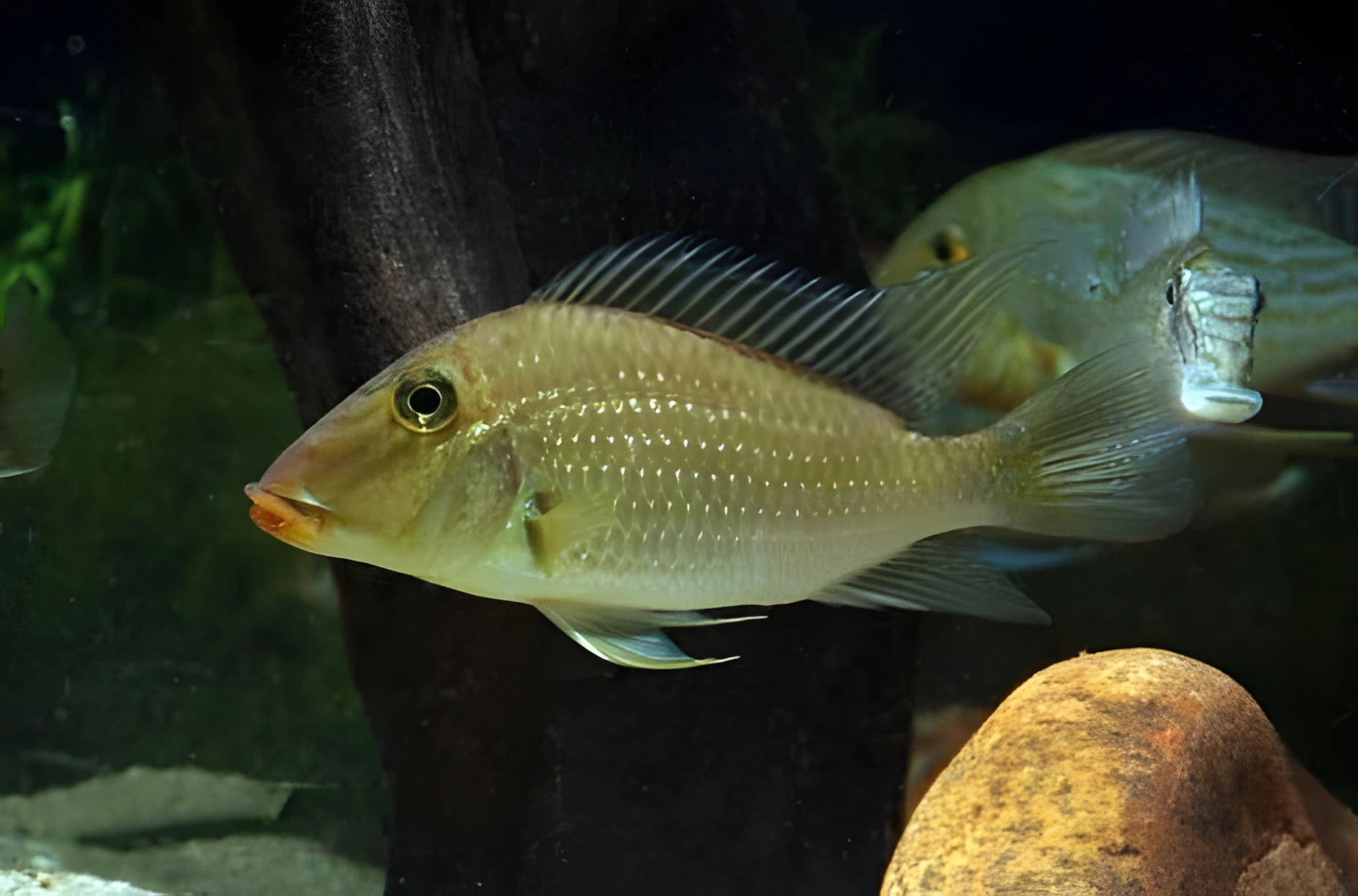
Adult males can reach up to 18 cm in length, while females are usually slightly smaller, up to 15 cm. Apart from these size differences, males and females are almost visually indistinguishable. Their coloration is usually uniform, and with changes in lighting, it can vary from silvery to beige. The head is large, adorned with a barely noticeable pattern of darkened lines. At the base of the caudal fin, in its upper part, there is a characteristic black spot.
Habitat
The origin of this fish is associated with the vast Amazon River basin in South America, where it is found everywhere. Jurupari particularly prefers small tributaries and oxbow lakes with a soft substrate. The bottom of such water bodies is always abundant with a layer of fallen leaves, branches, roots, and other plant debris, in which the fish often hides, completely burying itself.
Behavior and Compatibility
This fish is distinguished by a peaceful and calm disposition, especially when kept in a group of 5–8 individuals. If the number of fish is smaller, nervousness may be observed. The alpha male sometimes shows signs of aggression towards weaker relatives, which most often occurs due to lack of space. Jurupari treats other species of comparable size calmly. However, too small fish can become an accidental victim.
Care and Maintenance
The optimal aquarium volume for a group of 5–8 individuals is 500 L or more. The aquarium decor should be simple: snags on the bottom and sandy substrate. Rooted aquatic plants are unlikely to thrive due to the specific feeding method of Geophagus Jurupari. Lighting is recommended to be subdued, and floating plants on the surface will provide an additional source of shade. It is important to pay special attention to the choice of substrate: it should consist of sand or very fine pebbles. Large stones can get stuck in the fish's mouth. In their natural habitat, the bottom of water bodies is covered with a layer of fallen leaves; these can also be used in the aquarium, but in moderation, to leave large open areas of substrate. Leaves serve not only as a decorative element but also enrich the water with tannins as they decompose, thus forming a characteristic chemical composition. More detailed information can be found in the article "What tree leaves can be used in an aquarium". For successful keeping of Jurupari, the key aspect is maintaining high water quality – absence of pollution – and stability of hydrochemical parameters within acceptable limits. This requires regular aquarium maintenance. Weekly, 50–70% of the water volume must be replaced with fresh water, and food residues and fish waste products must be removed promptly. A significant load falls on the filtration system. It must be capable of cleaning large volumes of water and consistently coping with constant sand contamination, which often rises in small clouds when feeding the fish. Combined external filters are usually used. The first filter – mechanical – takes water from the aquarium, pumps it into a settling tank, and traps sand. From the settling tank, the water enters the second, main filter, which performs other types of purification, and then returns to the aquarium.
Diet
In their natural environment, these fish forage for food from the bottom; they take a portion of the substrate into their mouths and sift it through their gills, searching for zoo- and phytoplankton. In a home aquarium, it is important to offer sinking foods, the composition of which should be varied and enriched with plant components. For example, frozen artemia, daphnia, or small particles of bloodworms can be added to dry flakes and granules. The size of food fragments should be relatively small.
Breeding and Reproduction
Under favorable conditions, spawning can occur quite frequently. With the onset of the breeding season, the dominant male chooses a suitable female. After a short courtship phase, the pair separates from the main group and occupies a small area on the aquarium bottom. Their temporary territory is usually located near a snag or other solid object. A few days before spawning, the female and male begin to actively defend their territory, chasing away other fish. The female lays eggs in small portions of a few at a time, waiting for the male to fertilize them. This process is repeated several times until the total number of eggs reaches several hundred. After spawning is complete, the female leaves the clutch, leaving it under the protection of the male, who will continue to protect the offspring for several days after the fry hatch.
Diseases
The main cause of diseases often lies in the keeping conditions: if they go beyond acceptable limits, immunity decreases, making the fish vulnerable to various infections inevitably present in the environment. At the first suspicion of illness, it is important first of all to check the water parameters and ensure there are no dangerous concentrations of nitrogen cycle products. Often, restoring normal, suitable conditions promotes recovery. However, in some cases, medication may be required. Detailed information on symptoms and treatment methods is presented in the "Aquarium Fish Diseases" section.
How to choose
When selecting individuals, attention should be paid to the fish's activity and the condition of its skin. Healthy specimens should show curiosity, actively explore the substrate, and have no visible damage, ulcers, film, or signs of emaciation. Avoid fish with sunken bellies or apathetic behavior, as this may indicate digestive problems or parasitic diseases.
Since this species is schooling and requires socialization, it is recommended to acquire a group of 5-6 young individuals to form a natural hierarchy. It is important to ensure that the fish in the store are kept in suitable conditions with soft sandy substrate, as the inability to sift sand through their gills often leads to damage to the oral apparatus and stress in young fish.
Frequently asked questions
The essentials: size, tank volume, water parameters and care
How big does Geophagus Jurupari get?
An adult reaches 15–18 cm in length. Plan the tank around the maximum size: the fish quickly outgrows a cramped setup.
What size aquarium does Geophagus Jurupari need?
The minimum recommended volume is 500 L. A smaller tank speeds up nitrate build-up and raises stress levels.
What water parameters does Geophagus Jurupari need?
Temperature 20–28 °C, pH 5.5–7.5, hardness 2–12 dGH. Stability matters more than exact values: sudden swings are harder on the fish than a small deviation from the ideal.
How long does Geophagus Jurupari live?
Around 8 years when kept properly. Lifespan depends directly on tank volume, water quality and a varied diet.
Is Geophagus Jurupari aggressive?
Temperament: peaceful (regular). Keep this in mind when choosing tank mates.
How many Geophagus Jurupari should be kept together?
Recommended setup: medium group (6–8 individuals). Ignoring this is a common cause of stress and disease.
What does Geophagus Jurupari eat?
Diet type: high protein (predominantly meat). Feed small portions that are finished within a couple of minutes — overfeeding does more harm than underfeeding.
What is the scientific name of Geophagus Jurupari?
The scientific name of the species is Satanoperca jurupari, family Cichlids (Cichlidae). It also appears in the literature as: Geophagus jurupari, Satanoperca jurapari.