Temperature26 – 30 °C
Natural range
- Venezuela area
CichlidsConservation status: Least concern LC
Geophagus winemilleri, scientifically known as Geophagus winemilleri, belongs to the Cichlidae family. The fish was named after zoologist Kirk O. Winemiller, who actively studied tropical fish in Venezuela for two decades, discovering and thoroughly describing many previously unknown species. This species has high demands regarding its keeping conditions, requiring impeccable water quality and a strictly defined diet, which significantly limits its prevalence among amateur aquarists.
- Required aquarium volume
- 500 L
- Size in aquarium
- 18 – 20 cm
- Temperature
- 26 – 30 °C
- Temperament
- Peaceful (regular)
Parameters
Water pHAcidic (4) – Neutral (7)
Water dHVery soft (0) – Medium hardness (8)
Water salinityno salt (freshwater)
Size in aquarium18 – 20 cm
Lifespan10 years
TemperamentPeaceful (regular)
Toward small fishnot a predator
Required aquarium volume500 L
Lightingdimmed
Substratesandy (regular, light)
Water flowweak
FeedingHigh protein (predominantly meat)
CareMedium group (6–8 individuals)
Description
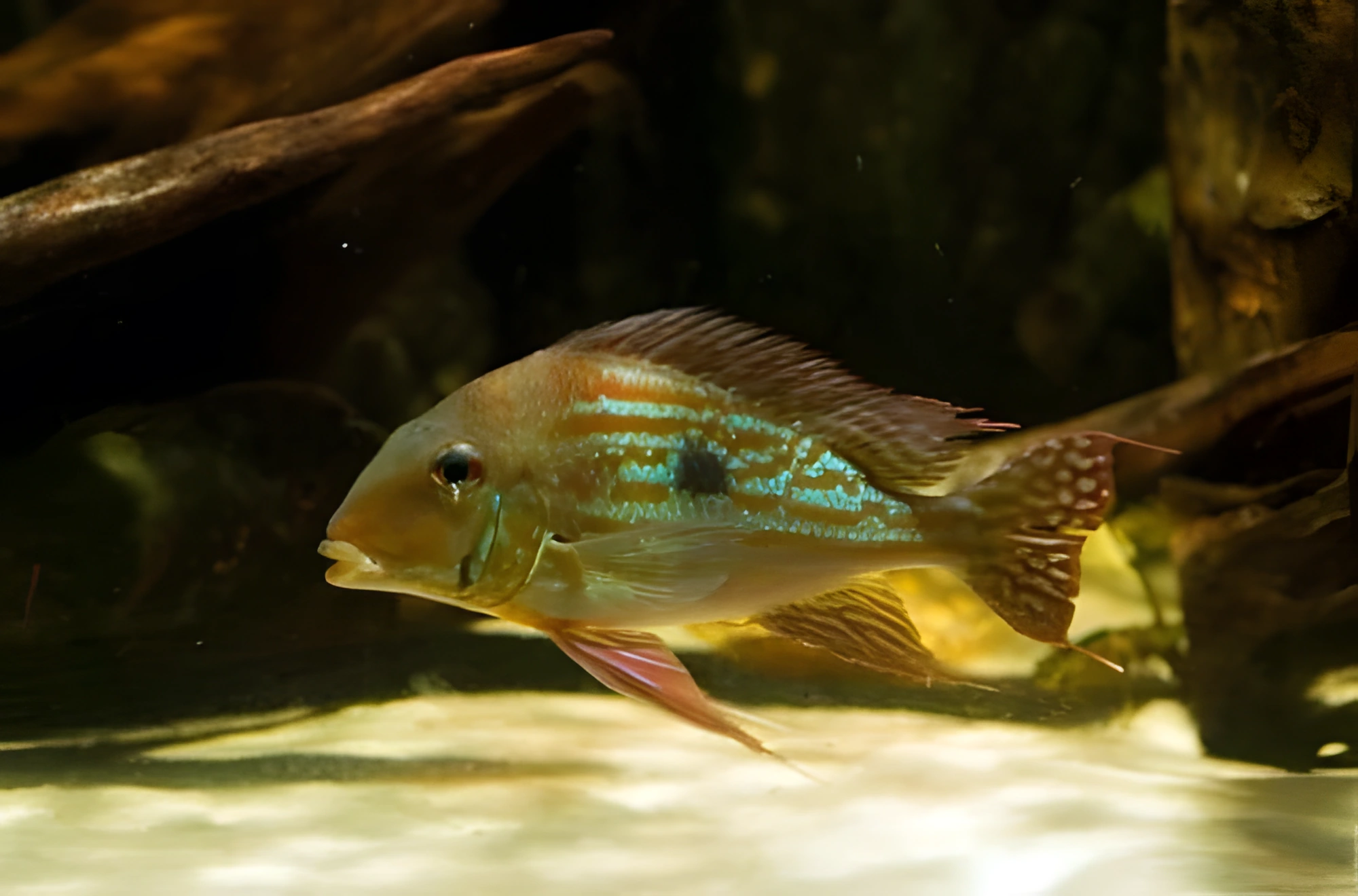
Adults of this fish typically reach 18–20 cm in length. Their bodies are brightly colored in yellow and orange tones, traversed by rows of blue horizontal stripes that extend from the head to the base of the tail. A distinctive dark spot can be observed in the central part of the body. The fins have a reddish hue, adorned with small light speckles. Sexual dimorphism in Geophagus winemilleri is weakly expressed, with no noticeable external differences between males and females.
Habitat
This species originates from South America, specifically from Venezuela, where it is found in the extensive Orinoco River basin. These fish prefer clean, clear waters, usually staying near gentle banks or islands in the middle of the river, where the bottom consists of soft substrates such as sand and silt.
Behavior and Compatibility
This fish is distinguished by its peaceful and calm disposition. It coexists well with many other species that thrive in similar conditions. However, caution should be exercised with very small fish (around 1 cm), as they may accidentally be eaten. Geophagus winemilleri prefer to live in groups of 5–8 individuals. With fewer individuals, there is an increased likelihood that the dominant male may show intolerance towards weaker conspecifics. The risk of such behavior is especially high if the aquarium volume is insufficient, for example, only 500 liters.
Care and Maintenance
For a group of 5 individuals, the aquarium should have a minimum volume of 500 liters. The setup should be simple, including two main elements: a sandy substrate and several snags. Special attention should be paid to the choice of substrate: it should not contain large abrasive particles to prevent them from getting stuck in the fish's mouth during feeding. Rooted plants are not recommended, as they are likely to be uprooted. However, floating plants are perfectly acceptable and can serve as an additional source of shade. Long-term and successful keeping of Geophagus winemilleri directly depends on maintaining stable water parameters — such as pH and dGH — within a strictly defined and rather narrow permissible range. Additionally, the water should be rich in dissolved tannins. In nature, these substances are formed by the decomposition of organic material (branches, roots, tree leaves, etc.) that enters water bodies in large quantities, and it is these that give the water its characteristic brown tint. In aquarium conditions, leaves from certain trees can also be a source of tannins. It is extremely important to remember that during feeding, fish can create clouds of suspended particles that can enter the filtration system. This aspect must be taken into account when choosing a specific filter model and its placement in the aquarium to prevent possible negative consequences.
Diet
In their natural habitat, these fish feed by sifting sand from the bottom with their mouths in search of small organisms. To recreate optimal feeding conditions in the aquarium, fine-grained sandy substrate must be used. It is recommended to offer the fish sinking dry foods with an obligatory content of vegetable components, which should be combined with frozen artemia, daphnia, and finely chopped bloodworms. It is important that the food particles are small.
Breeding and Reproduction
Under favorable conditions, these fish are capable of regular breeding. In aquariums, no seasonal dependence in reproduction is observed. With the onset of the breeding season, the alpha male and female form a pair for a short period and occupy a specific area on the bottom. After brief courtship, the female begins to lay eggs, a few at a time. In total, a clutch can consist of up to 200 eggs. Any flat surface, be it a snag or a large stone, usually serves as a spawning site. The incubation period lasts approximately 72 hours. Throughout this time, the parents stay nearby, vigilantly guarding their future offspring from any possible threats. After the fry hatch, the female, sometimes with the help of the male, gathers them into her mouth, where they spend the first days of their lives (about one to two weeks). Subsequently, if danger arises, the fry continue to seek refuge in the parents' mouths until they reach a sufficiently large size. This strategy of protecting offspring is characteristic of many cichlids, found both in South America and on other continents, for example, among cichlids from African Lakes Tanganyika and Malawi.
Diseases
The main cause of diseases often lies in the keeping conditions: if they go beyond acceptable limits, immunity decreases, making the fish vulnerable to various infections inevitably present in the environment. At the first suspicion of illness, it is important first of all to check the water parameters and ensure there are no dangerous concentrations of nitrogen cycle products. Often, restoring normal, suitable conditions promotes recovery. However, in some cases, medication may be required. Detailed information on symptoms and treatment methods is presented in the "Aquarium Fish Diseases" section.
How to choose
When purchasing, choose active individuals with clean scales, even fins, and no visible damage or sores. It is important to inspect the gill area: in healthy fish, they should have a natural color, without signs of inflammation or plaque. Avoid specimens with sunken bellies, sluggish behavior, or those that stay near the water surface, as this may indicate problems with internal organs or water quality in the store.
- Make sure the fish show interest in food and actively explore the substrate if there is sand in the aquarium.
- Prioritize individuals from the same group, as they adapt more easily when moved together.
- Avoid purchasing fish if other individuals in the same tank show signs of infectious diseases.
Frequently asked questions
The essentials: size, tank volume, water parameters and care
How big does Geophagus winemilleri get?
An adult reaches 18–20 cm in length. Plan the tank around the maximum size: the fish quickly outgrows a cramped setup.
What size aquarium does Geophagus winemilleri need?
The minimum recommended volume is 500 L. A smaller tank speeds up nitrate build-up and raises stress levels.
What water parameters does Geophagus winemilleri need?
Temperature 26–30 °C, pH 4–7, hardness 0–8 dGH. Stability matters more than exact values: sudden swings are harder on the fish than a small deviation from the ideal.
How long does Geophagus winemilleri live?
Around 10 years when kept properly. Lifespan depends directly on tank volume, water quality and a varied diet.
Is Geophagus winemilleri aggressive?
Temperament: peaceful (regular). Keep this in mind when choosing tank mates.
How many Geophagus winemilleri should be kept together?
Recommended setup: medium group (6–8 individuals). Ignoring this is a common cause of stress and disease.
What does Geophagus winemilleri eat?
Diet type: high protein (predominantly meat). Feed small portions that are finished within a couple of minutes — overfeeding does more harm than underfeeding.
What is the scientific name of Geophagus winemilleri?
The scientific name of the species is Geophagus winemilleri, family Cichlids (Cichlidae).