Temperature24 – 32 °C
Natural range
- Ucayali River
- Solimões River
- Amazonas State
- Peru area
CichlidsConservation status: Least concern LC
Other scientific names: Chromys proxima
Geophagus proximus, known scientifically as Geophagus proximus, belongs to the family Cichlidae, or cichlids. This species is not frequently sold individually; it more often enters home aquariums as part of large shipments of other geophaguses. Keeping and breeding this fish usually do not present difficulties, making it an excellent choice for beginner aquarists. It coexists well with various freshwater species.
- Required aquarium volume
- 600 L
- Size in aquarium
- 20 – 22 cm
- Temperature
- 24 – 32 °C
- Temperament
- Peaceful (regular)
Parameters
Water pHAcidic (4) – Neutral (7)
Water dHVery soft (1) – Medium hardness (10)
Water salinityno salt (freshwater)
Size in aquarium20 – 22 cm
Lifespan15 years
TemperamentPeaceful (regular)
Toward small fishnot a predator
Required aquarium volume600 L
Lightingdimmed
Substratesandy (regular, light)
Water flowweak
FeedingSinking (any)
CareMedium group (6–8 individuals)
Description
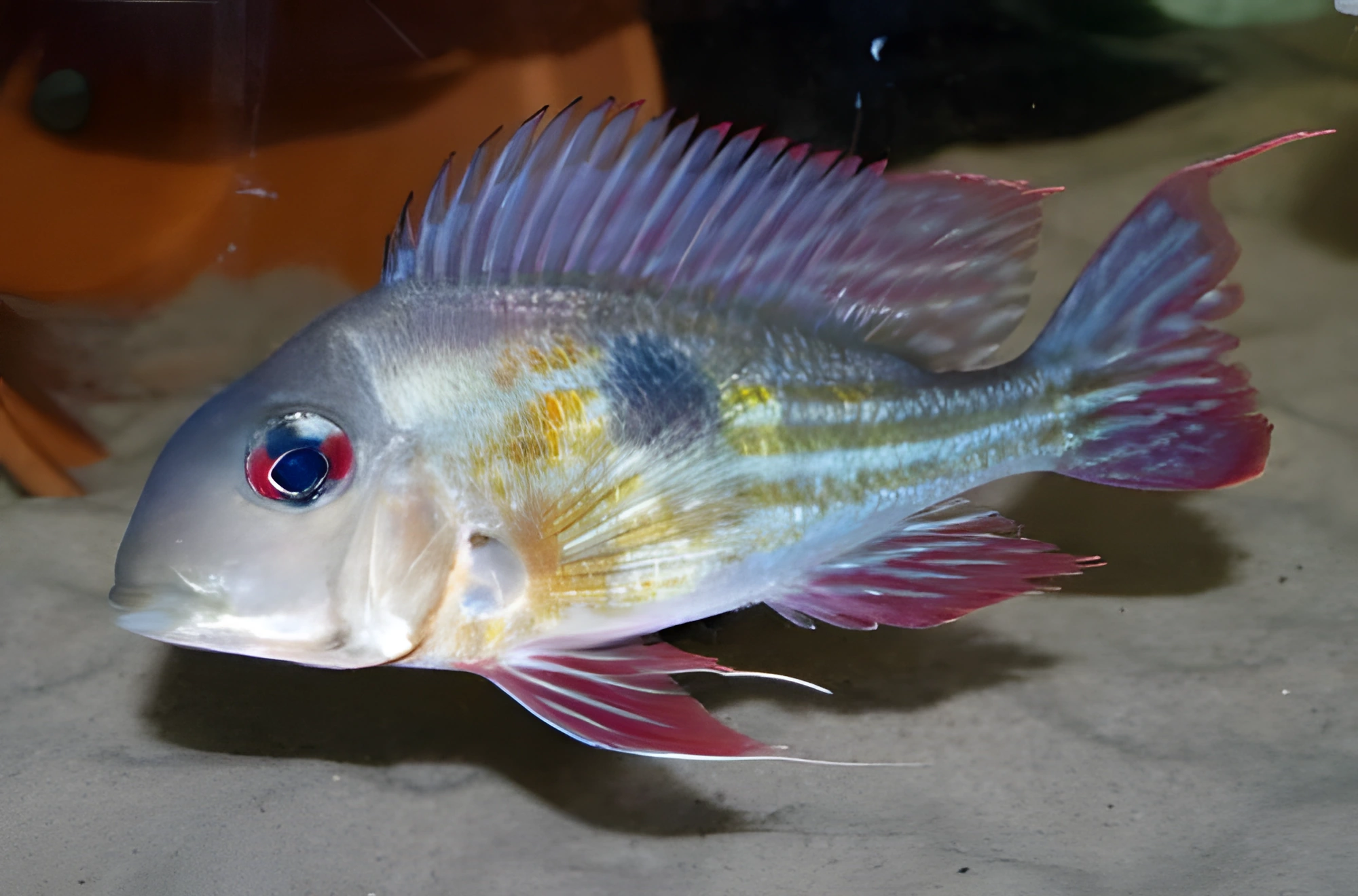
Adult Geophagus proximus grow up to 20–22 cm in length. Males can be distinguished by their slightly larger size, brighter coloration, and elongated last fin rays. Dominant alpha males often develop a characteristic nuchal hump. The fish's primary bluish hue is sometimes almost imperceptible due to pronounced yellow-orange pigmentation. A noticeable dark spot is located on the side of the body. The fins and tail are red with blue streaks and speckles.
Habitat
The natural habitat of Geophagus proximus is located in South America, covering the northeastern regions of Peru and the western territories of Brazil (Amazonas state). These fish inhabit the upper Amazon basin, from the Ucayali River to Solimões. They prefer areas with slow currents, where the sandy bottom is abundantly covered with driftwood. The water in these places has a rich brown tint due to the high content of tannins, which are formed during the decomposition of plant organic matter.
Behavior and Compatibility
Geophagus proximus is a peaceful fish, well compatible with many freshwater species. However, it is advisable to avoid cohabitation with aggressive or territorial fish, as well as very small species. The latter may accidentally become food if they are careless. Intraspecific relationships in Geophagus proximus are based on a hierarchy, where alpha males dominate. Despite this social structure, weaker individuals are usually not attacked by stronger conspecifics. It is recommended to keep these fish in groups of 5–8 individuals.
Care and Maintenance
For a group consisting of 5–8 individuals, the minimum aquarium volume should be at least 600 liters. The decor can be free, but special attention should be paid to the substrate. It is recommended to use sand without coarse inclusions, such as gravel or small pebbles, as large stones can get stuck in the fish's mouth and damage its gills. Geophagus proximus prefers slightly acidic water with low carbonate hardness. It is desirable that the water contains a certain amount of dissolved tannins, which are characteristic of their natural environment. Often, dried leaves of some trees are added to the aquarium for this purpose, which release the necessary substances upon decomposition. However, in the case of Geophagus proximus, this can lead to excessive substrate pollution. A more optimal option would be to use special liquid essences; just a few drops will provide the desired effect. Long-term and successful keeping also requires maintaining stable water conditions. It is important to avoid sharp temperature fluctuations, sudden changes in pH and dGH values, and to control the concentrations of ammonia, nitrites, and nitrates. The installation of a powerful filtration system and regular aquarium maintenance play a key role in this.
Diet
These fish feed at the bottom, actively sifting the substrate with their mouths in search of food. Their natural diet includes small invertebrates, detritus particles, algal films, and other organic matter. In aquarium conditions, Geophagus proximus readily accepts most popular sinking foods with plant additives. These can be dry flakes, granules, as well as frozen artemia, daphnia, and chopped bloodworms. It is recommended to feed 3–4 times a day in small portions.
Breeding and Reproduction
These fish do not have special requirements for breeding. For successful spawning, regular aquarium maintenance and a quality diet are usually sufficient. During the spawning season, the male and female form a temporary pair, which sometimes lasts for several years. The fish choose a spot on the bottom for future spawning, most often a flat surface, such as a stone. The female lays up to 200 eggs, which she takes into her mouth after fertilization. The eggs will remain there throughout the incubation period. The male may also participate in this process. After hatching, the fry remain in this safe haven – in the parents' mouths. Adult fish periodically release them for short free swims, gradually increasing the duration of these "outings." The parents continue to care for their offspring until they are large enough, after which the adults' interest in the fry wanes.
Diseases
The main cause of diseases often lies in the keeping conditions: if they go beyond acceptable limits, immunity decreases, making the fish vulnerable to various infections inevitably present in the environment. At the first suspicion of illness, it is important first of all to check the water parameters and ensure there are no dangerous concentrations of nitrogen cycle products. Often, restoring normal, suitable conditions promotes recovery. However, in some cases, medication may be required. Detailed information on symptoms and treatment methods is presented in the "Aquarium Fish Diseases" section.
How to choose
When purchasing, choose active individuals with clean fins and no external damage to the body. It is important to ensure there is no film, spots, or signs of emaciation, as the fish should show interest in their surroundings and food. Avoid specimens with sunken bellies or apathetic behavior, lingering in the corners of the aquarium. Since the species is schooling, it is recommended to acquire a group of 5–8 individuals simultaneously to establish a proper social hierarchy and reduce stress in the fish.
Frequently asked questions
The essentials: size, tank volume, water parameters and care
How big does Geophagus proximus get?
An adult reaches 20–22 cm in length. Plan the tank around the maximum size: the fish quickly outgrows a cramped setup.
What size aquarium does Geophagus proximus need?
The minimum recommended volume is 600 L. A smaller tank speeds up nitrate build-up and raises stress levels.
What water parameters does Geophagus proximus need?
Temperature 24–32 °C, pH 4–7, hardness 1–10 dGH. Stability matters more than exact values: sudden swings are harder on the fish than a small deviation from the ideal.
How long does Geophagus proximus live?
Around 15 years when kept properly. Lifespan depends directly on tank volume, water quality and a varied diet.
Is Geophagus proximus aggressive?
Temperament: peaceful (regular). Keep this in mind when choosing tank mates.
How many Geophagus proximus should be kept together?
Recommended setup: medium group (6–8 individuals). Ignoring this is a common cause of stress and disease.
What does Geophagus proximus eat?
Diet type: sinking (any). Feed small portions that are finished within a couple of minutes — overfeeding does more harm than underfeeding.
What is the scientific name of Geophagus proximus?
The scientific name of the species is Geophagus proximus, family Cichlids (Cichlidae). It also appears in the literature as: Chromys proxima.