Temperature26 – 32 °C
Natural range
- South America area
CichlidsConservation status: Least concern LC
Belonging to the Cichlidae family, Geophagus altifrons is an aquarium fish with the scientific name Geophagus altifrons. This species is quite large and places significant demands on aquarium volume and keeping conditions, making it not the easiest choice for those just starting their journey in aquaristics.
- Required aquarium volume
- 500 L
- Size in aquarium
- 20 – 22 cm
- Temperature
- 26 – 32 °C
- Temperament
- Peaceful (regular)
Parameters
Water pHAcidic (4.8) – Neutral (6.6)
Water dHVery soft (0) – Soft (5)
Water salinityno salt (freshwater)
Size in aquarium20 – 22 cm
Lifespan15 years
TemperamentPeaceful (regular)
Toward small fishnot a predator
Required aquarium volume500 L
Lightingdimmed
Substratesandy (regular, light)
Water flowweak
FeedingHigh protein (predominantly meat)
CareMedium group (6–8 individuals)
Description
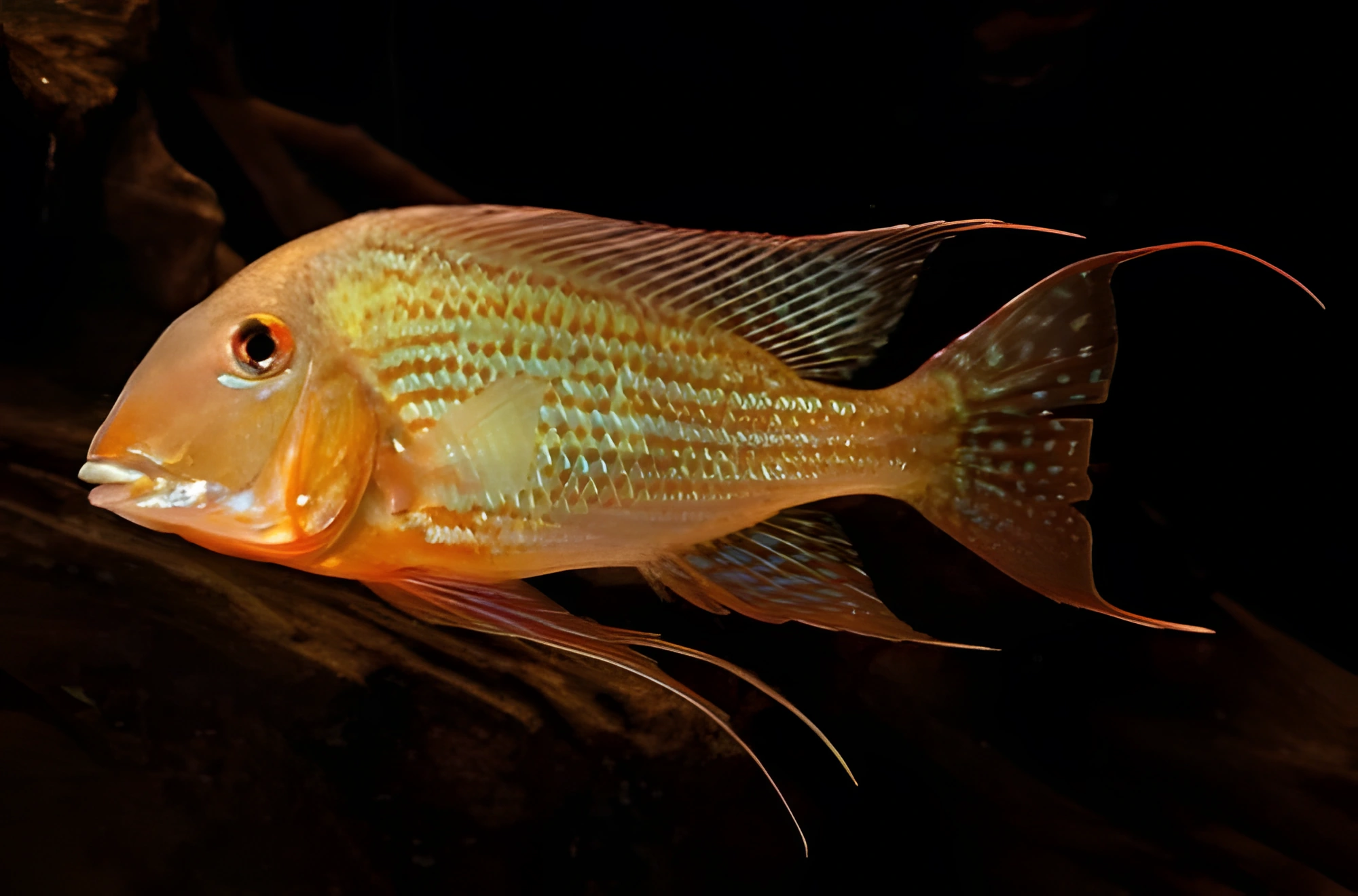
Adults can reach a length of 20–22 cm. Their coloration varies depending on their origin: reddish-orange as well as blue variations can be found. Despite some researchers' assumptions about the existence of several subspecies related to these color differences, all are currently classified as Geophagus altifrons. Males and females of this species are almost indistinguishable externally—sexual dimorphism is extremely weak.
Habitat
The natural habitat of this species is in South America, in the Rio Negro basin, where it prefers the lower reaches of rivers and floodplain lakes. It is found in areas with sandy or silty bottoms, most often along shorelines in clear water bodies.
Behavior and Compatibility
These fish behave peacefully and calmly if kept in a group of 5–8 individuals in a sufficiently spacious aquarium. Otherwise, with fewer fish or in cramped conditions, the dominant male may display aggression towards weaker individuals. They coexist well with other fish species, but it should be noted that very small fish (about 1 cm) and their fry may accidentally be eaten.
Care and Maintenance
For long-term keeping of a group of 3–4 fish, an aquarium of at least 500 liters will be required. Substrate plays a key role in aquarium design: as mentioned, a sandy bottom is necessary. The use of coarse materials, gravel, or small pebbles can hinder the normal feeding process, and there is also a risk of them getting stuck in the fish's mouth. Several snags, imitating tree roots and branches, can be used as decorative elements. Live or artificial plants are not recommended, as they will likely be quickly uprooted. The water should meet a fairly narrow range of hydrochemical parameters—low hardness and high acidity, and also contain a large amount of dissolved tannins. In their natural environment, these substances give the Rio Negro water a brown tint. In the aquarium, dried leaves of certain trees will be the source of tannins. Details can be found in the article "Which tree leaves can be used in an aquarium." Maintaining optimal water quality largely depends on weekly water changes of 50–70% with fresh water, as well as the efficiency of the filtration system. It is important that the filter model and its placement minimize sand ingress, as the fish stir it up in the aquarium with each feeding.
Diet
Geophagus altifrons feed at the bottom: they sift sand through their mouths and gills in search of the smallest particles of zoo- and phytoplankton. For the complete nutrition of these fish, the presence of a sandy substrate in the aquarium is important. Foods should be sinking, and their particles must be small enough, as despite their size, the fish are unable to swallow large pieces. The diet can consist of dry flakes or granules with vegetable additives, supplemented with frozen artemia, daphnia, and bloodworm pieces.
Breeding and Reproduction
Geophagus altifrons successfully breed in aquarium conditions. It appears that there is no specific factor in an artificial environment that stimulates spawning, so the breeding period can begin at any time. After a short courtship period, the male and female choose an area on the bottom that will serve as their temporary territory for raising offspring. The female gradually lays eggs on a suitable surface, such as a snag or a flat stone. Immediately after fertilization, she collects them in her mouth, after which she lays the next batch. The total number of eggs can reach 200, and all will remain in the female's mouth throughout the incubation period. This strategy of mouthbrooding is a special protective mechanism for the future offspring, characteristic of many cichlids, including those outside the South American continent. After hatching, the fry initially remain in the shelter, leaving it only on days 8–11, but they stay close to the female. The male remains nearby throughout this time, patrolling the territory. Sometimes the roles in the pair change, and then the male takes care of brooding the offspring, while the female provides protection.
Diseases
The main cause of diseases often lies in the keeping conditions: if they go beyond acceptable limits, immunity decreases, making the fish vulnerable to various infections inevitably present in the environment. At the first suspicion of illness, it is important first of all to check the water parameters and ensure there are no dangerous concentrations of nitrogen cycle products. Often, restoring normal, suitable conditions promotes recovery. However, in some cases, medication may be required. Detailed information on symptoms and treatment methods is presented in the "Aquarium Fish Diseases" section.
How to choose
When selecting individuals, pay attention to their activity and the absence of visible damage to the body or fins. Healthy fish should show interest in their surroundings and display natural behavior characteristic of the species, including periodic sifting of the substrate. Avoid specimens with sunken bellies, signs of emaciation, or unnaturally bloated abdomens, as well as fish that stay at the water surface or appear apathetic.
Since geophagus are schooling fish, it is recommended to purchase a group of 5–8 individuals simultaneously to reduce stress levels and avoid aggression from dominant individuals in the future. It is important to ask the seller what type of food the fish are accustomed to, as an abrupt change in diet can negatively affect their adaptation to a new aquarium.
Frequently asked questions
The essentials: size, tank volume, water parameters and care
How big does Geophagus altifrons get?
An adult reaches 20–22 cm in length. Plan the tank around the maximum size: the fish quickly outgrows a cramped setup.
What size aquarium does Geophagus altifrons need?
The minimum recommended volume is 500 L. A smaller tank speeds up nitrate build-up and raises stress levels.
What water parameters does Geophagus altifrons need?
Temperature 26–32 °C, pH 4.8–6.6, hardness 0–5 dGH. Stability matters more than exact values: sudden swings are harder on the fish than a small deviation from the ideal.
How long does Geophagus altifrons live?
Around 15 years when kept properly. Lifespan depends directly on tank volume, water quality and a varied diet.
Is Geophagus altifrons aggressive?
Temperament: peaceful (regular). Keep this in mind when choosing tank mates.
How many Geophagus altifrons should be kept together?
Recommended setup: medium group (6–8 individuals). Ignoring this is a common cause of stress and disease.
What does Geophagus altifrons eat?
Diet type: high protein (predominantly meat). Feed small portions that are finished within a couple of minutes — overfeeding does more harm than underfeeding.
What is the scientific name of Geophagus altifrons?
The scientific name of the species is Geophagus altifrons, family Cichlids (Cichlidae).