Temperature20 – 24 °C
Natural range
- Borneo area
- West Kalimantan area
LoachesConservation status: Near threatened NT
The Zebra Gastromyzon, also known by its scientific name Gastromyzon zebrinus, belongs to the family Balitoridae. This species does not attract the attention of all aquarists, which is due to its unusual appearance, constant bottom-dwelling lifestyle, not the brightest coloration, and the need to create special keeping conditions. Therefore, it is mainly found among enthusiasts specializing in gastromyzons.
- Required aquarium volume
- 70 L
- Size in aquarium
- 6 cm
- Temperature
- 20 – 24 °C
- Temperament
- Peaceful (regular)
Parameters
Water pHSlightly acidic (6) – Neutral (7.5)
Water dHSoft (5) – Hard (12)
Water salinityno salt (freshwater)
Size in aquarium6 cm
Lifespan5 years
TemperamentPeaceful (regular)
Toward small fishnot a predator
Required aquarium volume70 L
Lightingmoderate or bright
Substraterocky (rock formations, boulders, etc.)
Water flowmoderate or strong
FeedingSinking (plant-based)
CareBoth solitary and in group (flexible)
Description
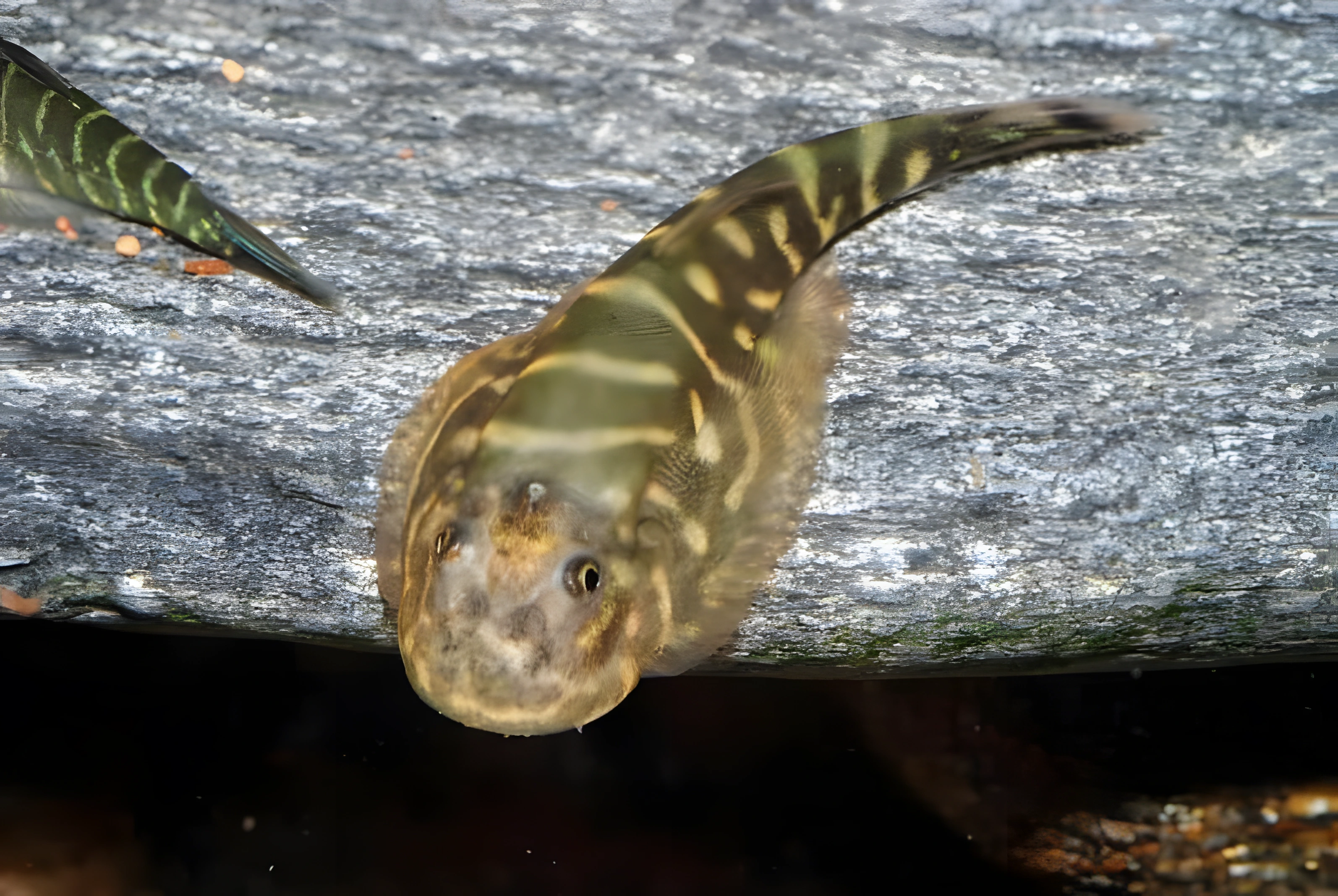
Adult Zebra Gastromyzons reach a length of about 6 cm. Their body has the strongly flattened-from-above shape characteristic of gastromyzons, which resembles a disc in the anterior part. Large pectoral fins follow the contour of the body, enhancing its roundness. This disc-shaped body, combined with a mouth apparatus that functions as a suction cup, allows the fish to effectively hold on in strong currents. Their coloration is dark gray or brownish with yellowish markings that form stripes on the back. It is this striped pattern that gave the species the name "zebra." Sexual dimorphism is weakly expressed, making sex determination difficult.
Habitat
The natural range of these fish covers Southeast Asia; in particular, they are endemic to the island of Borneo. They can be found in the mountain rivers of the Indonesian province of West Kalimantan. The typical habitat of the Zebra Gastromyzon is shallow sections of mountain rivers or streams. These areas are characterized by fast, and sometimes turbulent, currents, abundant with rapids, cascades, and waterfalls. The bottom of such bodies of water is usually covered with gravel, rocks, and boulders. Riparian aquatic vegetation is found mainly on the banks.
Behavior and Compatibility
Although the Zebra Gastromyzon is considered a territorial fish, its temperament is peaceful. Such territorial behavior manifests if food is distributed throughout the aquarium; they will not be able to peacefully consume food in one place. These fish feel great in the company of their kin and other non-aggressive species of comparable size. However, due to specific habitat requirements, the number of compatible species is small. For example, other loaches and gastromyzons will make good tankmates, and in less intense currents, danios, barbs, and other cyprinids.
Care and Maintenance
For a group of 3–4 Zebra Gastromyzons, an aquarium of at least 70 liters is optimal. The long-term well-being of these fish is ensured by maintaining clean water rich in dissolved oxygen, as well as creating a moderate or strong current, mimicking a mountain river. One or more internal filters will do an excellent job of this; their number depends on the size of the aquarium. It is desirable that the water volume be renewed 10–15 times per hour; thus, for a 100-liter aquarium, a filter with a capacity of at least 1000 liters per hour will be required. When decorating an aquarium with such a turbulent current, the choice of decorations is limited. Light elements should be avoided. The basis of the composition should be stones, pebbles, rock fragments, and several massive natural snags. Under bright lighting, snags will become a substrate for the growth of natural algae, providing an additional food source. Not all live plants will be able to thrive in such an environment. Preference should be given to varieties that can firmly attach to snags and withstand moderate current, such as Anubias, Java fern, Crinum, and others.
Diet
In their natural environment, Zebra Gastromyzons feed on algae that grow on the surface of stones and snags, as well as microorganisms living in these algae. In a home aquarium, their diet should primarily consist of plant-based food, supplemented with protein components. The choice of suitable foods is limited due to the strong current these fish require. The most natural option is natural algae, whose active growth can be stimulated by intense lighting. However, it is important to control that the algae do not overgrow. Another suitable type of food is special gel-like or paste-like products, often supplied in tubes. These foods are recommended to be placed in different parts of the aquarium to prevent territorial behavior in the fish.
Breeding and Reproduction
Cases of successful breeding of Zebra Gastromyzons in home aquariums have been recorded, but this requires significant experience from the aquarist and is unlikely to be within the capabilities of beginners.
Diseases
Health problems usually arise only with injuries or keeping in unfavorable conditions, which weakens the immune system and, consequently, provokes the development of various diseases. At the first signs of illness, it is primarily necessary to test the water to rule out exceeding certain parameters or the presence of dangerous concentrations of toxic substances (such as nitrites, nitrates, ammonia, etc.). After detecting and eliminating deviations and bringing all parameters back to normal, treatment can begin. More detailed information on symptoms and therapy methods is presented in the "Aquarium Fish Diseases" section. Source of scientific data: The Catalogue of Life
How to choose
When choosing a zebra gastromyzon, it should be considered that this species is often supplied in mixed batches with other related suckerfish. Carefully inspect the aquarium in the store: healthy individuals should actively move along the glass or stones, using their suction-cup fins, and show no visible damage, ulcers, or signs of emaciation. Avoid buying fish with sunken bellies, which often indicates prolonged starvation or digestive problems after transportation.
- choose individuals with clean coloration without white spots or film on the body and fins
- observe their behavior: a healthy fish should periodically make short dashes across surfaces, and not lie motionless in a corner or on the substrate
- ask the seller how long the fish have been in the store, as the adaptation period for this species is difficult and requires quarantine in conditions with high oxygen content
Frequently asked questions
The essentials: size, tank volume, water parameters and care
How big does Zebra Gastromyzon get?
An adult reaches 6 cm in length. Plan the tank around the maximum size: the fish quickly outgrows a cramped setup.
What size aquarium does Zebra Gastromyzon need?
The minimum recommended volume is 70 L. A smaller tank speeds up nitrate build-up and raises stress levels.
What water parameters does Zebra Gastromyzon need?
Temperature 20–24 °C, pH 6–7.5, hardness 5–12 dGH. Stability matters more than exact values: sudden swings are harder on the fish than a small deviation from the ideal.
How long does Zebra Gastromyzon live?
Around 5 years when kept properly. Lifespan depends directly on tank volume, water quality and a varied diet.
Is Zebra Gastromyzon aggressive?
Temperament: peaceful (regular). Keep this in mind when choosing tank mates.
How many Zebra Gastromyzon should be kept together?
Recommended setup: both solitary and in group (flexible). Ignoring this is a common cause of stress and disease.
What does Zebra Gastromyzon eat?
Diet type: sinking (plant-based). Feed small portions that are finished within a couple of minutes — overfeeding does more harm than underfeeding.
What is the scientific name of Zebra Gastromyzon?
The scientific name of the species is Gastromyzon zebrinus, family Balitoridae.