Temperature16 – 22 °C
Natural range
- Northern Thailand area
- Thailand area
LoachesConservation status: Data deficient DD
Hemimyzon nanensis, known as the Nan River Gastromyzon, belongs to the family Balitoridae. This fish is native to Southeast Asia, specifically Thailand, which is part of the Indochina region. It was first discovered in the Nan River, a tributary of the large Chao Phraya River. It is highly probable that this species inhabits the entire basin of this large river. Its natural habitat consists of the upper reaches of rivers, characterized by fast and turbulent currents. A typical biotope is a shallow mountain stream with numerous cascades, where sandbanks and rock formations develop. Aquatic vegetation is usually absent in such places.
- Required aquarium volume
- 80 L
- Size in aquarium
- 5 – 6 cm
- Temperature
- 16 – 22 °C
- Temperament
- Peaceful (regular)
Parameters
Water pHSlightly acidic (6) – Slightly alkaline (8)
Water dHVery soft (2) – Hard (15)
Water salinityno salt (freshwater)
Size in aquarium5 – 6 cm
Lifespan8 years
TemperamentPeaceful (regular)
Toward small fishnot a predator
Required aquarium volume80 L
Lightingmoderate (regular)
Substratesandy (regular, light)
Water flowmoderate or strong
FeedingPlant-based (algae, vegetables)
CareHarem (1 male and several females)
Description
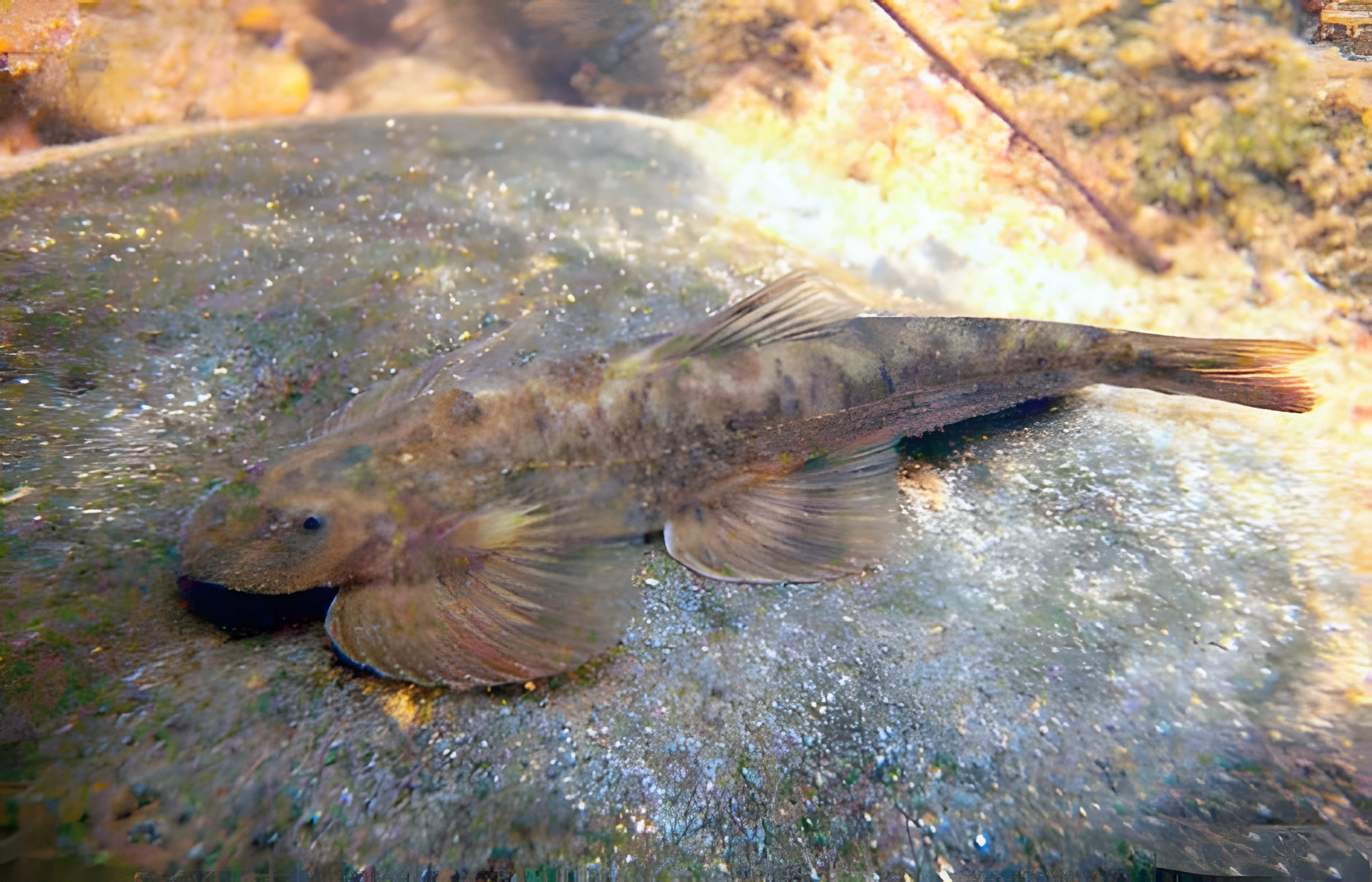
Adult individuals of this fish reach a length of 5–6 cm. Through evolution, the Nan River Gastromyzon has developed a unique flattened body, allowing it to successfully withstand strong currents and firmly cling to slippery rocks. The fish's coloration is subdued, brownish, with lighter shades in certain areas, serving as natural camouflage on the sandy-stony bottom.
Habitat
The species is endemic to the Nan River basin, a tributary of the Chao Phraya River in northern Thailand. In nature, it inhabits shallow, fast-flowing mountain streams and tributaries with high oxygen content. It prefers areas with rocky, sandy, or gravel bottoms, where boulders and pebbles covered with a layer of algae and biofilm are present. The water in such biotopes is usually clear, and the current can be very intense.
Behavior and Compatibility
The Nan River Gastromyzon exhibits territoriality. Nevertheless, this fish prefers to stay in groups of its kind, provided there is enough space for each on the aquarium bottom. Its temperament is peaceful, but due to specific keeping requirements (the need for strong current), the range of compatible species is limited. Among harmless fish that can comfortably live in similar conditions are Barilius dogaringa, Garra rufa, various large Danios, some Rasboras, Taiwan Gobies, Akysis catfish, and related loaches from the genus Gastromyzon.
Care and Maintenance
For keeping 4 fish, the optimal aquarium volume starts from 80 liters. Here, the bottom area is much more important than the tank height. The aquarium decor should be simple, including coarse sand, pebbles, as well as large boulders and stones. Several natural snags can be placed on the substrate. Many aquarium plants do not tolerate strong currents well and cannot take root in soft sand. However, if desired, aquatic mosses and ferns can be used, which are attached to stones and snags without the need for planting in the substrate. A key condition for successful keeping of Nan River Gastromyzons is ensuring clean water with minimal organic waste, as well as creating a moderate or strong current. To achieve these tasks, a powerful filter will be required, for example, a system of one or two internal filters. Such filters not only guarantee water purity but also provide the necessary internal current. Regular aquarium maintenance should not be forgotten. In particular, a portion of the water should be replaced with fresh water weekly, accumulated waste removed, and equipment preventive maintenance performed. In their natural habitat, they feed on the algal film covering stones and the small organisms inhabiting it. In a home aquarium, it is recommended to offer foods with a high content of plant components, such as spirulina and similar ingredients. Special briquettes, pastes, or tablets that can be securely fixed to the bottom without fear of being carried away by the current will be an excellent choice. Source of scientific data: The Catalogue of Life
Diet
In natural conditions, these fish feed on the layer of algal film that forms on stones, as well as the organisms inhabiting it. In a home aquarium, foods rich in plant components should be offered, for example, those containing spirulina and similar ingredients. Convenient solutions include special briquettes, pastes, or tablets that can be easily fixed to the bottom, preventing them from being carried away by the current. Data source: The Catalogue of Life.
Breeding and Reproduction
Breeding this species in aquariums is a challenging task and requires creating specific conditions that mimic a mountain stream. To stimulate spawning, cooler water changes, increased current, and an increased proportion of protein-rich foods in the diet are used. Fish use stones and snags as a substrate for spawning. After spawning, it is recommended to transfer the eggs to a separate container with similar water parameters to prevent them from being eaten by adult individuals. Fry are fed with small live foods, such as infusoria and Artemia nauplii.
Diseases
This species is susceptible to common diseases associated with improper keeping conditions, such as bacterial infections, fungal lesions, and parasitic infestations. The main risk factors are low oxygen levels, high concentrations of organic matter in the water, and lack of current, which leads to stress and weakened immunity. Prevention involves maintaining water cleanliness, ensuring powerful aeration, and regular filtration that mimics natural current.
How to choose
When selecting individuals, pay attention to their activity and plumpness. Avoid specimens with signs of emaciation, damaged fins, ulcers, or unnatural spots on the body. Healthy fish should actively move across hard surfaces and show interest in foraging. Ask the store employee to feed the fish: refusal to eat may indicate stress or poor health, which is common in recently imported specimens.
Frequently asked questions
The essentials: size, tank volume, water parameters and care
How big does Nan River Gastromyzon get?
An adult reaches 5–6 cm in length. Plan the tank around the maximum size: the fish quickly outgrows a cramped setup.
What size aquarium does Nan River Gastromyzon need?
The minimum recommended volume is 80 L. A smaller tank speeds up nitrate build-up and raises stress levels.
What water parameters does Nan River Gastromyzon need?
Temperature 16–22 °C, pH 6–8, hardness 2–15 dGH. Stability matters more than exact values: sudden swings are harder on the fish than a small deviation from the ideal.
How long does Nan River Gastromyzon live?
Around 8 years when kept properly. Lifespan depends directly on tank volume, water quality and a varied diet.
Is Nan River Gastromyzon aggressive?
Temperament: peaceful (regular). Keep this in mind when choosing tank mates.
How many Nan River Gastromyzon should be kept together?
Recommended setup: harem (1 male and several females). Ignoring this is a common cause of stress and disease.
What does Nan River Gastromyzon eat?
Diet type: plant-based (algae, vegetables). Feed small portions that are finished within a couple of minutes — overfeeding does more harm than underfeeding.
What is the scientific name of Nan River Gastromyzon?
The scientific name of the species is Hemimyzon nanensis, family Balitoridae.