Temperature20 – 27 °C
Natural range
- Mekong River Basin
- Laos area
- Vietnam area
- Cambodia area
CyprinidsConservation status: Least concern LC
Other scientific names: Cirrhina cambodgiensis, Garra parvifilum, Garra taeniata, Garra taeniatops
Garra cambodgiensis, also known as the false Siamese algae eater or Cambodian Garra, belongs to the family Cyprinidae (Carps). This herbivorous inhabitant of mountain rivers has high demands for water quality and requires strong internal current. Its breeding in aquarium conditions is very difficult. Therefore, this fish is usually not recommended for beginner aquarists.
- Required aquarium volume
- 250 L
- Size in aquarium
- 12 – 15 cm
- Temperature
- 20 – 27 °C
- Temperament
- Peaceful (regular)
Parameters
Water pHSlightly acidic (6) – Neutral (7.5)
Water dHVery soft (1) – Hard (15)
Water salinityno salt (freshwater)
Size in aquarium12 – 15 cm
Lifespan9 years
TemperamentPeaceful (regular)
Toward small fishnot a predator
Required aquarium volume250 L
Lightingbright
Substrateany (no restrictions)
Water flowmoderate
FeedingPlant-based (algae, vegetables)
CareSmall group (3–4 individuals)
Description
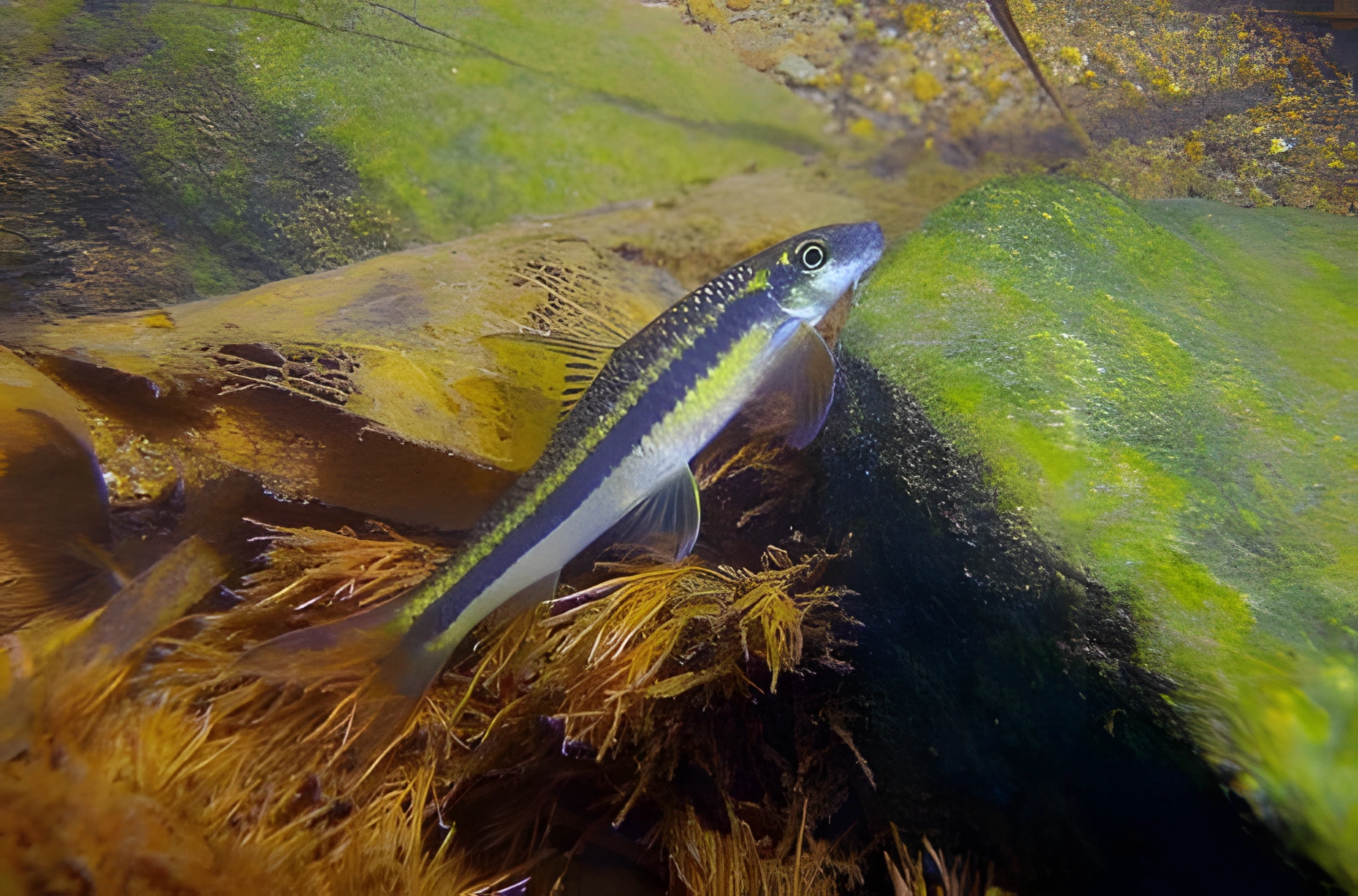
Adults of this fish reach a length of 12 to 15 cm. In appearance, it resembles the Siamese algae eater, which inhabits the same regions. The fish's body is adorned with a wide black stripe that runs from head to tail, bordered above by a golden line; its back is gray, and its belly is silvery. Sexual dimorphism in the species is weakly expressed; the most noticeable differences appear during the spawning period, when males develop small but numerous tubercles on their heads and reddish pigmentation around the mouth.
Habitat
The homeland of this fish is parts of Southeast Asia, located on the Indochinese Peninsula. Its natural habitat is the Mekong basin, one of the largest rivers in the region. It is found in the territories of Laos, Vietnam, Cambodia, and Thailand, preferring the headwaters of rivers with fast currents. The water here is clear and rich in oxygen, and the bottom consists of stones and boulders.
Behavior and Compatibility
This fish has a peaceful nature if kept in a group of its own kind. If kept alone, it may show aggression towards other aquarium inhabitants. It is advisable to acquire them in groups of 3–4 individuals; however, false Siamese algae eaters will not form a school but will keep separately.
Care and Maintenance
For a group of 3–4 fish, an aquarium of at least 250 liters will be optimal. In terms of decor, it is recommended to recreate the conditions of a mountain river, using a substrate of stones, sand, and fine gravel. You can also add several snags, on which plants capable of growing on woody surfaces, such as Anubias, Bolbitis, or Java moss, will be attached. For long-term keeping of Cambodian Garra, it is critically important to provide a strong internal current, maintain high water quality, and an adequate concentration of dissolved oxygen. An effective filtration system will help cope with these tasks. The water flow rate in the aquarium should be about 10 volumes per hour. This means that for a 250-liter aquarium, the filter must pump 2500 liters of water per hour. Bright lighting promotes the growth of algae on the surface of stones, which will serve as an additional food source.
Diet
In natural conditions, the main food for Garra consists of algal films abundantly covering the surface of boulders. In aquarium conditions, the diet can be based on spirulina-based foods, as well as fresh vegetables such as cucumber, zucchini, or melon. It is important to remember that this is not an exclusively herbivorous species. In addition to plant-based food, protein products should be offered, for example, bloodworms, pieces of shrimp, and dry granulated foods.
Breeding and Reproduction
The probability of successful breeding in home aquariums is extremely low. According to a 2004 study published in the book "Induced Spawning and Early Development of Stonelapping Minnow" (ISBN 3-86004-182-7: 399), induced spawning in artificial conditions was achieved only with the use of hormones. It was found that the incubation period for eggs was 15–16 hours at temperatures from 25 to 29°C, with fry survival exceeding 90% in the first month.
Diseases
The main causes of most diseases in these fish are usually unsuitable keeping conditions and low-quality food. Upon detecting the first signs of illness, the primary task is to check water parameters and determine the concentration of ammonia, nitrites, and nitrates. It is necessary to normalize the parameters before starting any treatment. More detailed information on symptoms and treatment methods can be found in the "Aquarium Fish Diseases" section.
How to choose
When purchasing, choose active individuals with clean skin, without visible damage, ulcers, or spots. It is important to avoid fish with signs of emaciation, sunken bellies, or behavioral anomalies such as lethargy or constant presence at the water surface. Since the species is territorial, it is recommended to assess the keeping conditions in the store beforehand and ensure that the fish do not show excessive aggression towards conspecifics in overcrowded aquariums. A healthy individual should show interest in its surroundings and actively explore the substrate or decorations, which is characteristic of their natural behavior. It should be noted that albino forms may be more sensitive to water quality, so it is worth clarifying the keeping parameters in the commercial aquarium before purchasing. Avoid buying fish that look frightened or have damaged fins, as this may indicate stress or poor transportation conditions.
Frequently asked questions
The essentials: size, tank volume, water parameters and care
How big does Cambodian Garra get?
An adult reaches 12–15 cm in length. Plan the tank around the maximum size: the fish quickly outgrows a cramped setup.
What size aquarium does Cambodian Garra need?
The minimum recommended volume is 250 L. A smaller tank speeds up nitrate build-up and raises stress levels.
What water parameters does Cambodian Garra need?
Temperature 20–27 °C, pH 6–7.5, hardness 1–15 dGH. Stability matters more than exact values: sudden swings are harder on the fish than a small deviation from the ideal.
How long does Cambodian Garra live?
Around 9 years when kept properly. Lifespan depends directly on tank volume, water quality and a varied diet.
Is Cambodian Garra aggressive?
Temperament: peaceful (regular). Keep this in mind when choosing tank mates.
How many Cambodian Garra should be kept together?
Recommended setup: small group (3–4 individuals). Ignoring this is a common cause of stress and disease.
What does Cambodian Garra eat?
Diet type: plant-based (algae, vegetables). Feed small portions that are finished within a couple of minutes — overfeeding does more harm than underfeeding.
What is the scientific name of Cambodian Garra?
The scientific name of the species is Garra cambodgiensis, family Cyprinids (Cyprinidae). It also appears in the literature as: Cirrhina cambodgiensis, Garra parvifilum, Garra taeniata.