Temperature15 – 24 °C
Natural range
- Southeastern United States
- Atlantic coastal plain area
LivebearersConservation status: Least concern LC
Other scientific names: Gambusia affinis, Gambusia holbrocki, Gambusia patruelis, Heterandria holbrooki, Schizophallus holbrooki, Zygonectes atrilatus
Gambusia, also known as the Mosquito fish, bears the scientific name Gambusia holbrooki and is a member of the Poeciliidae family. This lively and very active fish is renowned for its hardiness. It easily adapts to various water conditions, making it an excellent choice for beginner aquarists as their first fish. However, when choosing tank mates, one should be careful, as Gambusia can exhibit a rather pugnacious character.
- Required aquarium volume
- 40 L
- Size in aquarium
- 3 – 6 cm
- Temperature
- 15 – 24 °C
- Temperament
- Semi-peaceful (dangerous to smaller ones)
Parameters
Water pHSlightly acidic (6) – Slightly alkaline (8)
Water dHSoft (5) – Very hard (25)
Water salinityno salt (freshwater)
Size in aquarium3 – 6 cm
Lifespan2 years
TemperamentSemi-peaceful (dangerous to smaller ones)
Toward small fishnot a predator
Required aquarium volume40 L
Lightingmoderate (regular)
Substrateany (no restrictions)
Water flowweak
FeedingAny (universal)
CareSchooling (usually from 5–6 individuals and more)
Description
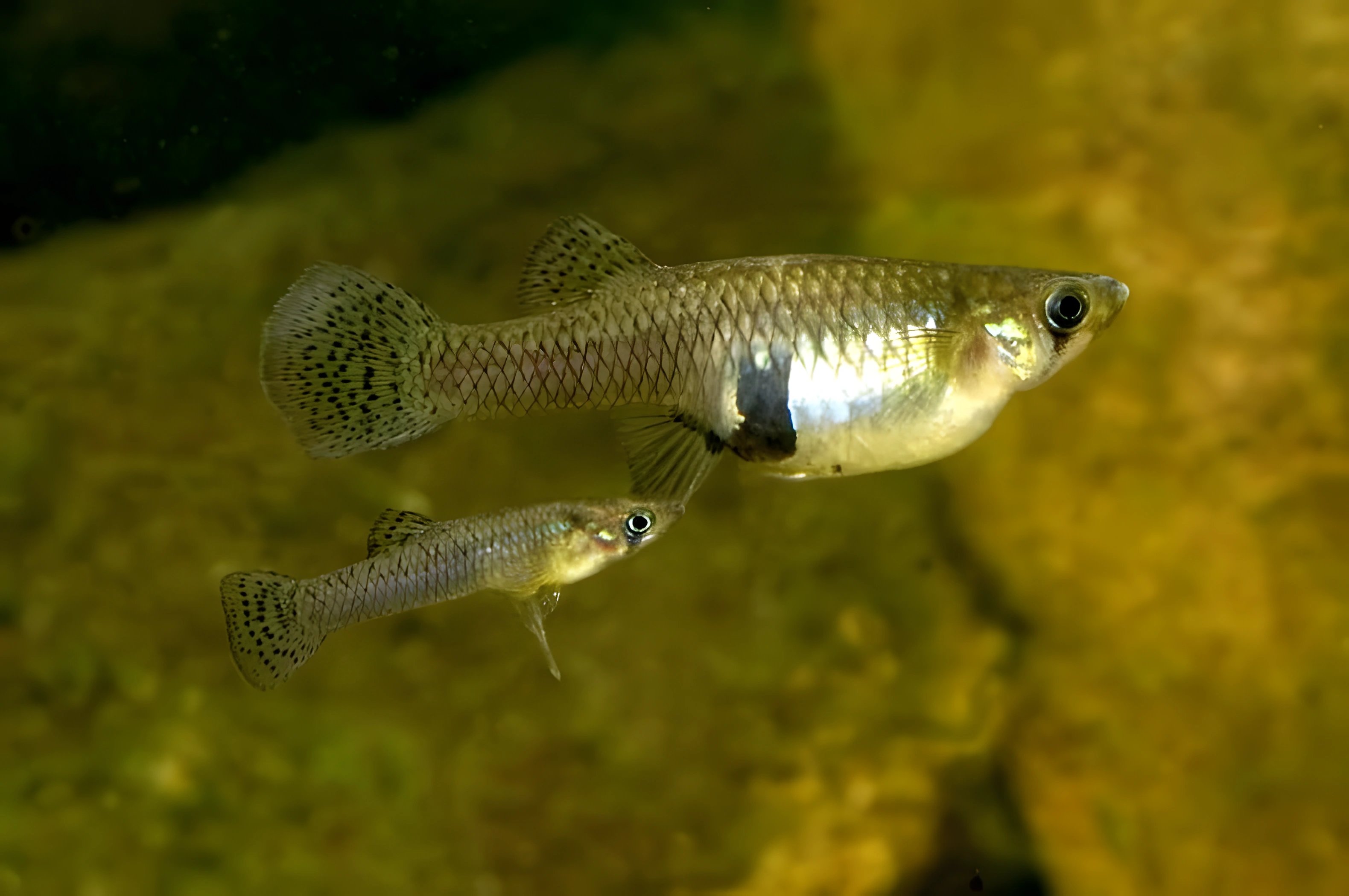
Gambusia is a small and rather slender fish. There are significant sexual differences between males and females: males are considerably more miniature and about half the size of females. Females, in turn, are larger and have a more rounded abdomen. Their coloration varies from yellowish-brown to dark. The caudal and dorsal fins are often adorned with black speckles. Females may also have a dark mark on their abdomen, located above the anal fin. Males possess a thin, modified anal fin used for fertilization.
Habitat
The natural habitat of this species includes shallow, swampy bodies of water in North America, where it is widely distributed. Gambusia have been artificially introduced into river systems where they were not previously found. This was done to combat blood-sucking insects, as they are known to eagerly consume mosquito larvae. Below are the care requirements and necessary conditions.
Behavior and Compatibility
This fish species is characterized by an uncooperative nature and tends to nip at the fins of other aquarium inhabitants. The most appropriate solution is to keep Gambusia in a separate aquarium, where they will be the only species. It is advisable to keep them in a shoal of at least 5–6 individuals. If kept alone, the fish lose vitality, become sluggish, and quickly perish.
Care and Maintenance
Gambusia is an extremely undemanding species that adapts excellently to a wide range of pH and GH values. These fish can survive in almost any water, which significantly simplifies their care. In a spacious aquarium abundant with rooted plants, specialized equipment, except for lighting, may not even be necessary. Plants will effectively take on the role of maintaining ecological balance. For disease prevention and cleanliness, it is recommended to perform weekly 10–20% water changes and clean the substrate with a siphon.
Diet
This species readily accepts various types of food. This includes dry foods such as flakes and granules, as well as frozen and live products — bloodworms, daphnia, or mosquito larvae. We recommend paying attention to Aqvium flake food for aquarium fish. This new product has become a bestseller on Ozon, receiving a 4.9 rating. The flake food is designed for most aquarium fish, and its raw materials are produced according to modern European Union standards (EU 2018/848). The product contains important vitamins: A, C, D3, E, as well as Omega 3-6. You can purchase it on Ozon.
Breeding and Reproduction
Gambusia is a quite prolific fish. No special conditions are required for spawning. Offspring appear several times a year. Fertilized eggs develop inside the female's body throughout the incubation period, and fully formed fry are born. This feature is a result of evolution and serves as effective protection for the offspring. Parents do not care for the fry; on the contrary, they may attack them if the young do not manage to find shelter in dense vegetation. Therefore, it is recommended to move the fry to a separate tank. Young should be fed micro-foods, as well as Artemia nauplii and other suitable foods.
Diseases
Diseases among these fish are quite rare. As a rule, they occur due to the aquarist's fault: poor keeping conditions, low water quality, contact with already sick fish, or physical injuries. More detailed information on symptoms and treatment methods can be found in the “Aquarium Fish Diseases” section.
How to choose
When choosing Gambusia, it should be noted that the species is rarely widely available for sale, so it is important to ensure correct fish identification. Healthy individuals should be active, exhibit natural schooling behavior for the species, and have clean skin without visible damage, ulcers, or film. Avoid specimens with signs of emaciation, clamped fins, or unnatural behavior, such as a constant desire to burrow into the substrate, which may indicate severe stress.
Since Gambusia can be carriers of dangerous parasites, such as the causative agents of bothriocephalosis, it is recommended to purchase fish only from reputable breeders or from healthy aquarium systems. When buying, be sure to clarify whether the fish were kept in conditions that exclude contact with local natural bodies of water, as this reduces the risk of invasion. In the store, pay attention to the keeping conditions: the presence of aggression towards tank mates is normal for this species, but in overcrowded tanks, fish can be severely injured.
Frequently asked questions
The essentials: size, tank volume, water parameters and care
How big does Gambusia get?
An adult reaches 3–6 cm in length. Plan the tank around the maximum size: the fish quickly outgrows a cramped setup.
What size aquarium does Gambusia need?
The minimum recommended volume is 40 L. A smaller tank speeds up nitrate build-up and raises stress levels.
What water parameters does Gambusia need?
Temperature 15–24 °C, pH 6–8, hardness 5–25 dGH. Stability matters more than exact values: sudden swings are harder on the fish than a small deviation from the ideal.
How long does Gambusia live?
Around 2 years when kept properly. Lifespan depends directly on tank volume, water quality and a varied diet.
Is Gambusia aggressive?
Temperament: semi-peaceful (dangerous to smaller ones). Keep this in mind when choosing tank mates.
How many Gambusia should be kept together?
Recommended setup: schooling (usually from 5–6 individuals and more). Ignoring this is a common cause of stress and disease.
What does Gambusia eat?
Diet type: any (universal). Feed small portions that are finished within a couple of minutes — overfeeding does more harm than underfeeding.
What is the scientific name of Gambusia?
The scientific name of the species is Gambusia holbrooki, family Poeciliidae. It also appears in the literature as: Gambusia affinis, Gambusia holbrocki, Gambusia patruelis.