Temperature22 – 26 °C
Natural range
- Amazon River Basin
- Guyana area
- Suriname area
- Peru area
Predators CatfishConservation status: Least concern LC
Other scientific names: Ageneiosus barranquenensis
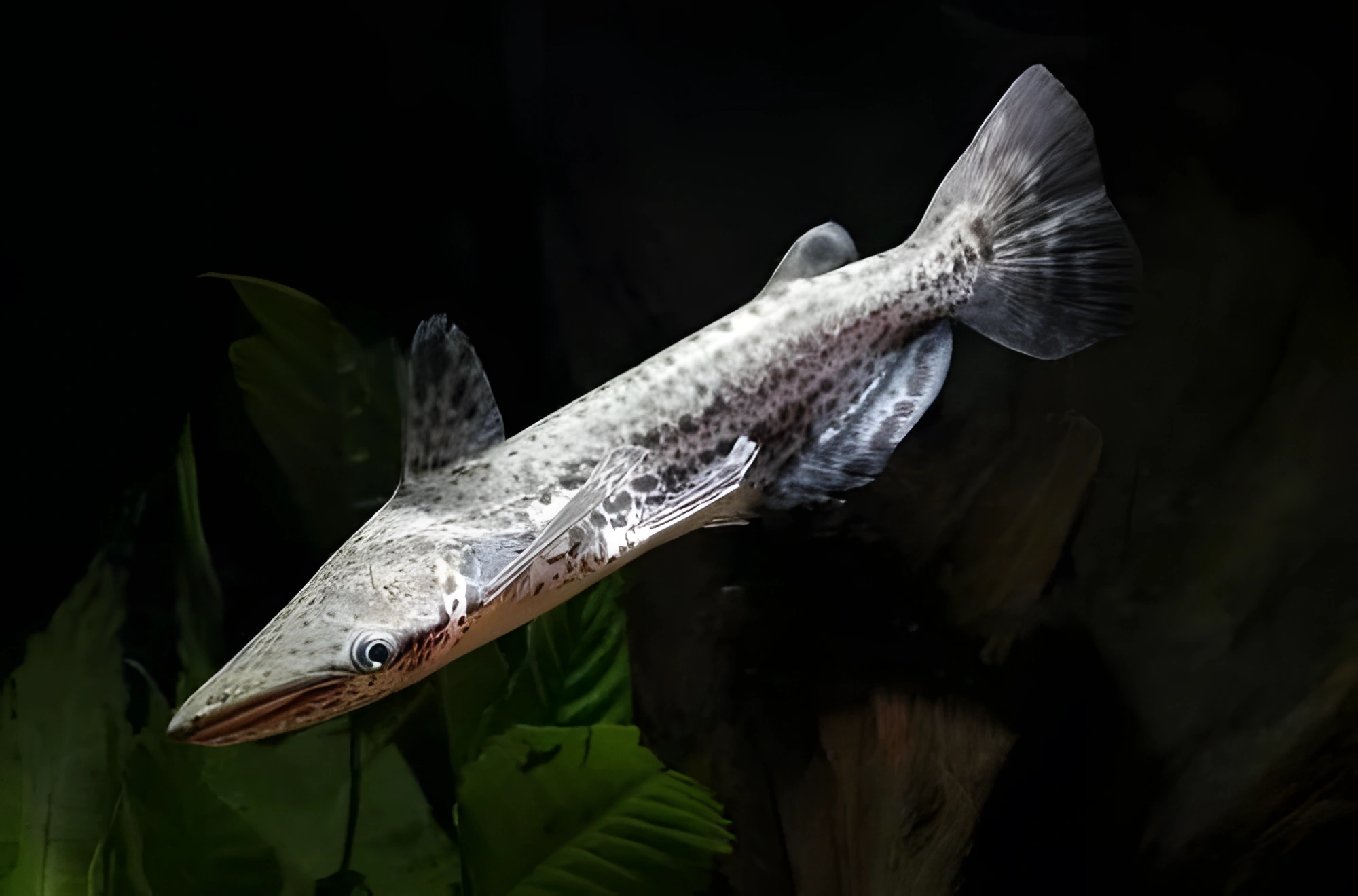
Ageneiosus marmoratus, also known as the Hammer Catfish, Guyana Catfish, or Marbled Ageneiosus, is a member of the Auchenipteridae family. This small but remarkable fish differs from most catfish in its active lifestyle, not preferring constant hiding places. Its carnivorous nature creates certain challenges for its keeping.
- Required aquarium volume
- 120 L
- Size in aquarium
- 18 cm
- Temperature
- 22 – 26 °C
- Temperament
- Predator, but semi-peaceful (gets along with large ones)
Parameters
Water pHSlightly acidic (6) – Neutral (7.5)
Water dHVery soft (3) – Medium hardness (10)
Water salinityno salt (freshwater)
Size in aquarium18 cm
Lifespan12 years
TemperamentPredator, but semi-peaceful (gets along with large ones)
Toward small fishpredator
Required aquarium volume120 L
Lightingdimmed
Substratesandy (regular, light)
Water flowweak or moderate
FeedingFor carnivores (live fish, insects, etc.)
CareBoth solitary and in group (flexible)
Description
Adults can reach up to 18 cm in length. Their body has an elongated shape, and the head is wide and flat, with a large mouth. During the breeding season, males develop a so-called “nuchal hump”: the area behind the head becomes noticeably raised and returns to its normal state after spawning. Apart from this feature, sexual dimorphism is weakly expressed, and external differences between males and females are minimal. The fish's coloration is gray, with a characteristic spotted pattern covering the entire body. Young individuals are usually lighter, and their pattern consists of larger spots, which often merge into stripes resembling a marble pattern. This characteristic feature is reflected in the species' name.
Habitat
The natural habitats of this species are in South America. Its distribution range is quite wide and covers most of the Amazon River basin, extending from the headwaters in Peru to the delta on the Brazilian coast. It can also be found in the river systems of Guyana and Suriname. Most sources indicate that these catfish prefer sections of rivers with slow currents.
Behavior and Compatibility
These fish are peaceful and active. Non-aggressive bottom-dwelling species that will not compete with the Guyana Catfish for food are suitable tank mates. However, it should be remembered that any fish small enough to fit into its mouth can become accidental prey.
Care and Maintenance
The Hammer Catfish demonstrates high activity but can be timid in the presence of large tank mates. Therefore, to ensure successful keeping, a spacious aquarium is necessary. For a single specimen, a volume of at least 120 liters is desirable. The tank's decor is not critically important, but to create the most comfortable environment, it is recommended to imitate a riverbed: use a sandy substrate mixed with stones, and add some driftwood. Lighting should be subdued. Due to the large amount of waste produced by carnivorous fish, an effective filtration system is essential. This is usually achieved by a combination of external canister filters and a sump system with water return. In addition to filtration, 30–50% of the water volume should be replaced weekly with fresh water to prevent the accumulation of organic decomposition products.
Diet
In nature, the diet of these catfish consists mainly of invertebrates, as well as small crustaceans and, if available, other small fish. In a home aquarium, their diet should be similar: live foods are recommended. Some individuals may be accustomed to specialized dry foods for carnivorous fish, but it is worth noting that many imported fish often refuse alternative products, preferring exclusively live food. Before acquiring a fish, it is important to clarify its dietary preferences.
Breeding and Reproduction
To date, no successful breeding cases of this species in home aquariums have been recorded. Their availability in trade comes from wild-caught specimens or from commercial fish farms where spawning is induced using hormonal injections.
Diseases
Most diseases in these fish are caused by unsuitable living conditions. Maintaining a stable environment is a key factor for successful keeping. If signs of illness appear, the first step is to check the water parameters and, if deviations are found, take measures to correct them. If symptoms persist or worsen, medication may be required. More detailed information on symptoms and treatment methods can be found in the "Aquarium Fish Diseases" section.
How to choose
When purchasing a Guyanese catfish, special attention should be paid to the condition of its skin and fins. A healthy fish should have no plaque, ulcers, hemorrhages, or damage, and the fins should be intact, without signs of splitting or erosion. An important indicator is behavior: the fish should be active but not exhibit panicked darting or a constant desire to hide, which may indicate stress or hidden diseases.
- Assess the clarity of the eyes, which should be clear, without cloudiness or bulging.
- Observe breathing: gill covers should move rhythmically, without rapid or labored breathing.
- Ensure there are no signs of emaciation, and the abdomen should not be excessively distended.
- If possible, visit the store during feeding to confirm the individual has a normal appetite.
Since this species is a predator often caught in the wild, it is important to ask the seller about the fish's adaptation period to aquarium conditions. Individuals that have already started accepting frozen or dry foods have a much higher chance of successful acclimatization in a new aquarium than recently imported specimens that refuse any food other than live fish.
Frequently asked questions
The essentials: size, tank volume, water parameters and care
How big does Guyana Catfish get?
An adult reaches 18 cm in length. Plan the tank around the maximum size: the fish quickly outgrows a cramped setup.
What size aquarium does Guyana Catfish need?
The minimum recommended volume is 120 L. A smaller tank speeds up nitrate build-up and raises stress levels.
What water parameters does Guyana Catfish need?
Temperature 22–26 °C, pH 6–7.5, hardness 3–10 dGH. Stability matters more than exact values: sudden swings are harder on the fish than a small deviation from the ideal.
How long does Guyana Catfish live?
Around 12 years when kept properly. Lifespan depends directly on tank volume, water quality and a varied diet.
Is Guyana Catfish aggressive?
Temperament: predator, but semi-peaceful (gets along with large ones). This is a predatory species — any fish small enough to fit in its mouth will eventually be eaten.
How many Guyana Catfish should be kept together?
Recommended setup: both solitary and in group (flexible). Ignoring this is a common cause of stress and disease.
What does Guyana Catfish eat?
Diet type: for carnivores (live fish, insects, etc.). Feed small portions that are finished within a couple of minutes — overfeeding does more harm than underfeeding.
What is the scientific name of Guyana Catfish?
The scientific name of the species is Ageneiosus marmoratus, family Auchenipteridae. It also appears in the literature as: Ageneiosus barranquenensis.