Temperature24 – 26 °C
Natural range
- Australia area
- Papua New Guinea area
UnusualConservation status: Least concern LC
Other scientific names: Eleotris mogurnda
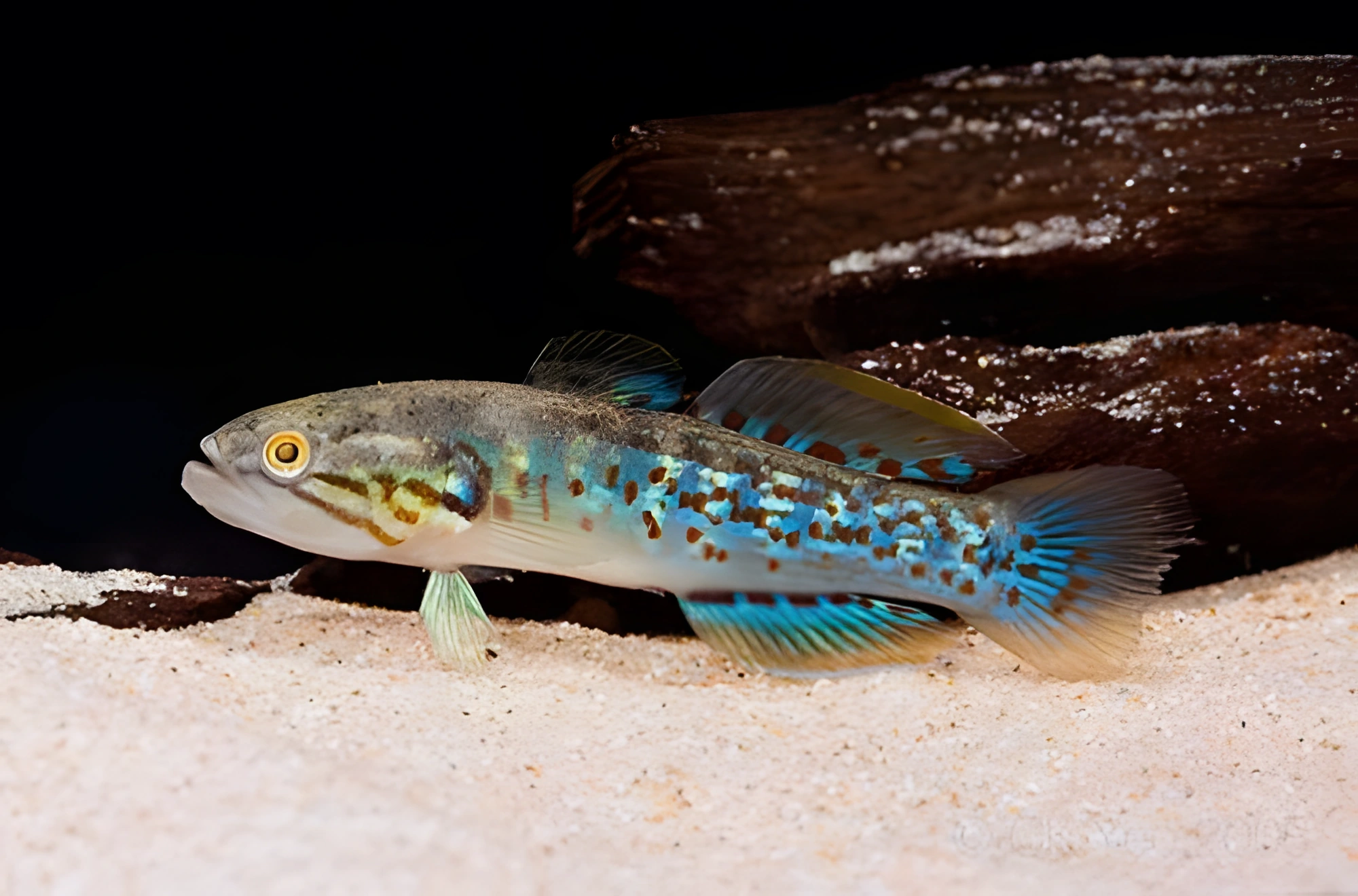
The Australian Mogurnda, also known as the Trout Mogurnda or Australian Gudgeon (scientific name Mogurnda mogurnda), belongs to the family Eleotridae. It makes an excellent choice for a novice aquarist. These fish are distinguished by their interesting coloration, and their care presents no particular difficulties. It should be noted that they are not frequently available for sale.
- Required aquarium volume
- 110 L
- Size in aquarium
- 17 cm
- Temperature
- 24 – 26 °C
- Temperament
- Semi-peaceful (including aggression during spawning / intraspecific conflicts)
Parameters
Water pHSlightly acidic (6) – Slightly alkaline (8)
Water dHMedium hardness (10) – Very hard (20)
Water salinityno salt (freshwater)
Size in aquarium17 cm
Lifespan6 years
TemperamentSemi-peaceful (including aggression during spawning / intraspecific conflicts)
Toward small fishnot a predator
Required aquarium volume110 L
Lightingdimmed
Substrateany (no restrictions)
Water flowweak
FeedingAny (universal)
CareBoth solitary and in group (flexible)
Description
Adults can reach up to 17 cm in length. Differences between males and females are subtle, meaning there is almost no external sexual dimorphism. These fish have a large head, and their dorsal and anal fins are well-developed and positioned closer to the tail. The base color is grey with a noticeable blue sheen. Small purple speckles can be seen on the body and fins. Two stripes of the same purple hue extend from the eyes to the gill covers.
Habitat
Its natural habitat extends across the Australian continent and the adjacent island of Papua New Guinea. These fish inhabit diverse aquatic landscapes: they can be found in streams, rivers, swamps, lakes, and even in the harsh conditions of water bodies located in desert regions or characterized by very low dissolved oxygen content.
Behavior and Compatibility
This species is territorial, so fish will compete for areas on the bottom with their conspecifics; it is important to provide enough space for everyone. Co-housing with other territorial fish, as well as those with long, flowing fins, should be avoided, as the Australian Mogurnda is capable of nipping them. Good tank mates include active fish such as Barbs, Rainbowfish, some Characins, and Corydoras catfish.
Care and Maintenance
For a small group of these fish, the optimal aquarium volume starts from 110 liters. Given that the Trout Mogurnda is naturally adapted to diverse, sometimes extreme biotopes, it does not require any special aquascaping. The aquarist can set up the aquarium according to their own preferences. The key condition is the presence of a sufficient number of potential shelters. These can be snags, dense plant thickets, specialized aquarium decorations, or even a simple ceramic pot turned on its side. A hollow PVC pipe would also be perfectly suitable. Water parameters also do not play a decisive role; the fish can adapt to a wide range of pH and dGH values. Nevertheless, when purchasing, it is advisable to ask the seller about the hydrochemical conditions in which the fish were kept and try to approximate these values in the home aquarium. Abrupt and significant changes generally have a negative impact on the well-being of any fish, even such a hardy one. During keeping, it is crucial to maintain high water quality. Although its composition can vary, the accumulation of organic pollutants and exceeding the concentrations of nitrites, nitrates, and other nitrogen cycle products must not be allowed. It is recommended to install a powerful filtration system and perform weekly partial water changes with fresh water.
Diet
The Australian Gudgeon is not particularly demanding regarding its diet. In aquarium conditions, these fish readily accept most offered dry, frozen, and live foods. For example, their daily diet can include flakes or granules combined with bloodworms and Artemia. The exclusive use of dry foods is permissible, but it is important to ensure their high quality and the presence of various components and additives in their composition.
Breeding and Reproduction
Breeding in a home aquarium is quite possible, but it involves certain difficulties. To ensure the survival of the offspring, spawning is preferably organized in a separate tank. In addition, the fish are quite picky about choosing a partner, so simply acquiring a male and a female is not enough to form a pair. A pair can form naturally if a group of young fish are kept together and grow up together. With the onset of the breeding season, the pair chooses a suitable spawning site. This can be a flat stone or any other flat surface. The female lays 20 to 200 eggs, attaching them with thin threads. After this, her role in the process ends. The male remains to guard the clutch throughout the incubation period, which lasts 5–7 days. Then he also loses interest in his offspring. Adult fish must be isolated from the fry, otherwise the latter may be eaten. Fry should be fed with infusoria or specialized micro-food, and as they grow, Artemia nauplii can be offered. It is worth noting that the fry will grow at different rates, and larger individuals will begin to eat their smaller siblings.
Diseases
Health problems in these fish arise only in the presence of injuries or keeping in unsuitable conditions, which leads to a weakening of the immune system and the subsequent occurrence of various diseases. At the first signs of illness, it is necessary first to check the water parameters for exceeding permissible values or the presence of toxic substances (such as nitrites, nitrates, ammonia). If deviations are found, all indicators should be normalized, and then treatment should begin. More detailed information on symptoms and treatment methods is available in the "Diseases of Aquarium Fish" section.
How to choose
When choosing a Trout Mogurnda, it is important to pay attention to the fish's activity and the condition of its skin. Healthy individuals should be curious, have clean scales free of visible ulcers, spots, or damage, and clear eyes. Avoid purchasing fish that appear emaciated, have sunken bellies, or show signs of apathy, lying on the bottom without attempting to hide when a person approaches.
Since this species is territorial and has a large mouth, when purchasing a group of individuals, their size should be considered: too large a difference in size can lead to cannibalism. It is optimal to acquire young fish so that they can adapt to the aquarium conditions and potentially form a pair naturally. Be sure to ask the seller what the fish were fed, as acclimatization to dry foods may take time, and the basis of the diet should consist of high-quality frozen or live products.
Frequently asked questions
The essentials: size, tank volume, water parameters and care
How big does Trout Mogurnda get?
An adult reaches 17 cm in length. Plan the tank around the maximum size: the fish quickly outgrows a cramped setup.
What size aquarium does Trout Mogurnda need?
The minimum recommended volume is 110 L. A smaller tank speeds up nitrate build-up and raises stress levels.
What water parameters does Trout Mogurnda need?
Temperature 24–26 °C, pH 6–8, hardness 10–20 dGH. Stability matters more than exact values: sudden swings are harder on the fish than a small deviation from the ideal.
How long does Trout Mogurnda live?
Around 6 years when kept properly. Lifespan depends directly on tank volume, water quality and a varied diet.
Is Trout Mogurnda aggressive?
Temperament: semi-peaceful (including aggression during spawning / intraspecific conflicts). Keep this in mind when choosing tank mates.
How many Trout Mogurnda should be kept together?
Recommended setup: both solitary and in group (flexible). Ignoring this is a common cause of stress and disease.
What does Trout Mogurnda eat?
Diet type: any (universal). Feed small portions that are finished within a couple of minutes — overfeeding does more harm than underfeeding.
What is the scientific name of Trout Mogurnda?
The scientific name of the species is Mogurnda mogurnda, family Sleepers (Eleotridae). It also appears in the literature as: Eleotris mogurnda.