Temperature27 – 32 °C
Cichlids
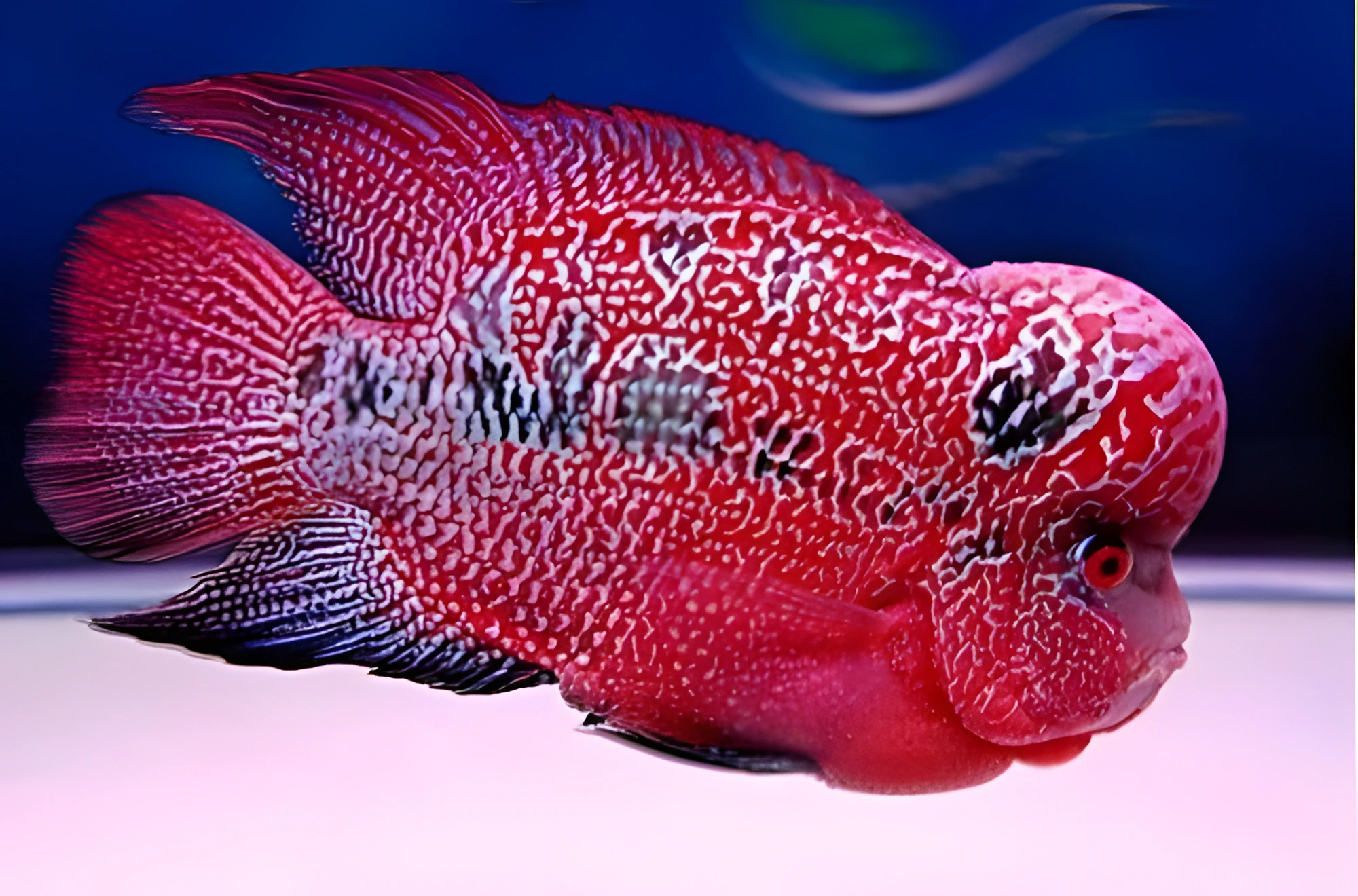
The Cichlidae family includes a remarkable representative — the Flowerhorn, also known as the Flowerhorn Cichlid. This fish stands out for its vibrant coloration and unusual shape, making it an excellent choice for connoisseurs of unique aquarium inhabitants. Its name, formed by the fusion of two words, "Flower" and "Horn," can be interpreted as "Flower Horn" or "Rainbow Horn," which accurately reflects its appearance.
- Required aquarium volume
- 400 L
- Size in aquarium
- 35 cm
- Temperature
- 27 – 32 °C
- Temperament
- Aggressive / incompatible / unfriendly
Parameters
Water pHNeutral (6.5) – Slightly alkaline (7.8)
Water dHMedium hardness (9) – Very hard (20)
Water salinityno salt (freshwater)
Size in aquarium35 cm
Lifespan10 years
TemperamentAggressive / incompatible / unfriendly
Toward small fishnot a predator
Required aquarium volume400 L
Lightingmoderate (regular)
Substratefine sand
Water flowmoderate
FeedingMeat / protein (live, frozen, fresh)
CareSolitary
Description
This large fish can reach 30–40 cm in length, depending on its origin. The Flowerhorn's body is massive and oval-shaped, and its distinctive feature is a prominent nuchal hump on its head. The dorsal and anal fins are long and pointed, while the caudal fin is rounded. The coloration of this fish is highly diverse: from a bluish-green metallic hue on one part of the body to pink and red tones around the head. The pattern on the body primarily consists of black horizontal markings, complemented by white spots. The coloration becomes particularly intense in adult specimens.
A reliable method for determining the sex of Flowerhorns has not yet been developed, and there is no single, approved list of characteristics. Each breeder uses their own observations, and even experienced professionals cannot always accurately identify a male or female.
Habitat
This fish is not found in the wild, as it was bred artificially. Its first specimens appeared in Asia in the mid-1990s, resulting from the crossbreeding of certain South American cichlid species. By the early 2000s, the modern form was developed, attracting attention with its whimsical body pattern, characteristic pink coloration, and famous protruding nuchal hump. In China, there is a belief that this fish brings its owner good luck, health, and prosperity. Although the cost of some unique specimens can reach thousands of dollars, fortunately for exotic fish enthusiasts, most of these fish are available at a very moderate price, making them accessible to a wide range of aquarists.
Behavior and Compatibility
This species is characterized by extremely aggressive and territorial behavior, showing intolerance not only to other species but also to members of its own kind. Solitary keeping is preferred, or pair keeping if breeding is planned, but in this case, a tank of at least 600 liters will be required so that each individual has its own territory. In very large aquariums, cohabitation with several fish of similar size and temperament is permissible, but it is best to entrust the selection of optimal tankmates to a specialist.
Care and Maintenance
Although Flowerhorns do not have strict requirements for water parameters, regular aquarium maintenance remains essential. These fish are quite voracious and produce a significant amount of waste. In addition, leftover meaty food can quickly contaminate the water. Therefore, it is recommended to clean the gravel and perform partial water changes (about 25%) every two weeks or once a month, depending on the aquarium volume and the degree of its contamination. During maintenance, it is important to exercise caution, as a hand in the water can be painfully bitten by the fish. Special attention should be paid to the filtration system, which must match the size of the aquarium and be powerful enough to handle a large volume of waste. In addition to the filter, necessary equipment includes an aerator, heater, and lighting system. All internal devices must be securely fastened and disguised so that an active Flowerhorn does not accidentally damage them. The aquarium setup should provide enough free swimming space that does not restrict the fish's movements. Rock shelters or pieces of wood are permissible, but it is better to place them along the side walls. A stony substrate with small boulders is preferred. Artificial plants are better to use, as live ones will be quickly destroyed.
Diet
This species is exclusively carnivorous and has an excellent appetite. The quality of the food is more important than its variety, as the brightness of the fish's coloration largely depends on it. Flowerhorns readily consume both frozen and live foods, such as bloodworms, earthworms, crickets, insect larvae, and small krill. It is also recommended to add specialized vitamin complexes designed for cichlids. It is strictly forbidden to feed them beef heart or other mammalian meat products, as this can lead to serious digestive problems and subsequent diseases of the digestive tract. Despite the fact that such products are often mentioned in recommendations on various websites, their use is a serious mistake that is replicated without proper justification.
Breeding and Reproduction
An interesting feature of Flowerhorns, rare among hybrids, is their ability to produce offspring that inherit parental traits. However, this process has its nuances regarding partner selection. It is necessary to know the fish's pedigree, as the partner must originate from similar initial species; otherwise, the offspring may quickly degenerate into ordinary cichlids. Another problem is individual compatibility: fish may simply not like each other, and the male may attack the female, even if she belongs to the necessary species. All these factors indicate the significant difficulty of breeding Flowerhorns at home.
Diseases
These fish are susceptible to typical diseases characteristic of tropical species. In an aquarium with optimal balance and clean water, health problems usually do not arise. Diseases only begin to manifest when living conditions deteriorate or due to poor nutrition/underfeeding. More detailed information on symptoms and treatment methods can be found in the "Aquarium Fish Diseases" section.
How to choose
When choosing a Flowerhorn, preference should be given to active individuals with clean skin without visible damage, ulcers, or white film. It is important to assess the head shape: healthy young males may already show a characteristic nuchal hump at an early age, but its absence in small individuals is not always a sign of illness. Avoid fish that appear apathetic, stay near the surface, or have a sunken belly, as this often indicates digestive problems or parasitic diseases. Since the species is an artificial hybrid, when purchasing, pay attention to body symmetry and color brightness, which serves as an indicator of breeding quality. It is recommended to observe the fish's behavior in the store: a healthy Flowerhorn exhibits pronounced territoriality and curiosity towards surrounding objects.
Frequently asked questions
The essentials: size, tank volume, water parameters and care
How big does Flowerhorn get?
An adult reaches 35 cm in length. Plan the tank around the maximum size: the fish quickly outgrows a cramped setup.
What size aquarium does Flowerhorn need?
The minimum recommended volume is 400 L. A smaller tank speeds up nitrate build-up and raises stress levels.
What water parameters does Flowerhorn need?
Temperature 27–32 °C, pH 6.5–7.8, hardness 9–20 dGH. Stability matters more than exact values: sudden swings are harder on the fish than a small deviation from the ideal.
How long does Flowerhorn live?
Around 10 years when kept properly. Lifespan depends directly on tank volume, water quality and a varied diet.
Is Flowerhorn aggressive?
Temperament: aggressive / incompatible / unfriendly. Keep this in mind when choosing tank mates.
How many Flowerhorn should be kept together?
Recommended setup: solitary. Ignoring this is a common cause of stress and disease.
What does Flowerhorn eat?
Diet type: meat / protein (live, frozen, fresh). Feed small portions that are finished within a couple of minutes — overfeeding does more harm than underfeeding.
What is the scientific name of Flowerhorn?
The scientific name of the species is Amphilophus hybrid, family Cichlids (Cichlidae).