Temperature20 – 28 °C
Natural range
- Suriname area
CharacinsConservation status: Least concern LC
Other scientific names: Megalamphodus roseus, Megalomphodus roseus
The Yellow Phantom Tetra, scientifically known as Hyphessobrycon roseus, belongs to the Characidae family. This freshwater fish is notably popular among aquarists due to its ease of care and breeding. It also coexists wonderfully with other non-aggressive species.
- Required aquarium volume
- 40 L
- Size in aquarium
- 2 – 2.5 cm
- Temperature
- 20 – 28 °C
- Temperament
- Peaceful (regular)
Parameters
Water pHSlightly acidic (5) – Neutral (7)
Water dHVery soft (1) – Medium hardness (10)
Water salinityno salt (freshwater)
Size in aquarium2 – 2.5 cm
Lifespan4 years
TemperamentPeaceful (regular)
Toward small fishnot a predator
Required aquarium volume40 L
Lightingdimmed or moderate
Substratesandy (regular, light)
Water flowweak
FeedingSmall / appropriate size / pieces
CareGroup (8–10 individuals)
Description
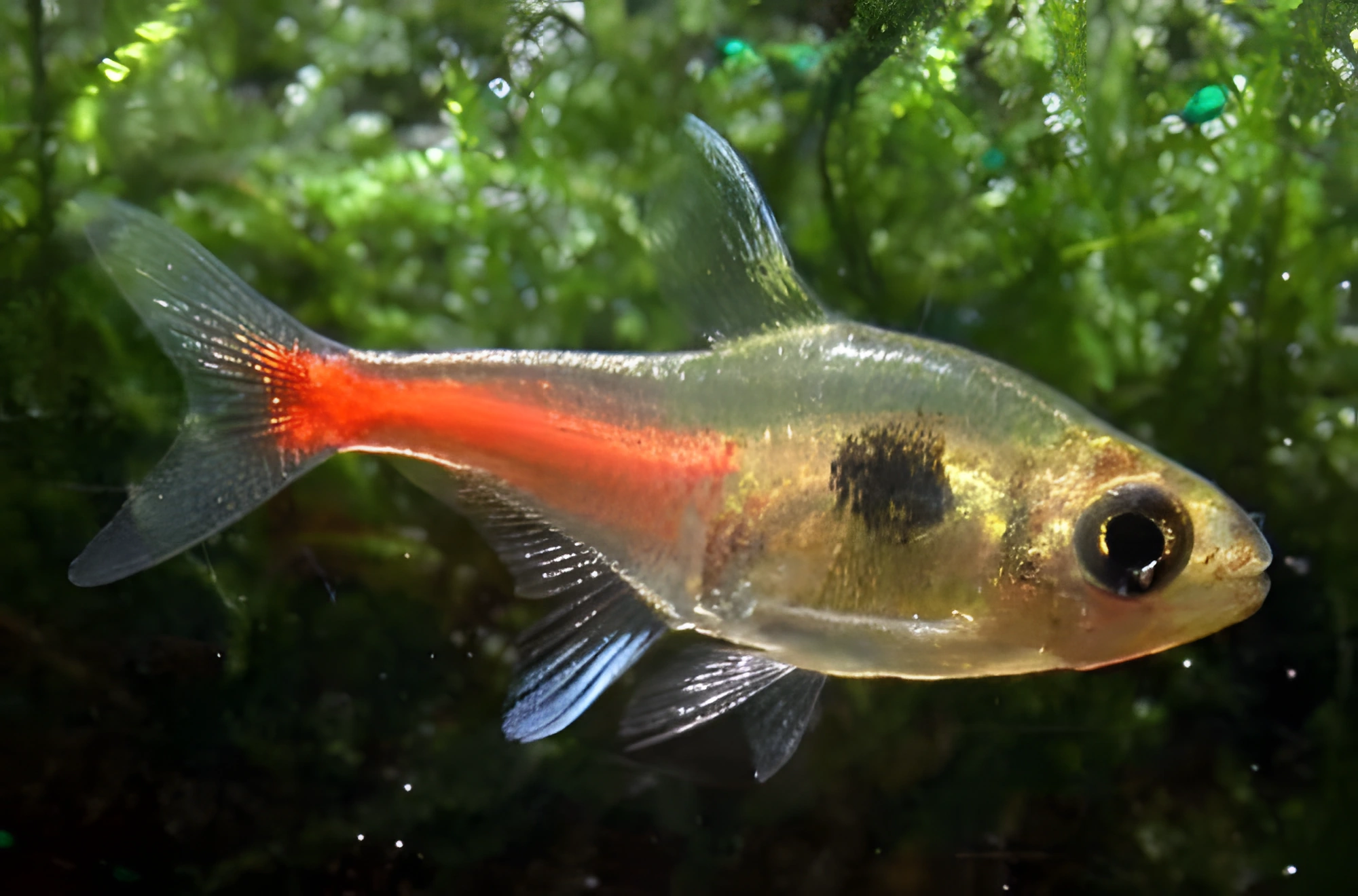
Adults do not exceed 2 cm in length. Males and females are externally difficult to distinguish, with sexual dimorphism being weakly expressed. The body coloration is silvery-yellow, and the caudal fin can be pink or red. A characteristic feature is a large black spot located in the middle of the body.
Habitat
The natural habitat of this species is in South America, primarily within Suriname, including the Corantijn, Maroni, and Sinnamary river basins. Here, the fish inhabits small streams and rivers flowing under the dense canopy of the humid tropical forest. These water bodies are characterized by slow currents, and the thick tree crowns create constant partial shade. The streambeds are often abundant with snags and fallen leaves, and the banks are densely overgrown with aquatic vegetation. As a result of the decomposition of organic matter, the water acquires a distinct brown tint.
Behavior and Compatibility
The Yellow Phantom Tetra is a peaceful schooling fish, so it is recommended to keep them in a group of at least 8–10 individuals. They are well compatible with other freshwater species of similar size. It is advisable to avoid overly large tank mates to prevent accidental predation of such small Phantoms.
Care and Maintenance
Thanks to its modest size, the Yellow Phantom Tetra can be successfully kept in so-called nano-aquariums. A tank volume of 40 liters will be sufficient for a relatively large school of 15–20 individuals. The aquarium setup should ideally mimic its natural habitat, using sandy substrate, snags, and dense aquatic plants. However, the fish are capable of adapting to almost any conditions, surviving even in a semi-empty tank. Experienced aquarists often add leaves from certain trees to the bottom. Similar to natural bodies of water, these leaves release tannins as they decompose, giving the water a characteristic brown color. Additionally, they serve as a basis for the growth of microorganism colonies, such as paramecia, which are an excellent food source for fry. The successful keeping of this species, like many other freshwater fish, directly depends on maintaining stable water parameters—temperature and hydrochemical indicators (pH and dGH)—within acceptable limits, as well as preventing the accumulation of dangerous concentrations of nitrogen cycle products (ammonia, nitrites, nitrates). The Yellow Ornate Tetra should only be introduced into a biologically established aquarium. The desired stability is ensured by an effective filtration system and other necessary equipment, as well as regular care: weekly partial water changes, removal of organic waste (uneaten food, excrement), and, if necessary, replacement of fallen leaves.
Diet
This omnivorous species readily accepts most common aquarium foods of appropriate size. To maintain good tone and vibrant coloration, their diet should be varied. In addition to dry foods such as flakes and granules, it is recommended to offer live or frozen brine shrimp and daphnia.
Breeding and Reproduction
The breeding strategy is typical for characins: females scatter eggs among dense vegetation or directly onto open substrate, after which males fertilize them. Since parental instincts are undeveloped in these fish, there is no care for the offspring. Moreover, if given the opportunity, the fish may eat their own eggs and fry. To preserve the brood, fertilized eggs are moved to a separate breeding tank, where water conditions are identical to the main tank. It should be equipped with a simple air-driven sponge filter and a heater. An artificial light source is not required; ambient room light is sufficient. Newly hatched fry need microscopic food, such as infusoria, or specialized powdered products available in pet stores. As they grow, they can be offered brine shrimp nauplii and finely crushed dry flake food.
Diseases
Specific diseases that affect only this particular fish species have not been identified. When kept in suitable conditions, including high water quality, a balanced diet, and peaceful tank mates, health issues usually do not arise. The most common cause of illness is a deterioration of living conditions, which weakens the immune system and makes the fish susceptible to infections that are always present in their environment. Upon noticing initial signs of sickness (such as lethargy, emaciation, refusal to eat, or clamped fins), it is crucial to immediately check the basic water parameters. Often, restoring acceptable living conditions will lead to self-recovery, but if the fish is too weak or has suffered visible damage, medicinal treatment may be required. For more details on symptoms and treatment methods, consult the section “Diseases of Aquarium Fish.”
How to choose
When purchasing, choose active individuals that stay in a school and show natural curiosity. Inspect the fish for fin damage, white spots, or unnatural growths on the body — a healthy phantom should have clean coverings and transparent fins. It is important to ensure that the fish do not look emaciated and that their breathing is even and calm.
- Avoid specimens with signs of lethargy, which stay at the surface or, conversely, constantly lie on the bottom.
- Assess the conditions in the store's aquarium: the water should be clear, without a strong odor, and the number of individuals in the school sufficient to reduce stress.
- Keep in mind that young individuals may be less brightly colored than adults; color intensity will manifest with proper care and adaptation in home conditions.
Frequently asked questions
The essentials: size, tank volume, water parameters and care
How big does Yellow Phantom Tetra get?
An adult reaches 2–2.5 cm in length. Plan the tank around the maximum size: the fish quickly outgrows a cramped setup.
What size aquarium does Yellow Phantom Tetra need?
The minimum recommended volume is 40 L. A smaller tank speeds up nitrate build-up and raises stress levels.
What water parameters does Yellow Phantom Tetra need?
Temperature 20–28 °C, pH 5–7, hardness 1–10 dGH. Stability matters more than exact values: sudden swings are harder on the fish than a small deviation from the ideal.
How long does Yellow Phantom Tetra live?
Around 4 years when kept properly. Lifespan depends directly on tank volume, water quality and a varied diet.
Is Yellow Phantom Tetra aggressive?
Temperament: peaceful (regular). Keep this in mind when choosing tank mates.
How many Yellow Phantom Tetra should be kept together?
Recommended setup: group (8–10 individuals). Ignoring this is a common cause of stress and disease.
What does Yellow Phantom Tetra eat?
Diet type: small / appropriate size / pieces. Feed small portions that are finished within a couple of minutes — overfeeding does more harm than underfeeding.
What is the scientific name of Yellow Phantom Tetra?
The scientific name of the species is Hyphessobrycon roseus, family Characidae. It also appears in the literature as: Megalamphodus roseus, Megalomphodus roseus.