Temperature20 – 26 °C
Natural range
- South Asia area
- Pakistan area
- Nepal area
- Myanmar area
CyprinidsConservation status: Least concern LC
Other scientific names: Cyprinus danrica, Cyprinus jogia, Cyprinus sutiha, Esmous danricus, Esomous danricus, Esomus dandrica
The flying barb, scientifically known as Esomus danrica, is a member of the Cyprinidae family, or carps. This fish first arrived in Europe in 1905, brought from British colonies in Asia. In its early years, it gained widespread popularity among aquarists, largely due to its unpretentious nature. However, over time, interest in this species significantly waned as more vibrant and exotic fish appeared on the market.
- Required aquarium volume
- 200 L
- Size in aquarium
- 6 – 7 cm
- Temperature
- 20 – 26 °C
- Temperament
- Semi-peaceful (including aggression during spawning / intraspecific conflicts)
Parameters
Water pHSlightly acidic (6) – Slightly alkaline (8)
Water dHVery soft (1) – Hard (15)
Water salinityno salt (freshwater)
Size in aquarium6 – 7 cm
Lifespan4 years
TemperamentSemi-peaceful (including aggression during spawning / intraspecific conflicts)
Toward small fishnot a predator
Required aquarium volume200 L
Lightingdimmed
Substrateany, but dark
Water flowweak
FeedingFloating (any)
CareGroup (8–10 individuals)
Description
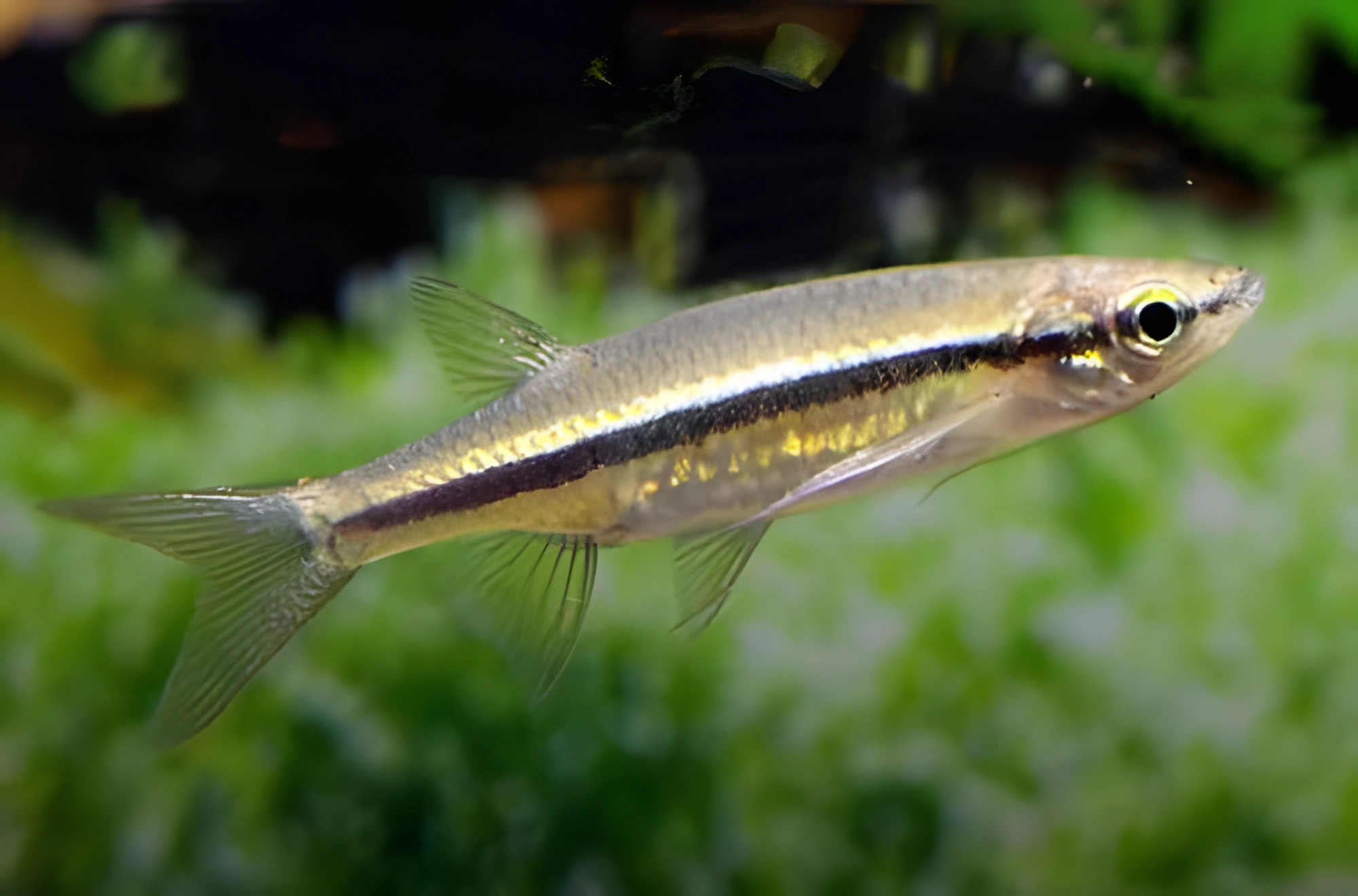
Adults of this species reach a length of 6–7 cm. The fish is characterized by an elongated, streamlined body and large, pointed fins located closer to the caudal part. The pectoral fins are notable: their size and position relative to the body resemble wings. This analogy is not accidental, as the flying barb earned its name due to its ability to jump out of the water and briefly glide in the air. Although in this “aerial” art, it still falls short of its South American “relatives” — the hatchetfish. The body color is usually gray, with a silvery belly, and two stripes run along the body — one black and one golden. Sexual dimorphism in this species is weakly expressed; males are usually slimmer and slightly smaller than females.
Habitat
The natural habitat of this species covers most of South Asia, including the modern territories of Pakistan, Nepal, Myanmar, Bangladesh, a significant part of India, and the island of Sri Lanka. In nature, these fish prefer shallow areas of rivers and streams, swamps, and tropical forests flooded during the rainy season. They are often found in places with abundant aquatic vegetation.
Behavior and Compatibility
This species of aquarium fish is characterized by a peaceful nature and prefers to stay in a group. It is important to note that this is not a typical schooling species, as a complex hierarchy forms within the group, where individuals are not equal. It is recommended to keep a group of at least 8–10 individuals to avoid aggression from stronger fish, which can occur with smaller numbers. Sometimes such hostile behavior can also be directed at other aquarium inhabitants. Good tank mates include non-aggressive species of comparable size, such as Danios, Barbs, and other Cyprinids.
Care and Maintenance
For comfortable keeping of a group of 8–10 flying barbs, an aquarium of 200–250 liters will be required. Since these fish primarily inhabit the upper layers of the water, it is important to pay attention to the surface area of the tank, not just its depth. For decoration, it is recommended to use a dark substrate, as well as abundant aquatic vegetation and driftwood, which will serve as shelters. Given the fish's ability to jump, the aquarium must be equipped with a reliable lid. In general, keeping this species is not difficult, as the fish adapts well to various conditions, which is confirmed by its frequent habitation in flooded rice fields in nature. Nevertheless, regular aquarium maintenance should not be neglected, including weekly partial water changes and systematic removal of organic waste, such as food remnants and excrement. Being an omnivorous species, the flying barb readily accepts most popular dry, frozen, and live foods. It is optimal to offer them floating foods, as food particles that sink to the bottom are likely to be ignored.
Diet
The flying barb is an omnivorous species that will readily accept most common foods, whether dry, frozen, or live. However, it is worth noting that floating foods are preferable. Food that sinks to the bottom of the aquarium generally remains untouched by these fish.
Breeding and Reproduction
Breeding the flying barb in aquarium conditions is characterized as a task of moderate difficulty. A separate breeding tank is required for spawning, as the fish are prone to eating their own eggs. Stimulation for the start of the process is achieved by imitating the rainy season, which is done by frequent water changes with fresh, softer water and a gradual increase in temperature to the upper limit of the recommended range.
Spawning is usually in pairs or groups, during which females scatter small eggs among dense, fine-leaved plants. After the process is complete, the parents should be immediately removed. The incubation period and fry development proceed standardly for carp fish. Infusoria and microworms serve as initial food for the hatched offspring; as the fry grow, they are transitioned to Artemia nauplii.
Diseases
This species is characterized by a specific pathology known as “wasting syndrome,” which manifests as rapid muscle mass loss. Currently, effective treatment methods for this condition have not been developed. Otherwise, the fish have strong immunity provided that water purity is maintained and stressful factors are absent.
How to choose
When selecting individuals, attention should be paid to the overall activity of the fish in the aquarium: healthy flying barbs should be mobile and primarily occupy the upper layers of the water. Avoid specimens with signs of fin damage, as these fish are prone to intraspecific aggression if the hierarchy is disrupted or the group size is insufficient. It is recommended to acquire a school of 8-10 individuals at once to reduce stress during adaptation.
Frequently asked questions
The essentials: size, tank volume, water parameters and care
How big does Flying barb get?
An adult reaches 6–7 cm in length. Plan the tank around the maximum size: the fish quickly outgrows a cramped setup.
What size aquarium does Flying barb need?
The minimum recommended volume is 200 L. A smaller tank speeds up nitrate build-up and raises stress levels.
What water parameters does Flying barb need?
Temperature 20–26 °C, pH 6–8, hardness 1–15 dGH. Stability matters more than exact values: sudden swings are harder on the fish than a small deviation from the ideal.
How long does Flying barb live?
Around 4 years when kept properly. Lifespan depends directly on tank volume, water quality and a varied diet.
Is Flying barb aggressive?
Temperament: semi-peaceful (including aggression during spawning / intraspecific conflicts). Keep this in mind when choosing tank mates.
How many Flying barb should be kept together?
Recommended setup: group (8–10 individuals). Ignoring this is a common cause of stress and disease.
What does Flying barb eat?
Diet type: floating (any). Feed small portions that are finished within a couple of minutes — overfeeding does more harm than underfeeding.
What is the scientific name of Flying barb?
The scientific name of the species is Esomus danrica, family Cyprinids (Cyprinidae). It also appears in the literature as: Cyprinus danrica, Cyprinus jogia, Cyprinus sutiha.