Temperature18 – 23 °C
Natural range
- Southeastern Guinea area
- Northern Liberia area
KillifishConservation status: Least concern LC
Other scientific names: Aplocheilus lamottei, Epiplatys fasciolatus
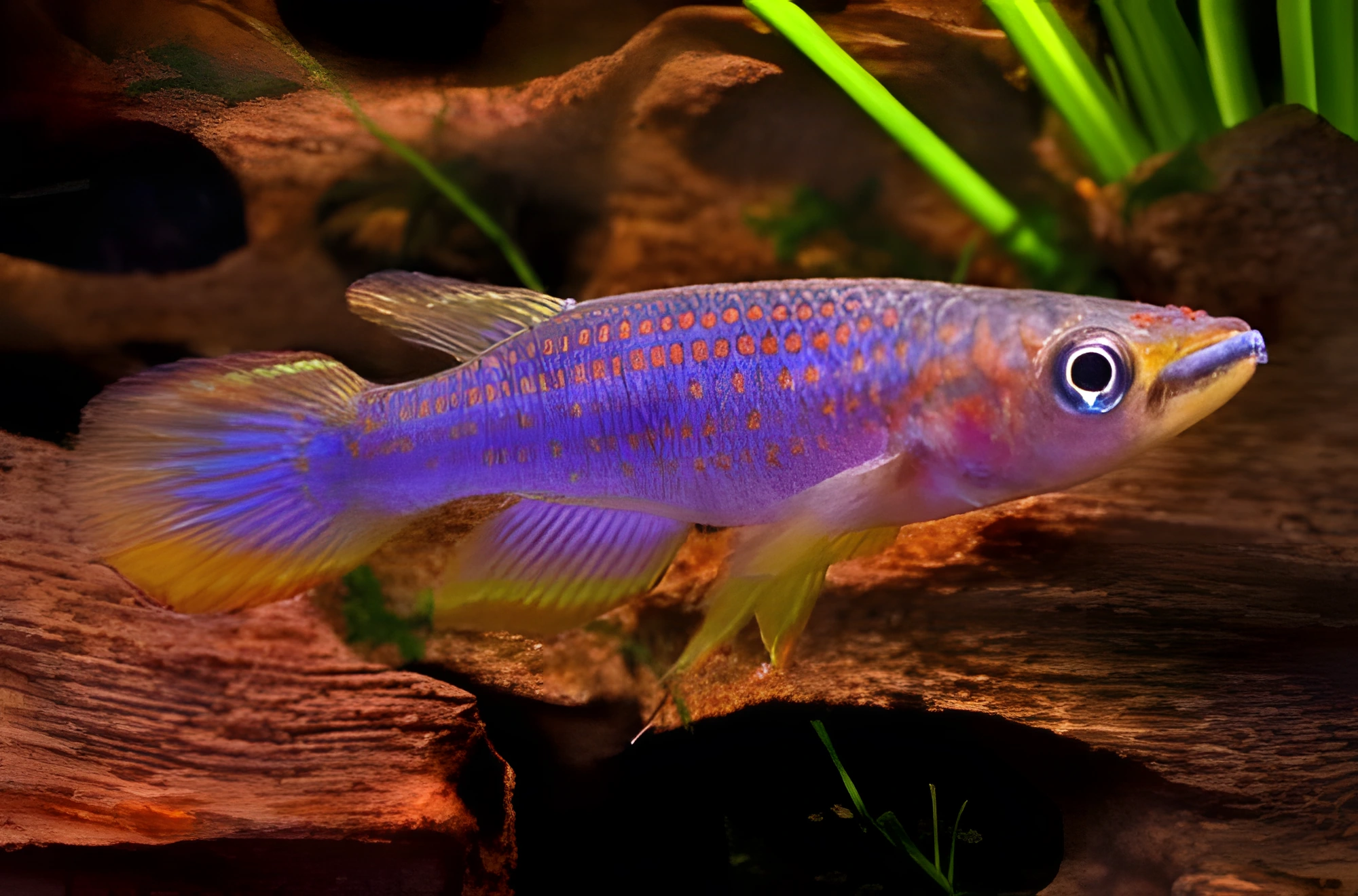
The Red-spotted Panchax, also known as Lamotte's Epiplatys (Epiplatys lamottei), belongs to the family Nothobranchiidae. Thanks to its original and remarkably colorful pattern, which is not often found among freshwater species, this beautiful fish has gained popularity among aquarists worldwide. The species received its scientific name relatively recently, in 1954, in honor of the researcher M. Lamotte, who collected the first specimens.
- Required aquarium volume
- 100 L
- Size in aquarium
- 6 cm
- Temperature
- 18 – 23 °C
- Temperament
- Semi-peaceful (including aggression during spawning / intraspecific conflicts)
Parameters
Water pHSlightly acidic (5) – Neutral (7)
Water dHVery soft (1) – Medium hardness (10)
Water salinityno salt (freshwater)
Size in aquarium6 cm
Lifespan3 years
TemperamentSemi-peaceful (including aggression during spawning / intraspecific conflicts)
Toward small fishnot a predator
Required aquarium volume100 L
Lightingdimmed or moderate
Substratesandy (regular, light)
Water flowmoderate or strong
FeedingSinking (meat / protein)
CarePair (male/female)
Description
There is pronounced sexual dimorphism between males and females of this species. Males are usually larger, reaching up to 6 cm in length, and their fins are more developed and their coloration is brighter. In contrast, females are distinguished by their more modest size and less saturated color pattern.
Habitat
This species originates from the African continent, where it is found in the upper reaches and tributaries of the Niger River. Its range covers the territories of modern-day southeastern Guinea and northern Liberia. The fish prefers to inhabit small streams and tributaries of large rivers. Unfortunately, its natural habitat is currently under threat due to active mining operations.
Behavior and Compatibility
This is a peaceful and harmless species, so it is necessary to select tank mates of comparable size and calm disposition for cohabitation. The presence of overly active neighbors can force the Red-spotted Panchax to constantly seek shelter, which will negatively affect its well-being due to continuous stress.
Care and Maintenance
For a group of several individuals, an aquarium of about 100 liters is optimal; however, a pair of fish will thrive in a tank half that size. It is important to remember that the principle of “bigger is better” is always relevant. When setting up the aquarium, it is desirable to create a landscape resembling their natural habitat. Sandy substrate is best, supplemented with many shelters made from snags, branches, and tree roots. Fallen dry leaves will not only give the aquarium a natural look but will also gradually release humic substances into the water, which are essential for the fish's health. Additionally, as they decompose, the leaves contribute to the development of microorganism colonies, such as paramecia, which serve as an additional food source for fry. In addition to leaves, it is beneficial to add alder cones to the aquarium. Leaf litter and cones should be replaced every 2 weeks. It is also appropriate to place areas with dense thickets of aquatic plants, including floating ones, in the aquarium. Panchax prefers subdued lighting, so when choosing plants, opt for shade-tolerant species. Essential equipment includes a filtration system, an aerator, and a heater. Lighting should be approached with the need for low light intensity in mind. In a room with sufficiently bright natural light, an additional light source in the aquarium may not be required. The water should be soft, with a slightly acidic or neutral reaction. More detailed information on dGH and pH values is provided in the “Hydrochemical composition of water” section.
Diet
In the wild, the Red-Spotted Panchax exhibits carnivorous behavior, with its primary diet consisting of terrestrial and aquatic invertebrates, as well as zooplankton. In an aquarium environment, the fish readily accepts dry foods of appropriate size, such as flakes or granules. The daily diet should be supplemented with meaty foods, offering both live and frozen options, such as bloodworms, brine shrimp, daphnia, grindal worms, mosquito larvae, or Drosophila fruit flies. Feeding is recommended 2–3 times a day, providing an amount of food that will be consumed within 5 minutes. It is important to promptly remove any uneaten remnants.
Breeding and Reproduction
Reproduction of this species can occur in a community tank, however, to successfully preserve the offspring, it is advisable to set up a separate breeding tank, as other inhabitants may eat the eggs and fry. During the breeding period, the male becomes noticeably brighter than usual and begins to actively pursue the females, which signals the impending spawning and the need to separate the pair. The breeding tank must have dense floating plants. The substrate can be any, even its complete absence is acceptable. For equipment, a heater and a simple filter set to low power to avoid strong currents will suffice. It is important to provide sponge pre-filters at the filter intake points to prevent accidental suction of fry. The female lays eggs in dense plant thickets near the surface, where fertilization occurs. After spawning is complete, the pair should be returned to the main aquarium. Fry hatch within a few days. Their initial feeding consists of micro-foods, such as brine shrimp nauplii and infusoria.
Diseases
These fish are quite hardy, and no specific diseases inherent to this species have been noted. Health problems can arise solely from unfavorable keeping conditions, such as poor water quality, an unbalanced diet, or contact with already infected individuals. More detailed information on symptoms and treatment methods can be found in the "Aquarium Fish Diseases" section.
How to choose
When selecting individuals, attention should be paid to the cleanliness of the skin and the absence of fin damage, as the species is sensitive to water quality and stress. A healthy fish should be active, stay in the upper layers of the water, and show interest in offered food. Avoid acquiring individuals with signs of emaciation, sunken bellies, or unnatural behavior, such as constant presence at the bottom or near the surface when no food is present.
- Assess the condition of the eyes: they should be clear, without cloudiness or signs of inflammation.
- Ask the seller about the keeping conditions, as the species requires adaptation to aquarium water parameters.
- Pay attention to the coloration: in healthy adult males, it should be rich and bright, corresponding to species standards.
Frequently asked questions
The essentials: size, tank volume, water parameters and care
How big does Lamotte's Epiplatys get?
An adult reaches 6 cm in length. Plan the tank around the maximum size: the fish quickly outgrows a cramped setup.
What size aquarium does Lamotte's Epiplatys need?
The minimum recommended volume is 100 L. A smaller tank speeds up nitrate build-up and raises stress levels.
What water parameters does Lamotte's Epiplatys need?
Temperature 18–23 °C, pH 5–7, hardness 1–10 dGH. Stability matters more than exact values: sudden swings are harder on the fish than a small deviation from the ideal.
How long does Lamotte's Epiplatys live?
Around 3 years when kept properly. Lifespan depends directly on tank volume, water quality and a varied diet.
Is Lamotte's Epiplatys aggressive?
Temperament: semi-peaceful (including aggression during spawning / intraspecific conflicts). Keep this in mind when choosing tank mates.
How many Lamotte's Epiplatys should be kept together?
Recommended setup: pair (male/female). Ignoring this is a common cause of stress and disease.
What does Lamotte's Epiplatys eat?
Diet type: sinking (meat / protein). Feed small portions that are finished within a couple of minutes — overfeeding does more harm than underfeeding.
What is the scientific name of Lamotte's Epiplatys?
The scientific name of the species is Epiplatys lamottei, family Nothobranchiidae. It also appears in the literature as: Aplocheilus lamottei, Epiplatys fasciolatus.