Temperature20 – 28 °C
Natural range
- Sumatra area
- Borneo area
CatfishConservation status: Least concern LC
Other scientific names: Cryptopterus amboinensis, Cryptopterus bicirris, Kryptopterus bicirrus, Silurus bicirrhis
Kryptopterus bichirris, known as the Two-barbel Indian Glass Catfish, belongs to the family Siluridae (Catfishes). It is not commonly found in aquariums, although the name "glass catfish" is sometimes mistakenly applied to another very similar species. It is noted for its ease of care. This catfish can peacefully coexist with other non-aggressive species of similar size.
- Required aquarium volume
- 250 L
- Size in aquarium
- 12 – 15 cm
- Temperature
- 20 – 28 °C
- Temperament
- Peaceful (regular)
Parameters
Water pHSlightly acidic (6) – Neutral (7.5)
Water dHVery soft (2) – Hard (15)
Water salinityno salt (freshwater)
Size in aquarium12 – 15 cm
Lifespan6 years
TemperamentPeaceful (regular)
Toward small fishnot a predator
Required aquarium volume250 L
Lightingdimmed
Substrateany (no restrictions)
Water flowweak or moderate
FeedingAny (universal)
CareSmall group (3–4 individuals)
Description
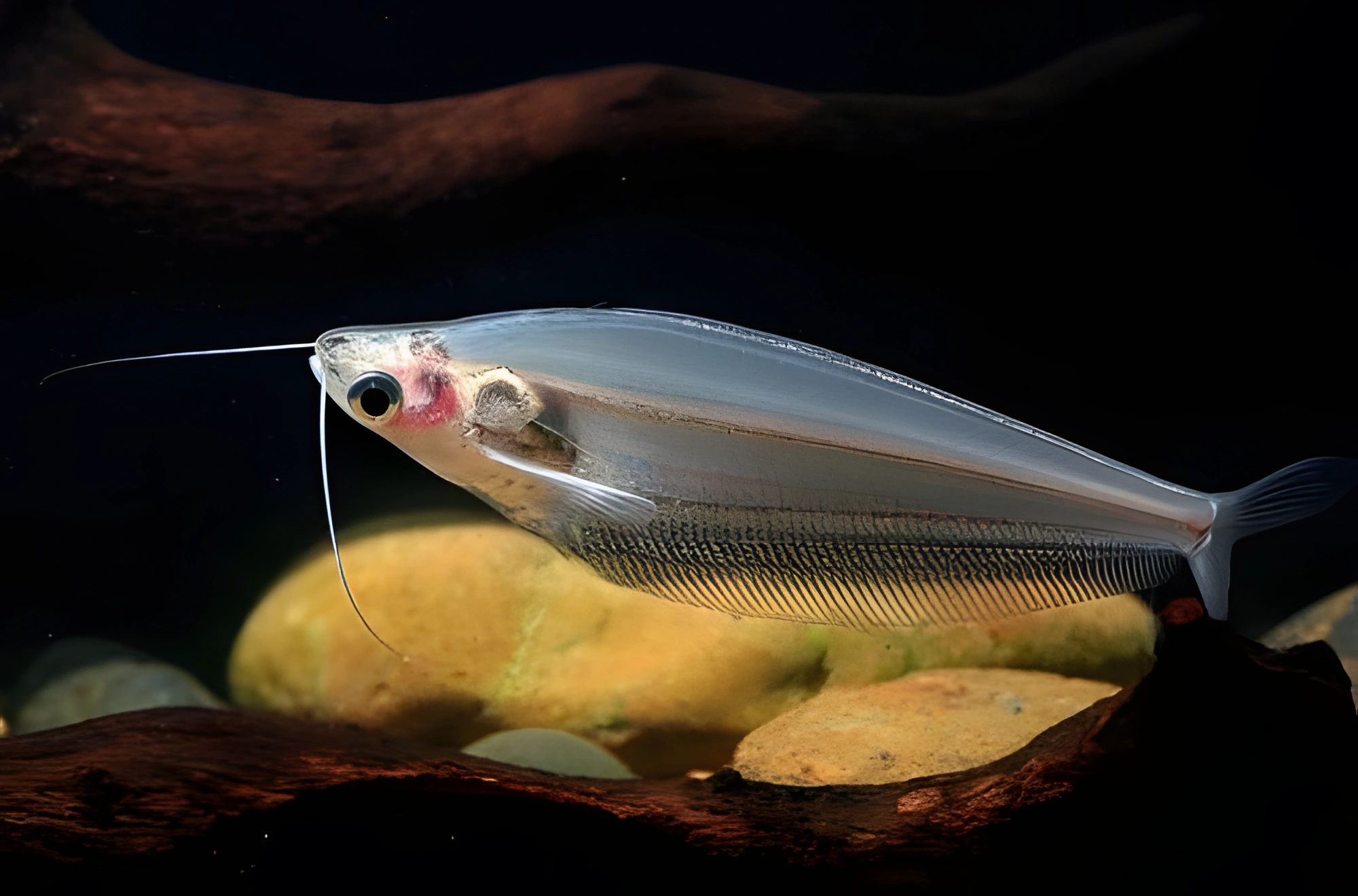
Adults can reach a length of 12–15 cm. The body shape of this fish differs from the typical catfishes: it is elongated and laterally compressed. The dorsal fin is completely absent, and the anal fin extends from the head to the caudal part. Their coloration is grey. Sexual dimorphism is weakly expressed; males and females are visually difficult to distinguish. This catfish is a close relative of the Glass Catfish (Kryptopterus vitreolus) and is almost indistinguishable from it in appearance, but it can be identified by its opaque body.
Habitat
Its natural range extends across Southeast Asia, covering key river systems in Thailand, Laos, Cambodia, Vietnam, Peninsular Malaysia, and the Greater Sunda Islands (Sumatra, Borneo, Java). This species has been recorded in the Mekong, Chao Phraya, Hari, Rajang, and Kapuas rivers, as well as their numerous tributaries. It inhabits areas with fast currents, and at the end of the rainy season, it is found in calm backwaters of floodplain lakes and swamps.
Behavior and Compatibility
This catfish is distinguished by its peaceful, even timid nature. It prefers to live in groups of at least 3–4 individuals. When choosing tank mates, one can select fish of similar size. The catfish will not be able to successfully compete for food with large and overly active species. It is also important to remember its carnivorous diet. Fry and other very small aquarium inhabitants can accidentally become its prey.
Care and Maintenance
For a group of 3–4 individuals, the optimal aquarium volume starts from 250 liters. The tank setup can be anything, but given the timidity of this catfish, it is advisable to provide several hiding places. These can be dense plant thickets or a labyrinth of intertwined driftwood. Any decorative elements will also work. The Two-barbel Indian Glass Catfish is not particularly demanding regarding water parameters; it can comfortably exist in a fairly wide range of pH and dGH values. This circumstance simplifies its maintenance in the aquarium in terms of water preparation. Nevertheless, it should not be placed in a biologically uncycled aquarium. It is important to ensure stable water conditions and avoid the accumulation of organic waste, as this can disrupt the nitrogen cycle.
Diet
In the wild, the catfish is a carnivorous species; its diet consists of crustaceans, invertebrates, and smaller fish. In home aquariums, it should be offered a varied diet, combining dry, frozen, and, if possible, live foods of appropriate size.
Breeding and Reproduction
Due to its rarity in aquaristics, reliable data on the successful breeding of this species in home aquariums are unavailable.
Diseases
Most health problems in fish often arise from unsuitable keeping conditions. Maintaining a stable and comfortable habitat is a key factor for successful keeping. If symptoms of illness appear, the first step is to check the water quality. If deviations are found, it is important to take immediate measures to eliminate them. If the symptoms do not disappear or worsen, medicinal treatment may be required. More detailed information on symptoms and treatment methods can be found in the "Diseases of Aquarium Fish" section.
How to choose
When selecting healthy individuals, pay attention to body transparency: in a healthy fish, it should be clear, without cloudy spots, whitish film, or ulcers. Avoid specimens with damaged barbels, signs of emaciation, or a sunken belly. In the store, the fish should be schooling and active, not lying motionless on the bottom, unless this is their brief stress reaction to transfer. Due to the species' high sensitivity to environmental conditions, it is recommended to purchase only fish that have been kept in clean water with good filtration. Given the social nature of the species, do not buy fewer than 10 individuals at a time, as solitary keeping or too small a group leads to severe stress, refusal to eat, and rapid death.
Frequently asked questions
The essentials: size, tank volume, water parameters and care
How big does Two-barbel Glass Catfish get?
An adult reaches 12–15 cm in length. Plan the tank around the maximum size: the fish quickly outgrows a cramped setup.
What size aquarium does Two-barbel Glass Catfish need?
The minimum recommended volume is 250 L. A smaller tank speeds up nitrate build-up and raises stress levels.
What water parameters does Two-barbel Glass Catfish need?
Temperature 20–28 °C, pH 6–7.5, hardness 2–15 dGH. Stability matters more than exact values: sudden swings are harder on the fish than a small deviation from the ideal.
How long does Two-barbel Glass Catfish live?
Around 6 years when kept properly. Lifespan depends directly on tank volume, water quality and a varied diet.
Is Two-barbel Glass Catfish aggressive?
Temperament: peaceful (regular). Keep this in mind when choosing tank mates.
How many Two-barbel Glass Catfish should be kept together?
Recommended setup: small group (3–4 individuals). Ignoring this is a common cause of stress and disease.
What does Two-barbel Glass Catfish eat?
Diet type: any (universal). Feed small portions that are finished within a couple of minutes — overfeeding does more harm than underfeeding.
What is the scientific name of Two-barbel Glass Catfish?
The scientific name of the species is Kryptopterus bicirrhis, family Sheatfishes (Siluridae). It also appears in the literature as: Cryptopterus amboinensis, Cryptopterus bicirris, Kryptopterus bicirrus.