Temperature28 – 31 °C
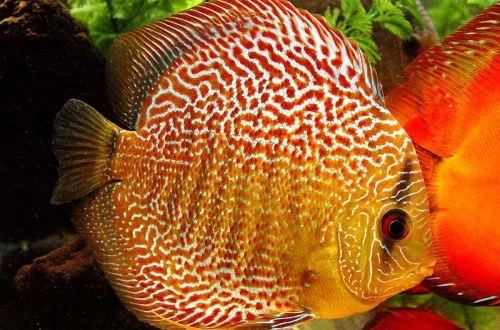
Other scientific names: Symphysodon aequifasciata, Symphysodon axelrodi, Symphysodon discus, Symphysodon haraldi
The Discus, or Symphysodon aequifasciatus, belongs to the Cichlidae family. This majestic and elegant fish is often called the “King of Aquarium Fish.” Discus are highly regarded worldwide, earning the devotion of aquarists due to their exquisite shape and truly regal bearing.
Discus are large fish, reaching up to 25 cm in length. Their body has a laterally compressed, disc-like shape. The dorsal and anal fins are almost symmetrical, starting from the middle of the body and meeting at the base of the caudal fin. The pectoral fins are thin and significantly elongated. The coloration and pattern on the body can vary significantly depending on the specific species and selected breeding form.
These fish are widespread in the Amazon basin, including its tributaries, in the territories of modern-day Brazil, Peru and Colombia. They prefer still or slow-moving waters along riverbanks, finding refuge among the tangled roots and branches of riparian trees and shrubs. Their diet primarily consists of insects, their larvae, and various aquatic invertebrates.
This peaceful species thrives in a school, so it is advisable to keep at least 6 individuals. Suitable tank mates include peaceful schooling fish that can live in similar conditions and tolerate high water temperatures—around 30°C.
Keeping such large fish requires a spacious aquarium. Acquire the largest volume you can: 255 litres is the minimum for a small group of young fish, while adult discus need 250–300 litres or more, allowing roughly 40 litres per fish. Approximately 25% of the total water volume needs to be changed weekly, with substrate siphoning performed concurrently. The fresh water added must fully match the main parameters: temperature, pH, and GH. Siphon carefully, avoiding sudden movements, to prevent excessive stress for the fish. It should be noted that stress often causes diseases in these species. Given the high water temperature required for Discus, decomposition processes (excrement, food remnants, plant particles) occur rapidly. Therefore, a powerful filtration system is essential to maintain stable water parameters. Mandatory equipment also includes a heater, an aerator, and a lighting system set to moderate light. When introducing new fish, it is recommended to dim the lighting for better adaptation. The aquarium decor should include shelters—caves, grottoes, driftwood with groups of thermophilic plants creating shaded areas—and also leave enough open space for swimming.
Being a carnivorous species, these fish prefer meaty foods, which can be either live or frozen. Their diet can perfectly include brine shrimp, bloodworms, mosquito larvae, and chopped beef heart. It is also advisable to use specialized Discus foods, as they provide the full range of necessary nutrients and additives, including plant components. Feeding is recommended 2-3 times a day, offering an amount of food that the fish can consume in approximately 5 minutes. It is important to note that Discus feed quite slowly, so in the company of more active species, they may simply not get enough food. All uneaten food remnants must be promptly removed from the aquarium. This is critically important to prevent water contamination, as meat products actively release dangerous substances during decomposition and promote the proliferation of pathogenic bacteria.
Breeding Discus in a home aquarium is quite feasible, but the best chances of success are observed in a species-specific tank where no other fish are present. Sexual dimorphism is subtle, but in a school, this is not a significant issue, as the male and female will find each other and form a pair. A stimulating factor for spawning is the establishment of specific water parameters: temperature in the range of 28–31°C, pH 5.5–6.0, and GH 3–10. After some time, one or more pairs will emerge from the school, occupying a specific area of the aquarium and turning it into their spawning territory. The female lays 200 to 400 eggs on plants, driftwood, or other decorative elements. Fry appear approximately 60 hours later and begin to stay close to their parents. The adult Discus finds itself surrounded by its offspring. During the first week, the fry feed on a special secretion produced on the parents' skin, and only after that do they transition to micro-foods (daphnia, cyclops, brine shrimp).
Under unsuitable keeping conditions, various health problems inevitably arise. Stress also causes similar difficulties, especially in fish that have been moved to a new aquarium or recently purchased from a pet store.
When purchasing, choose active fish with clear, bright eyes and fins held close to the body. Avoid individuals with sunken bellies, spinal deformities, skin lesions, or film on their scales. A healthy Discus should show curiosity, not hide in a corner or constantly be in a state of severe fright. Assess the overall condition of the aquarium in the store: the presence of sick fish or a large number of deceased individuals in neighboring tanks poses a serious health risk to the fish being purchased.
The essentials: size, tank volume, water parameters and care
An adult reaches 25 cm in length. Plan the tank around the maximum size: the fish quickly outgrows a cramped setup.
The recommended volume is 255 L. A smaller tank speeds up nitrate build-up and raises stress levels.
Temperature 28–31 °C, pH 6–6.5, hardness 5–10 dGH. Stability matters more than exact values: sudden swings are harder on the fish than a small deviation from the ideal.
Around 10 years when kept properly. Lifespan depends directly on tank volume, water quality and a varied diet.
Temperament: peaceful (regular). Keep this in mind when choosing tank mates.
Recommended setup: schooling (usually from 5–6 individuals and more). Ignoring this is a common cause of stress and disease.
Diet type: meat / protein (live, frozen, fresh). Feed small portions that are finished within a couple of minutes — overfeeding does more harm than underfeeding.
The scientific name of the species is Symphysodon aequifasciatus, family Cichlids (Cichlidae). It also appears in the literature as: Symphysodon aequifasciata, Symphysodon axelrodi, Symphysodon discus.
Matched by family, categories and overlapping keeping conditions
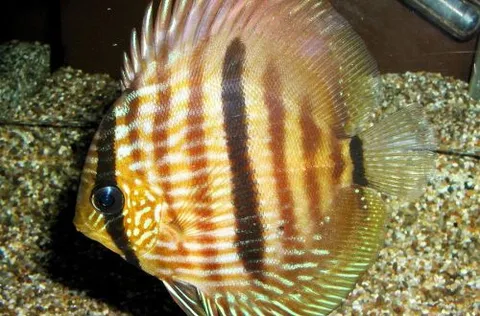
Symphysodon discus
The Heckel Discus, known scientifically as Symphysodon discus, belongs to the Cichlidae family. This species stands out among its relatives in the Discus genus due to its refined and original coloration: three distinct…
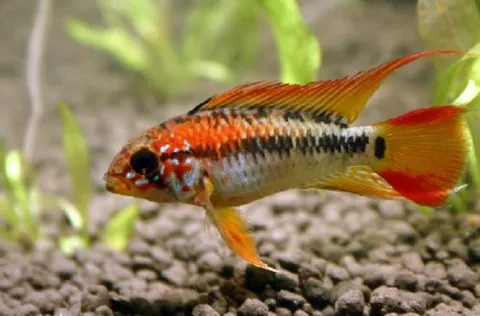
Apistogramma viejita
Apistogramma viejita, also known as the Fire-tailed Apistogramma, belongs to the Cichlidae family. This fish attracts attention with its bright coloration and calm temperament, allowing it to coexist well with many…
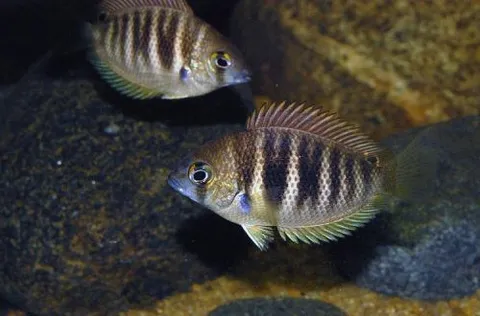
Etroplus canarensis
Etroplus Canara, scientifically known as Etroplus canarensis, belongs to the family Cichlidae. This fish was named after the region of its discovery – South Canara, located in the Indian state of Karnataka. This species…
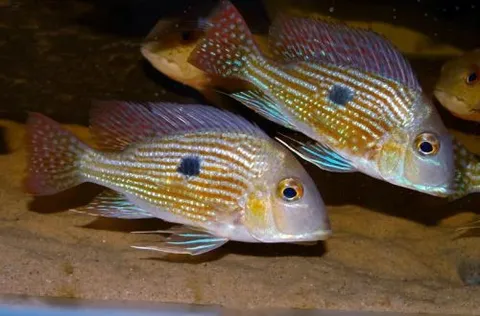
Geophagus sp. Pindare
Geophagus sp. Pindare, or Geophagus pindare, belongs to the family Cichlidae. This fish was named after the Pindaré River, where it was first discovered. In general, these fish are considered quite undemanding in terms…