Temperature24 – 29 °C
Natural range
- Niger Delta area
- Nigeria area
Killifish
Other scientific names: Fundulopanchax deltaense
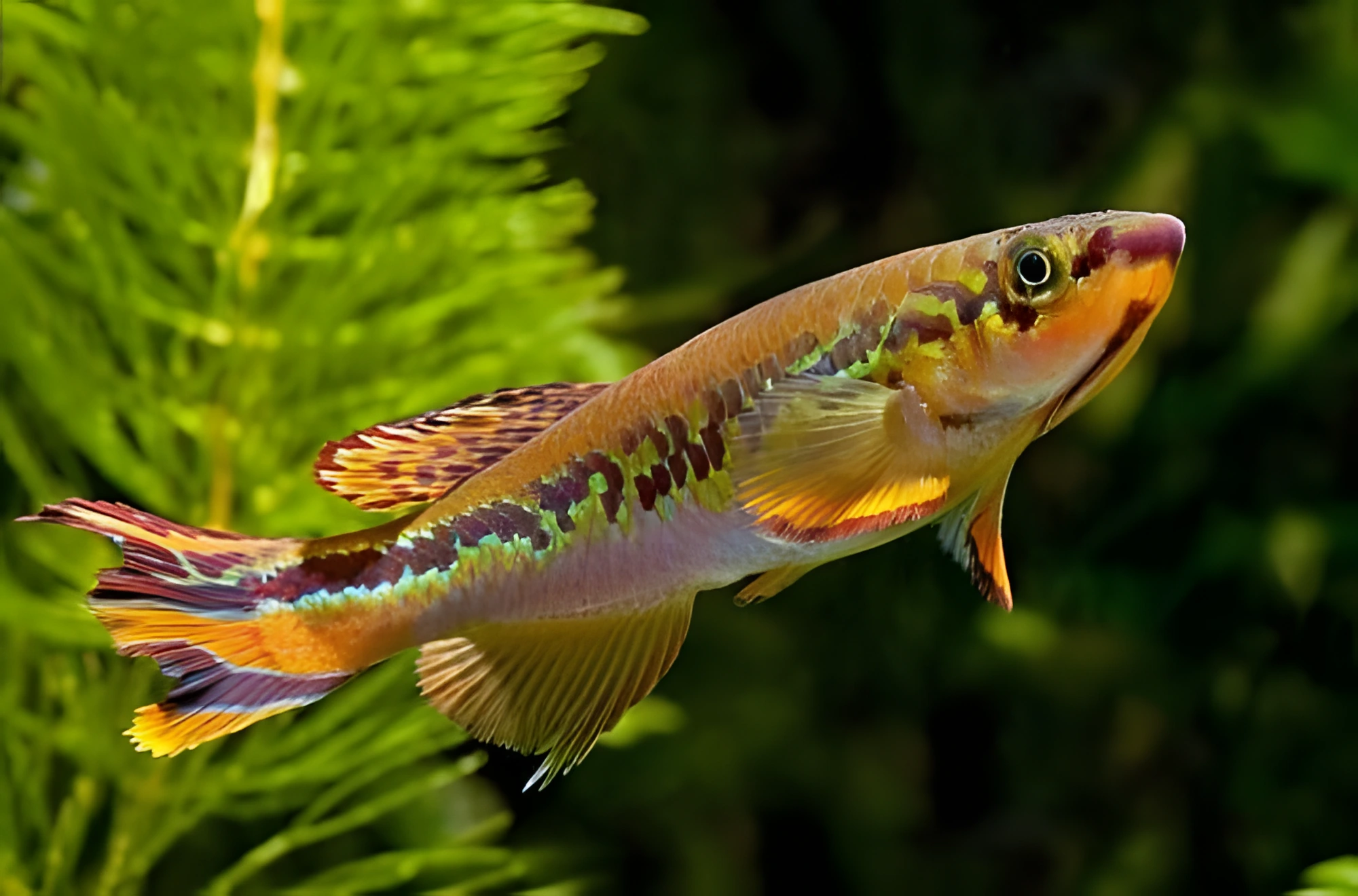
Belonging to the family Nothobranchiidae, the Delta Killifish, scientifically known as Fundulopanchax deltaensis, is a truly amazing fish. Its original and vibrant coloration is not often found in natural waters. However, this species has one key feature that makes it not the most suitable choice for most aquarists: the fish's lifespan is extremely short. In home aquariums, it is only about 1 year, and only in exceptional cases can it reach 2 years.
- Required aquarium volume
- 80 L
- Size in aquarium
- 10 cm
- Temperature
- 24 – 29 °C
- Temperament
- Territorial (often aggressive)
Parameters
Water pHNeutral (6.5) – Slightly alkaline (8.2)
Water dHVery soft (2) – Very hard (19)
Water salinityvery low (up to ~3 g/L)
Size in aquarium10 cm
Lifespan3 years
TemperamentTerritorial (often aggressive)
Toward small fishnot a predator
Required aquarium volume80 L
Lightingmoderate (regular)
Substratesoft fibrous
Water flowmoderate
FeedingMeat / protein (live, frozen, fresh)
CarePair (male/female)
Description
The fish has an elongated body with well-developed fins and a flattened head. The lower jaw is larger than the upper, creating a characteristic upward curve. This mouth structure helps capture prey from the water's surface. The coloration varies greatly, with shades ranging from greenish or bluish to light brown or creamy. Dark spots are located all over the body, forming an interrupted line from head to tail. This line is highlighted by a blue-green or creamy outline. The fins are also colored and may have dark spots. These features are mainly characteristic of males, while females look significantly more modest.
Males are distinguished by their bright coloration, while females are practically devoid of bright colors and are also half the size.
Habitat
Its first scientific description was made relatively recently, in 1976. The habitats of this fish are swamps located in the Niger River delta. During the dry season, these bodies of water dry up, leading to the death of their inhabitants. However, if the bodies of water persist, the fish can live for another year. In the wild, its diet consists of small aquatic insects, crustaceans, and worms.
Behavior and Compatibility
This peaceful species coexists well with other fish of similar size, but due to their short life cycle, cohabitation may not always be convenient. Sometimes males can engage in quite serious skirmishes with each other, so in a small aquarium, keeping a pair (male/female) will be optimal. In larger tanks of 200 liters or more, schooling with several males is also acceptable.
Care and Maintenance
Due to the short lifespan of these fish, it is recommended to keep them in a species-specific aquarium, without representatives of other species. For a pair of fish, a tank of at least 80 liters will be required, and for a school of 5–6 individuals, an aquarium of more than 200 liters will be needed. Delta Killifish require very clean water and are extremely sensitive to changes in its hydrochemical composition, so a productive filter along with weekly 25–30% water changes is a mandatory condition. Other necessary equipment includes an aerator, heater, and lighting system. A lid should also be provided to prevent accidental jumping out. The fish can live in fresh water, but for breeding, brackish water will be required. The concentration of sea salt is approximately 5 grams per 10 liters of water, which corresponds to about 4 level teaspoons. In the aquarium design, it will be optimal to recreate the natural habitat. For this, a substrate of sand or fine gravel with groups of plants, leaving free space for swimming, is suitable. Several snags, branches, or roots can be placed as shelters.
Diet
This species is carnivorous, representing a small predator. Successful keeping and breeding are only possible if their gastronomic preferences are satisfied. The diet should include live or frozen foods: bloodworms, mosquito and fly larvae, daphnia, Drosophila flies, and other similar foods.
Breeding and Reproduction
The breeding process of the Delta Killifish has its own characteristics. For spawning, an aquarium of 80 liters or more will be required, equipped with an airlift filter and a heater. The water should be brackish with a constant temperature of 24–25.5°C. It is desirable to decorate the aquarium with thickets of plants where the female can hide from the male and rest. Treated peat should serve as the spawning substrate. It is placed in a container, for example, a ceramic bowl, and then the bowl with peat is placed in the aquarium. It is in this peat that the fish will hide its eggs. After spawning, the peat is removed and dried at room temperature, spread out on a mesh or fine grate to accelerate water evaporation. It is important not to use heating devices or open flames; drying should occur naturally. The peat should not be completely dried; it should remain slightly moist. Then it is placed in a plastic bag, sealed, and stored in a dark place at a temperature of about 25°C. After 3–4 months, the sealed peat is removed and immersed in an aquarium with clean water; the fry will appear within a week. They are fed with Artemia nauplii, small daphnia, and similar foods. In case of successful breeding, it is recommended to leave more males to get a beautiful and vibrant community in your aquarium.
Diseases
The fish are exceptionally hardy, and in a balanced aquarium, health problems usually do not arise. However, deteriorating conditions can provoke an outbreak of diseases. More detailed information on symptoms and treatment methods can be found in the section "Diseases of Aquarium Fish."
How to choose
When choosing Delta Fundulopanchax, preference should be given to young individuals, as they adapt more easily to new keeping conditions. Carefully inspect the fish: the body should be clean, without signs of damage, ulcers, or white plaque on the scales and fins. A healthy fish is active, stays in the water column, and exhibits natural behavior. Avoid buying individuals that appear sluggish, constantly lie on the bottom, or have an unnaturally swollen abdomen. Given the territorial nature of the species, when buying several fish for one aquarium, it is recommended to choose a group with a predominance of females to minimize intraspecific aggression.
Frequently asked questions
The essentials: size, tank volume, water parameters and care
How big does Delta Killifish get?
An adult reaches 10 cm in length. Plan the tank around the maximum size: the fish quickly outgrows a cramped setup.
What size aquarium does Delta Killifish need?
The minimum recommended volume is 80 L. A smaller tank speeds up nitrate build-up and raises stress levels.
What water parameters does Delta Killifish need?
Temperature 24–29 °C, pH 6.5–8.2, hardness 2–19 dGH. Stability matters more than exact values: sudden swings are harder on the fish than a small deviation from the ideal.
How long does Delta Killifish live?
Around 3 years when kept properly. Lifespan depends directly on tank volume, water quality and a varied diet.
Is Delta Killifish aggressive?
Temperament: territorial (often aggressive). Keep this in mind when choosing tank mates.
How many Delta Killifish should be kept together?
Recommended setup: pair (male/female). Ignoring this is a common cause of stress and disease.
What does Delta Killifish eat?
Diet type: meat / protein (live, frozen, fresh). Feed small portions that are finished within a couple of minutes — overfeeding does more harm than underfeeding.
What is the scientific name of Delta Killifish?
The scientific name of the species is Fundulopanchax deltaensis, family Nothobranchiidae. It also appears in the literature as: Fundulopanchax deltaense.