Temperature18 – 26 °C
Natural range
- Northern Myanmar area
Cyprinids
Danio tinwini, also known as the Gold-ring Danio or Burmese Spotted Danio, bears the scientific name Danio tinwini and belongs to the family Cyprinidae. It received one of its names in honor of U Tin Win, a prominent freshwater fish exporter and collector from Myanmar. This species has been present in the aquarium hobby since 2003. The fish is undemanding to keep and coexists easily with many other freshwater species.
- Required aquarium volume
- 40 L
- Size in aquarium
- 2.2 – 3 cm
- Temperature
- 18 – 26 °C
- Temperament
- Peaceful (regular)
Parameters
Water pHNeutral (6.5) – Neutral (7.5)
Water dHVery soft (1) – Soft (5)
Water salinityno salt (freshwater)
Size in aquarium2.2 – 3 cm
Lifespan3 years
TemperamentPeaceful (regular)
Toward small fishnot a predator
Required aquarium volume40 L
Lightingdimmed
Substrategravel (dark)
Water flowweak or moderate
FeedingSmall / appropriate size / pieces
CareGroup (8–10 individuals)
Description
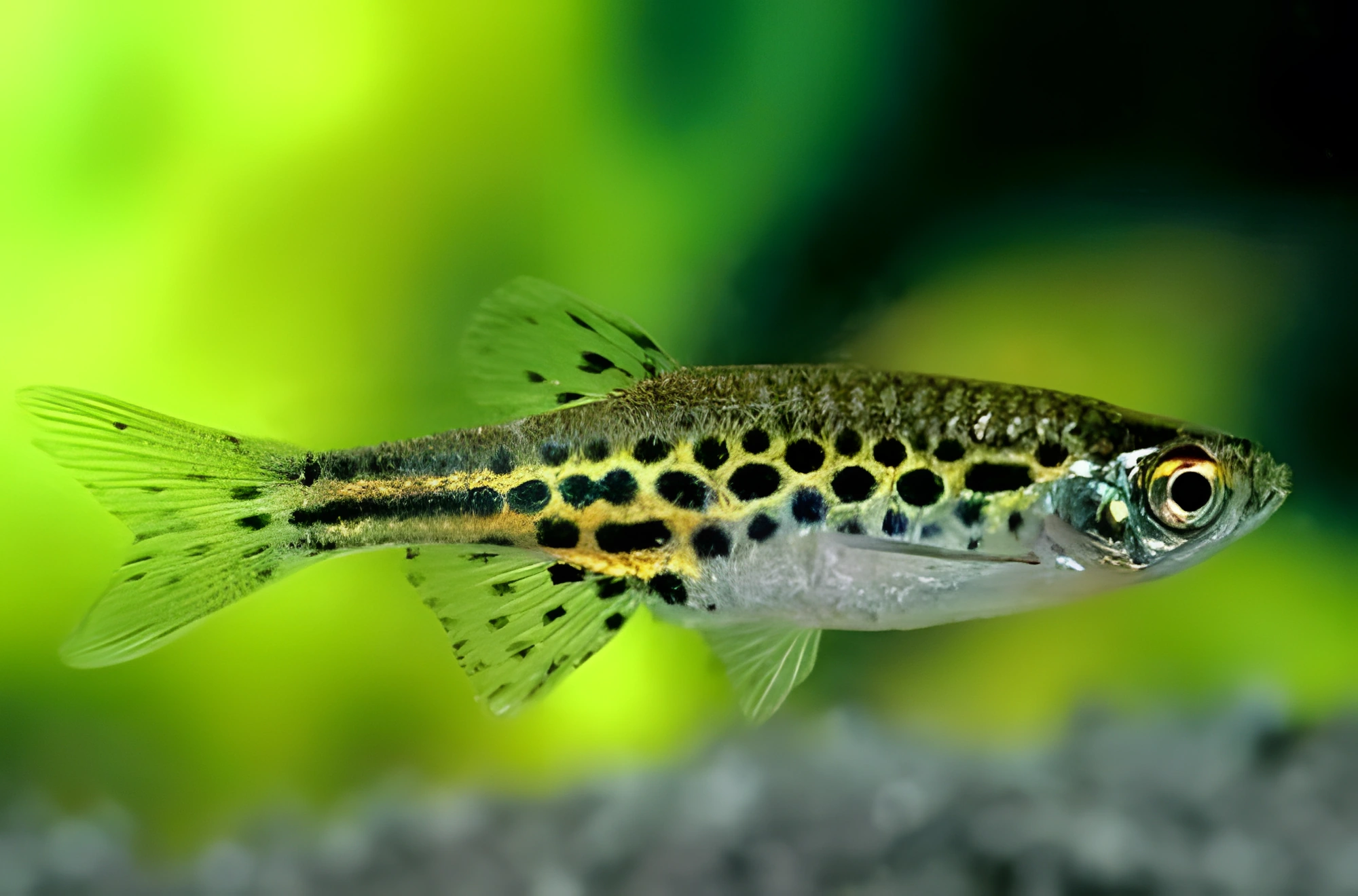
Adults of this species typically reach a length of about 2–3 cm. Black dots are distributed across their golden body, creating a leopard-like pattern. The fins are translucent and also adorned with speckles. The belly has a silvery hue. Differences between the sexes are quite subtle.
Habitat
The natural habitat of this species spans northern Myanmar (Burma) in Southeast Asia, where it is found in the upper Irrawaddy River basin. Danios primarily inhabit small streams and rivulets; less frequently, they can be found in the main river channel. The fish feel most comfortable in calm waters with abundant aquatic vegetation.
Behavior and Compatibility
This species is characterized by an active and peaceful disposition. Danio tinwini is highly compatible with other non-aggressive fish of comparable size. However, keeping them with any large fish, even if vegetarian, should be avoided. Gold-ring Danios prefer to be in a group, which should consist of at least 8–10 individuals. Keeping them in smaller numbers negatively affects their behavior, and in some cases, such as solitary or paired keeping, it can significantly reduce their lifespan.
Care and Maintenance
For a group of 8–10 Danio tinwini, an aquarium of at least 40 L will be required. The tank's decor can be quite arbitrary, but it is recommended to use a dark substrate and provide an abundance of aquatic plants. The presence of driftwood and other natural decorative elements has a beneficial effect on the fish's well-being. Lighting should be subdued, as fish may lose their vibrant coloration in a sparsely planted aquarium with excessive light. Danio tinwini can thrive in moderate current and requires clean, oxygen-rich water. However, it should be noted that lush flora, when decaying, can become a source of excess organic matter, and at night, when photosynthesis ceases, plants begin to consume oxygen, leading to an increase in carbon dioxide levels. Using artificial plants can be an optimal solution for maintaining stable conditions. To ensure ecological balance, a powerful filtration and aeration system must be installed, and the aquarium should be regularly maintained. The latter typically includes standard procedures: weekly partial water changes, cleaning the substrate of organic waste (excrement, food remnants), equipment maintenance, and monitoring and maintaining stable pH and dGH values.
Diet
These fish do not exhibit special requirements regarding their diet. They readily accept most popular aquarium foods of appropriate size. Their diet can include dry flakes, granules, as well as live or frozen foods such as bloodworms, Artemia, and Daphnia.
Breeding and Reproduction
Breeding this species is straightforward and does not require significant time or financial investment. Under suitable conditions, spawning can occur throughout the year. Like many cyprinids, these fish scatter numerous eggs among plant thickets, after which their parental instincts cease. The incubation period lasts 24–36 hours, and two days later, the hatched fry begin to swim freely. Since Danios do not care for their offspring, the survival rate of the young will be extremely low if they are not promptly moved to a separate tank. A small container of 10 L or more, filled with water from the main aquarium, will suffice for this purpose. The necessary equipment consists of a simple air-driven filter and a heater. A separate light source is not required.
Diseases
In a balanced aquarium ecosystem that meets the needs of this species, diseases are rare. Most often, ailments are provoked by deteriorating environmental conditions, contact with already sick fish, or mechanical damage. If the fish shows clear signs of illness, medicinal treatment should be applied. More detailed information on symptoms and therapy methods can be found in the “Aquarium Fish Diseases” section.
How to choose
When selecting Danio tinwini, attention should be paid to the activity and appearance of the individuals. Healthy fish should be active, without visible damage, ulcers, or white spots on their scales. Fins should be spread, without signs of deterioration or clamping. Avoid purchasing fish that appear emaciated, stay near the water surface, or, conversely, constantly hide at the bottom, showing signs of apathy. Since this species is schooling, it is recommended to acquire a group of 8–10 individuals simultaneously to minimize stress during adaptation to new conditions. Keep in mind that in store aquariums, due to bright lighting and lack of hiding places, the fish's coloration may be paler than natural, but after transfer to a suitable environment with dark substrate and plants, the vibrancy is restored.
Frequently asked questions
The essentials: size, tank volume, water parameters and care
How big does Danio tinwini get?
An adult reaches 2.2–3 cm in length. Plan the tank around the maximum size: the fish quickly outgrows a cramped setup.
What size aquarium does Danio tinwini need?
The minimum recommended volume is 40 L. A smaller tank speeds up nitrate build-up and raises stress levels.
What water parameters does Danio tinwini need?
Temperature 18–26 °C, pH 6.5–7.5, hardness 1–5 dGH. Stability matters more than exact values: sudden swings are harder on the fish than a small deviation from the ideal.
How long does Danio tinwini live?
Around 3 years when kept properly. Lifespan depends directly on tank volume, water quality and a varied diet.
Is Danio tinwini aggressive?
Temperament: peaceful (regular). Keep this in mind when choosing tank mates.
How many Danio tinwini should be kept together?
Recommended setup: group (8–10 individuals). Ignoring this is a common cause of stress and disease.
What does Danio tinwini eat?
Diet type: small / appropriate size / pieces. Feed small portions that are finished within a couple of minutes — overfeeding does more harm than underfeeding.
What is the scientific name of Danio tinwini?
The scientific name of the species is Danio tinwini, family Cyprinids (Cyprinidae).