Temperature18 – 26 °C
Natural range
- Rakhine State
- Myanmar area
Cyprinids
Danio absconditus, known as the Hidden Danio, belongs to the family Cyprinidae. This species was discovered relatively recently, in 2015. The intriguing name "Hidden" does not describe the fish's behavior but is related to the fact that, despite the relatively well-studied fauna of its region, the species remained unnoticed for a long time.
- Required aquarium volume
- 40 L
- Size in aquarium
- 6 cm
- Temperature
- 18 – 26 °C
- Temperament
- Peaceful (regular)
Parameters
Water pHSlightly acidic (6) – Neutral (7.5)
Water dHVery soft (2) – Hard (12)
Water salinityno salt (freshwater)
Size in aquarium6 cm
Lifespan5 years
TemperamentPeaceful (regular)
Toward small fishnot a predator
Required aquarium volume40 L
Lightingdimmed
Substrateany, but dark
Water flowweak or moderate
FeedingSmall / appropriate size / pieces
CareLarge group (10+ individuals)
Description
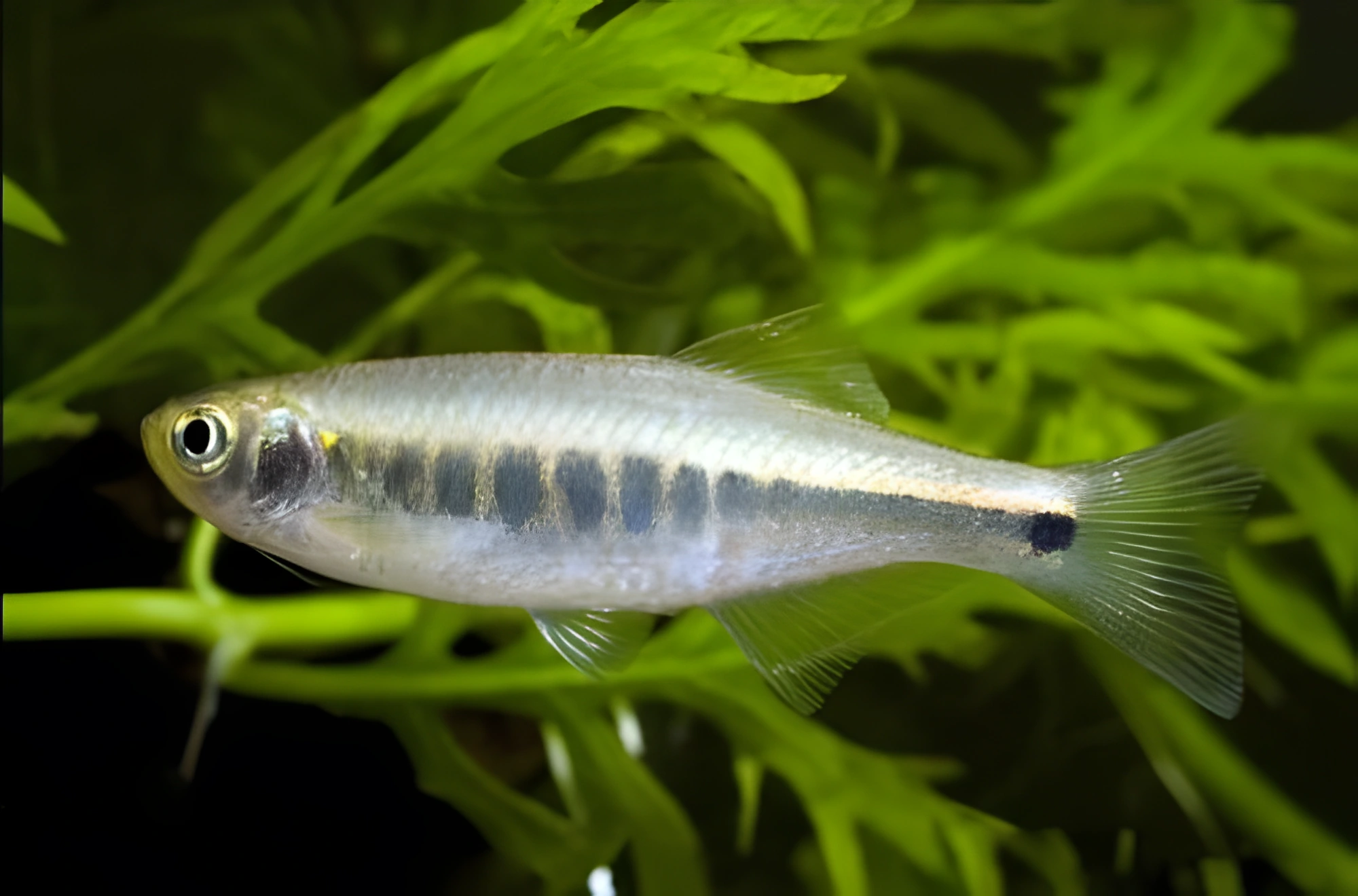
Adults reach a length of approximately 5–6 cm. Their coloration is silvery, complemented by a dark longitudinal stripe intersected by golden streaks. A black spot can be observed at the base of the caudal fin. When in a group, the "alpha male" acquires a more saturated color. Sexual dimorphism in this species is not pronounced.
Habitat
Its origin is Southeast Asia, specifically the western part of Myanmar (Burma), located between the Arakan Mountains and the Bay of Bengal. These fish favor rivers and streams originating in the foothills. The natural conditions of their habitat are characterized by significant variability, associated with seasonal monsoons that occur from May to October.
Behavior and Compatibility
These active and peaceful fish coexist well with many other aquarium inhabitants of comparable size. However, it is recommended to avoid cohabiting them with excessively small or timid species, as active Danios may disturb them. They prefer to stay in schools of 10 or more individuals. The larger the school, the more expressive and striking the Hidden Danios appear.
Care and Maintenance
For a small group of these fish, an aquarium of 100 L or more is recommended. Creating a setup that mimics their natural habitat will be very beneficial. This includes an abundance of aquatic plants, a dark rocky substrate with several large boulders and driftwood. Lighting should be subdued, and a moderate current will be welcomed. The most important aspect of maintenance is to maintain consistently high water quality with pH and dGH parameters appropriate for the species. To achieve this, it is crucial to equip the aquarium with a powerful filtration system and regularly perform necessary maintenance procedures: weekly partial water changes with fresh water, as well as cleaning the substrate and decorative elements from organic deposits, food remnants, and excrement. It should be noted that these fish are prone to jumping, so the aquarium must be equipped with a reliable protective lid.
Diet
This fish species does not have special dietary requirements, readily accepting a variety of foods intended for aquarium inhabitants. Their diet can include dry flakes and granules, as well as live or frozen foods: bloodworms, Artemia, Daphnia, and similar types.
Breeding and Reproduction
In nature, these fish spawn during the rainy season, when abundant food and flooded areas of the tropical forest create ideal refuges for the fry. In a home aquarium, a drop in water temperature, mimicking natural rainfall, can stimulate spawning. However, in fish bred in artificial environments for several generations, the reaction to changes in external conditions may be less pronounced, so spawning sometimes occurs spontaneously. Like most cyprinid species, Danios scatter their eggs among aquatic plants and do not exhibit parental care. The incubation period for the eggs is about a week, and the fry begin to swim after an additional 1–2 days. It is important to remember that adult fish may eat their offspring if given the opportunity. To protect the young, the fry should be transferred to a separate tank with the same water conditions as the main aquarium. This fry tank should be equipped with a simple air-driven filter and a heater. An additional light source is not required. The fry should be fed specialized powdered foods or, if possible, Artemia nauplii.
Diseases
In a balanced aquarium ecosystem that meets the needs of this species, diseases are rare. Most often, ailments are provoked by deteriorating environmental conditions, contact with already sick fish, or mechanical damage. If the fish shows clear signs of illness, medicinal treatment should be applied. More detailed information on symptoms and therapy methods can be found in the “Aquarium Fish Diseases” section.
How to choose
When purchasing Danio absconditus, preference should be given to individuals with clean, undamaged fins and no white film or sores on the body. Healthy fish should be active, show interest in their surroundings, and stay in a school, avoiding isolation in the corners of the aquarium or near the water surface. Avoid purchasing fish that appear emaciated, have sunken bellies, or show signs of apathy.
- Inspect the aquarium in the store for dead individuals, as this may indicate general health problems with the entire batch.
- Ensure that the fish's coloration matches the species characteristics and that the scales are tightly adhered to the body.
- Ask the seller what the fish are fed to ensure there are no problems with feeding behavior.
Frequently asked questions
The essentials: size, tank volume, water parameters and care
How big does Danio absconditus get?
An adult reaches 6 cm in length. Plan the tank around the maximum size: the fish quickly outgrows a cramped setup.
What size aquarium does Danio absconditus need?
The minimum recommended volume is 40 L. A smaller tank speeds up nitrate build-up and raises stress levels.
What water parameters does Danio absconditus need?
Temperature 18–26 °C, pH 6–7.5, hardness 2–12 dGH. Stability matters more than exact values: sudden swings are harder on the fish than a small deviation from the ideal.
How long does Danio absconditus live?
Around 5 years when kept properly. Lifespan depends directly on tank volume, water quality and a varied diet.
Is Danio absconditus aggressive?
Temperament: peaceful (regular). Keep this in mind when choosing tank mates.
How many Danio absconditus should be kept together?
Recommended setup: large group (10+ individuals). Ignoring this is a common cause of stress and disease.
What does Danio absconditus eat?
Diet type: small / appropriate size / pieces. Feed small portions that are finished within a couple of minutes — overfeeding does more harm than underfeeding.
What is the scientific name of Danio absconditus?
The scientific name of the species is Danio absconditus, family Cyprinids (Cyprinidae).